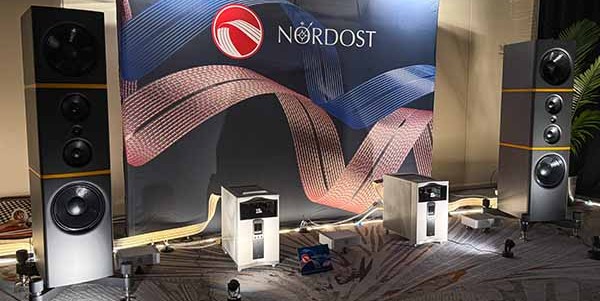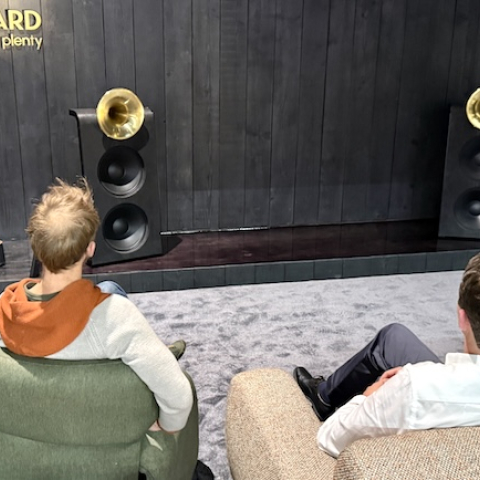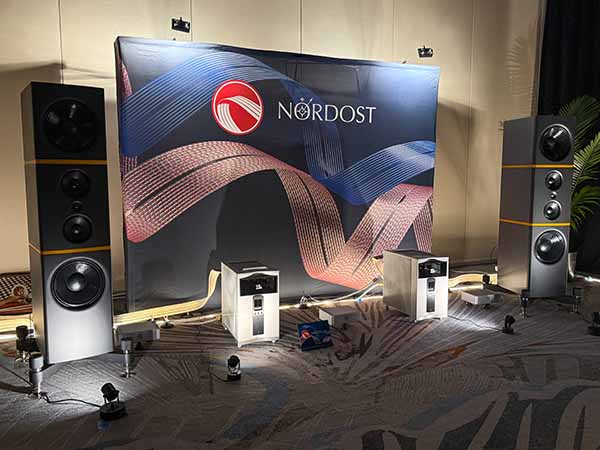
George Michael's music wasn't in the room, but it was in my head. Despite my telling him to please shut up, he belted "I want your SX" as soon as I'd entered the Schaumburg F ballroom at the Renaissance Schaumburg Hotel during AXPONA 2026. Apparently, the invisible English singer was serenading Stenheim's Reference Ultime Two SX speakers ($200,000/pair and up, depending on finish). Each three-way Stenheim tower sports five drivers: two 12" woofers, dual 6.5" midranges, and a single 1" soft-dome tweeter in a ported D'Appolito array.
The Swiss-built product is unusually efficient at 95dB sensitivity—and unusually adjustable too, with rear-panel jumpers that let the user tweak bass, midrange, and treble level independently. The SX designation has nothing to do with a roll in the hay (though quietly, lust I did); it refers to the massive aluminum outrigger platform with adjustable feet—a refinement developed primarily for stability that, Stenheim claims, also delivers sonic improvements.
Driving the speakers were two VTL Lohengrin Reference monoblocks ($100,000/pair). The Lohengrin—the mighty Siegfried amp's little brother—is VTL's latest top-tier tube amplifier, delivering 400W per channel (pc) in tetrode mode, or 200Wpc in triode from an eight-tube output stage using 6550 or KT88 bottles. While it made its prototype debut at High End Munich last year and put in an impressive performance at Audio Video 2025 in Warsaw last fall, AXPONA 2026 marked the Lohengrin's first U.S. showing in production form. Its zero global negative feedback design, wide audio bandwidth (–1dB at 100kHz), automatic bias control, and adjustable damping factor are all part of a package that marries tube warmth with solid-state discipline.
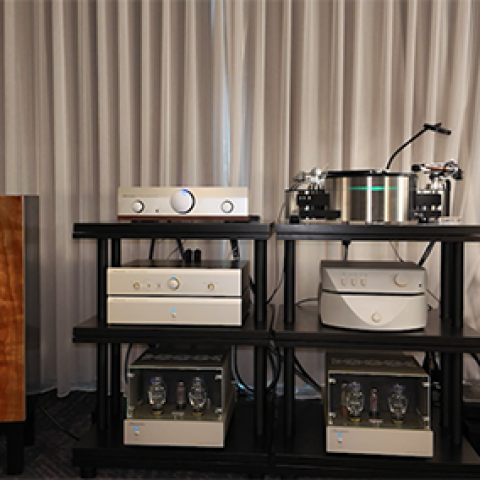
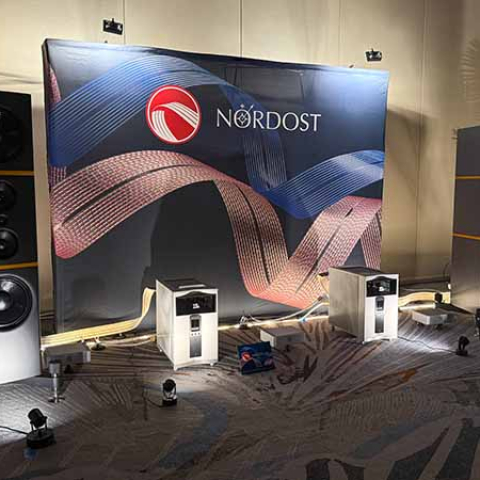
The amps received their signal via the VTL TL-7.5 Series III Reference preamplifier ($40,000) and TP-6.5 Series II Signature preamplifier ($17,000). Vinyl playback came courtesy of a VPI Avenger Direct turntable with a 12" VPI Fatboy Gimbal tonearm ($36,000), wired internally with Nordost reference cable. On the digital side, a dCS Vivaldi Apex DAC, Upsampler Plus, and Master Clock formed a three-piece stack totaling roughly $95,000. The whole system was wired with Nordost's Odin Gold and Odin 2 Supreme Reference cabling.
The first artist to quiet George Michael's intrusive crooning was Annie Lennox, whose version of Al Green's "Take Me to the River" (originally from 1995's Medusa, on RCA) had power and quiet chills through the VTL/Stenheim combo. Next up was side 1 of David Bowie's 1976 Station to Station album (also originally on RCA), a sterling performance on equally outstanding gear. "Here are we / one magical moment" intoned the Thin White Duke on the title track. "Such is the stuff from where dreams are woven / Bending sound."
All apt, all true.