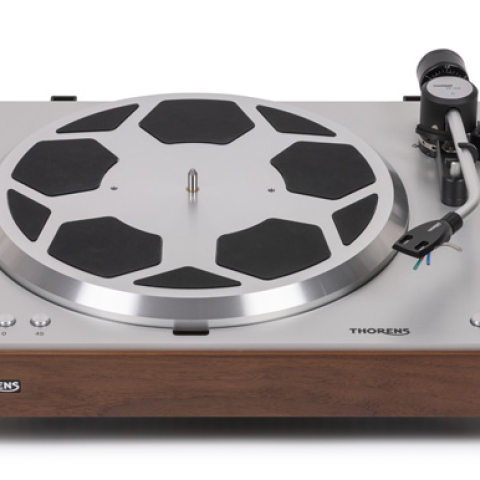
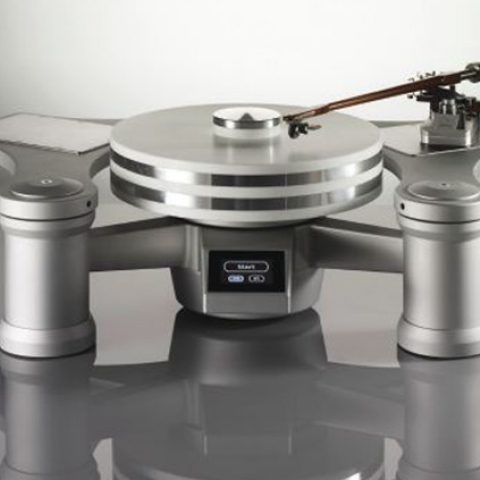
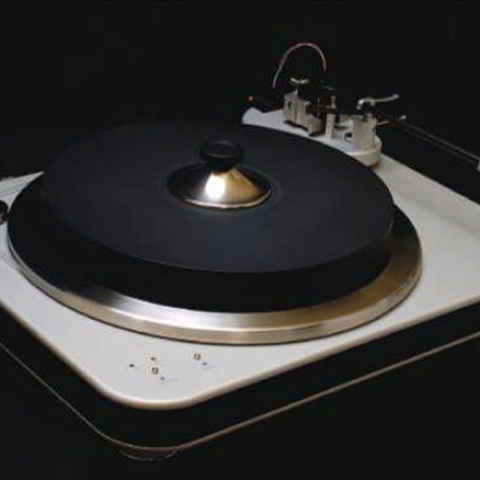
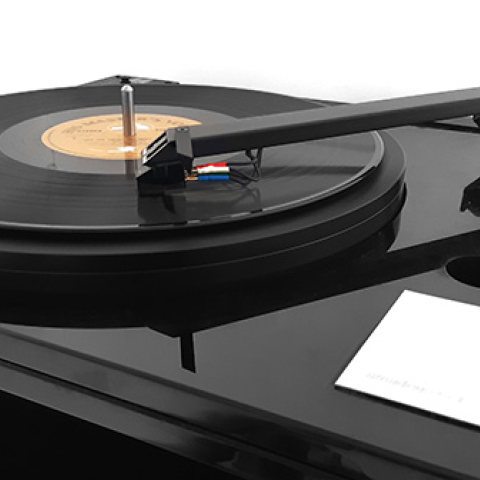
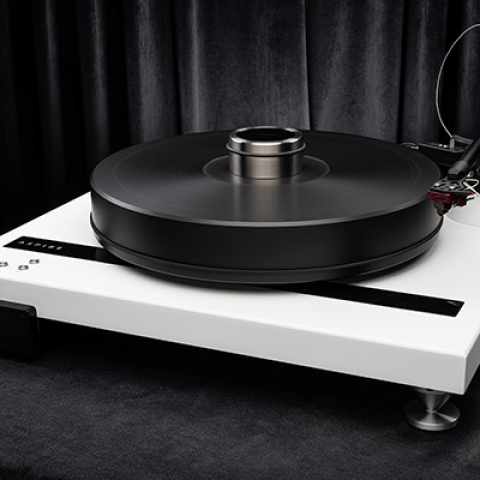
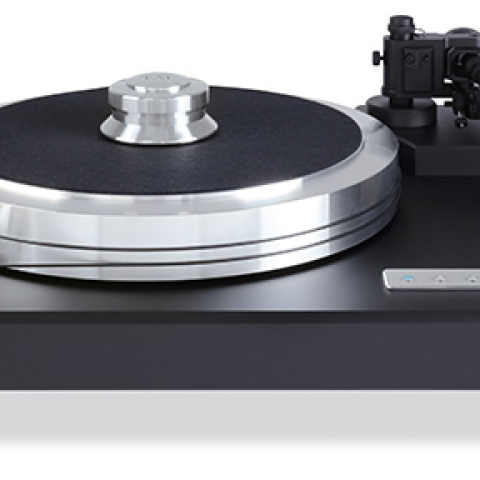
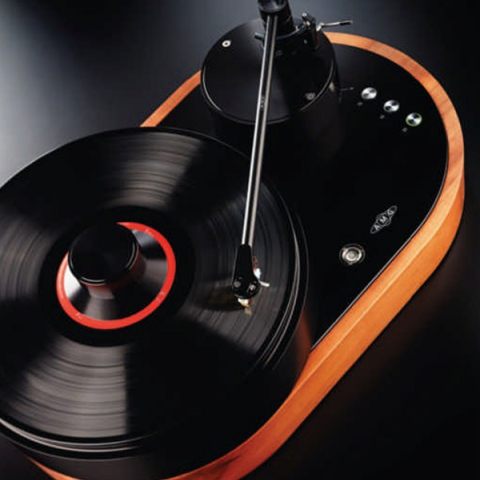
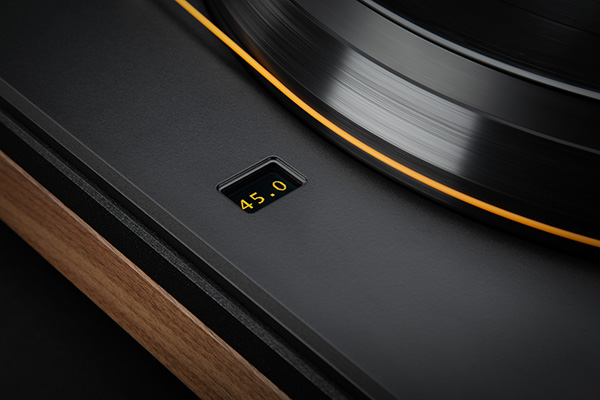
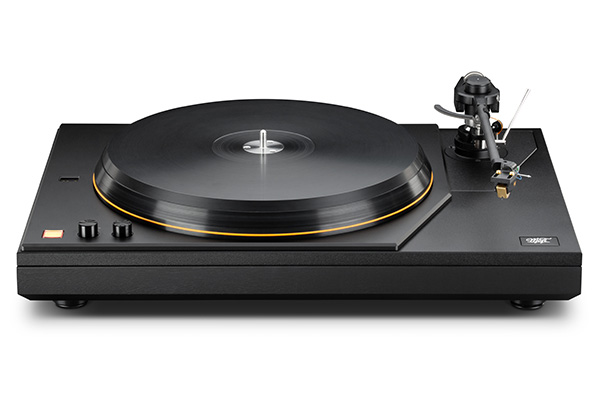
 Acknowledging both the vinyl and, apparently, the shellac resurgence, the MasterDeck offers a multiplicity of speeds: 33 1/3, 45, and 78rpm. A discreet dial, stationed in the turntable's southwest corner, allows for speed selection. Adjacent to this dial, a trim dial enables fine-tuning for absolute accuracy of the platter's pacing. A four-digit digital readout provides granular control over speed adjustments.
Stationed in an isolated mount to quiet signal-muddying resonances, the MasterDeck's three-phase sinusoidal ("one with a smooth, repetitive oscillation"—Wikipedia) synchronous motor is driven by a new MoFi system. The motor system tests the speed at start-up and locks it in as it arrives at the desired speed.
"There are sensors under the platter that tell the computer the platter speed," Perkins wrote. "When it hits the set speed the sensing system cuts out and the drive continues to send the motor the frequency to maintain that speed. The speed is not readjusted during record playback. The motor is controlled by a computer with its own algorithms. This system is proprietary and developed by MoFi."
Acknowledging both the vinyl and, apparently, the shellac resurgence, the MasterDeck offers a multiplicity of speeds: 33 1/3, 45, and 78rpm. A discreet dial, stationed in the turntable's southwest corner, allows for speed selection. Adjacent to this dial, a trim dial enables fine-tuning for absolute accuracy of the platter's pacing. A four-digit digital readout provides granular control over speed adjustments.
Stationed in an isolated mount to quiet signal-muddying resonances, the MasterDeck's three-phase sinusoidal ("one with a smooth, repetitive oscillation"—Wikipedia) synchronous motor is driven by a new MoFi system. The motor system tests the speed at start-up and locks it in as it arrives at the desired speed.
"There are sensors under the platter that tell the computer the platter speed," Perkins wrote. "When it hits the set speed the sensing system cuts out and the drive continues to send the motor the frequency to maintain that speed. The speed is not readjusted during record playback. The motor is controlled by a computer with its own algorithms. This system is proprietary and developed by MoFi."
 Setup
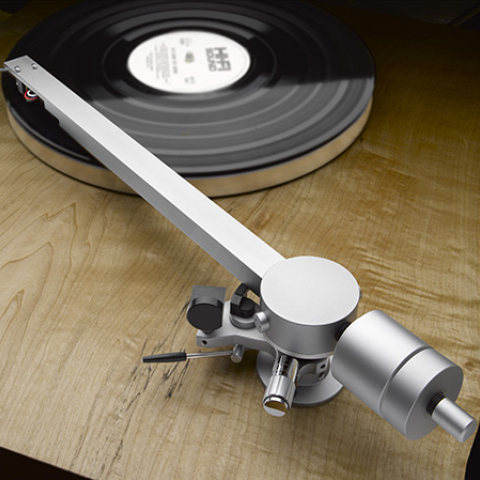
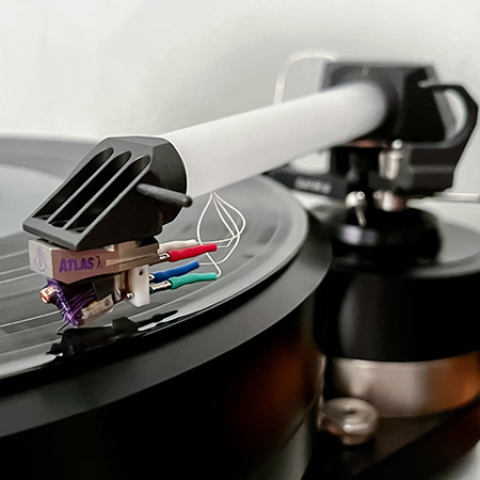
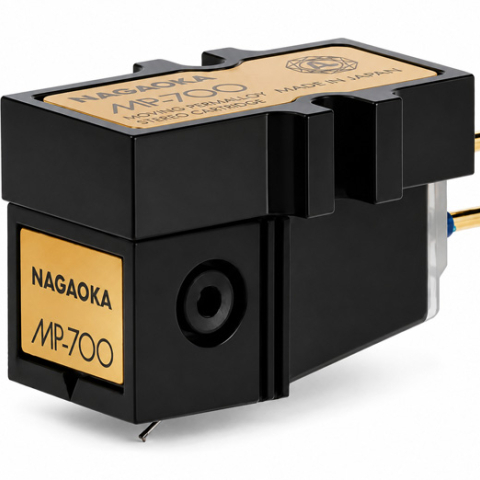
SetupPerkins's unique counterweight system enabled one of the easiest VTF adjustments I've ever encountered. It worked as advertised, the knurled counterweight dial easily moving the counterweight in either direction to lock in the correct tracking force. The tonearm came prefitted with a MoFi UltraGold MC cartridge from the factory. Mounting a second cart, the Luxman LMC-5 ($2695), using the provided headshell was easy. VTA adjustment was also smooth and involved rotating the plastic dial at the tonearm's base. The adjustable feet did their job, but shims were required to entirely level the MasterDeck. Azimuth set at the factory was A-OK. I set antiskate using Analogue Productions' Ultimate Analogue Test LP (AAPT 1), which offers multiple setup parameters including an antiskate track and a silent groove, neither of which require additional tools.
 Listening
If you watch YouTube turntable videos, read turntable manufacturers' websites, or dig deep into white papers on noise suppression, two words dominate: resonance control. Allen Perkins has gone a long way to address resonance goblins inside and out of the MoFi MasterDeck, from smartly chosen materials to unique mechanical approaches. Would a low noisefloor be obvious when spinning wax on the MasterDeck? Initially, I wasn't so sure. Shouldn't a major audio improvement resemble trumpets blasting? That new car smell? The proverbial "last call for alcohol" at your local? I pulled out an assortment of test LPs to gauge performance, using the Luxman cartridge.
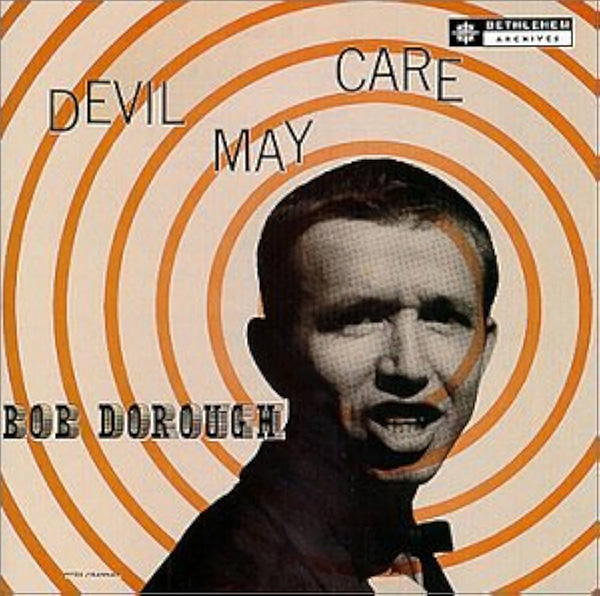 I recently stumbled upon a copy of Bob Dorough's timeless Devil May Care (at Red Hook, Brooklyn's Music Shoppe), a gem from 1956 (Bethlehem BCP-11). Dorough, a singer unlike any other, employs trippy cadences, a stark vocal tone, and elastic phrasing to deliver a musical injection of pure fun and swinging style. The MoFi knocked out this mono disc as taut, present, and driving, with Bill Takus's crazy bass walking especially full-bodied, taut, and energy-mad.
The MoFi imprint performed a similar archaeological feat on The Great Jazz Trio's "A Night in Tunisia" (from Direct from L.A., East Wind EW-100005), unearthing a performance I'd never encountered. Each instrument was exhumed, given full weight and a spotlight. While most 'tables capitulate to Tony Williams's thunderous solo, as if overwhelmed, the MoFi met Tony's assault with a controlled yet robust refinement. It revealed not only Williams's brute force but also his surprising grace.
I recently stumbled upon a copy of Bob Dorough's timeless Devil May Care (at Red Hook, Brooklyn's Music Shoppe), a gem from 1956 (Bethlehem BCP-11). Dorough, a singer unlike any other, employs trippy cadences, a stark vocal tone, and elastic phrasing to deliver a musical injection of pure fun and swinging style. The MoFi knocked out this mono disc as taut, present, and driving, with Bill Takus's crazy bass walking especially full-bodied, taut, and energy-mad.
The MoFi imprint performed a similar archaeological feat on The Great Jazz Trio's "A Night in Tunisia" (from Direct from L.A., East Wind EW-100005), unearthing a performance I'd never encountered. Each instrument was exhumed, given full weight and a spotlight. While most 'tables capitulate to Tony Williams's thunderous solo, as if overwhelmed, the MoFi met Tony's assault with a controlled yet robust refinement. It revealed not only Williams's brute force but also his surprising grace.
 MoFi meets MoFi
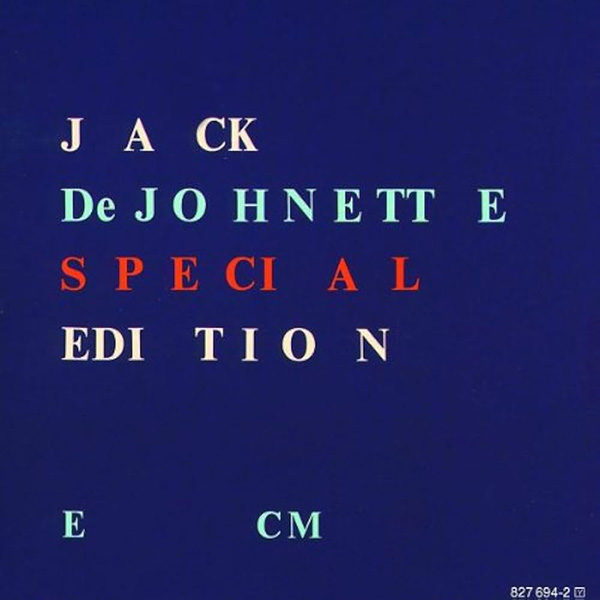
Replacing the Luxman LMC-5 with MoFi's UltraGold MC cart ($1495) was a sonic gamble that paid off. The UltraGold, a leaner, meaner beast, electrified the MasterDeck. It traded the LMC-5's lushness for speed and dynamism, breathing fresh life into all my old records. From Stable Mates (Savoy 1211J) to Jack DeJohnette's Special Edition (ECM 1152), the UltraGold's deep dive into sonic detail and locomotive energy made for thrills galore. It brought out a swinging, grooving quality from the MasterDeck that was incredibly engaging. I was so taken with the UltraGold's keening, charged, dramatic quality, I pulled out a handful of Jack DeJohnette records to relish the flow. "Sunrise," from Terje Rypdal/Miroslav Vitous/Jack DeJohnette (ECM 1-1125), arranges DeJohnette's drums across a wide stereo spread, snare and toms in left and right channels, cymbals in both, bass drum dead center. The UltraGold created an incredible sense of energy and drive, Jack's drumming a marvel. The MasterDeck continued this spectacle on DeJohnette's Audio Visualscapes (Impulse! MCA-8029), Irresistible Forces (Impulse! MCA-5992), Gateway (ECM 1061), Rypdal's To Be Continued (ECM 1-1192), and DeJohnette's New Directions (ECM 1-1128). Watch out for a feature interview with DeJohnette in an upcoming issue.
 Conclusion
So, to the earlier question, did I hear trumpets blare and the wow factor skyrocket with the MasterDeck? Yes, I did. But it wasn't the same old song and dance as with other decks. Perkins's MasterDeck is a forensic tool, a musical CSI, dissecting a record's every nuance, from the hidden depths of its grooves to surface muck and mire. It did so with intellectual indifference, a sense of precision that's more akin to a studio monitor than a domestic turntable. It laid bare the mix, the soundstage, the tone, the dynamics, the frequency range, and lifeforce of the music, all with an unflinching eye. If there's a better turntable for nearly $6k, I haven't heard it. An exceptional music playing machine.