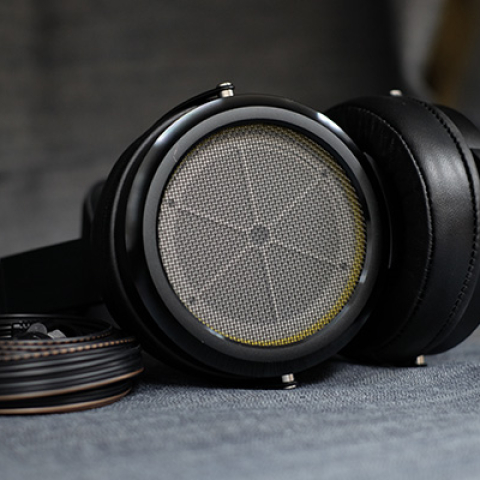
Only moments after I'd received my review samples of open-back Audeze EL-8s, they committed their first act of transcendent love: I played Paul McCreesh and the Gabrieli Consort and Players' recording of Cristóbal de Morales's Mass for the Feast of St. Isidore of Seville (CD, Deutsche Grammophon 93904). Once again, the roof of my head became the dome of a cathedral. This 16th-century composition perfectly expresses the earthy sacredness of Spanish Christian feeling. The sound of the male choir was so well formed and accessible that I prepared to abandon my pagan rascality and join up with those hooded monks in their stone churches. The EL-8s' special beauty was their holistic way with space and inner detail—they made music seem beautifully proportional and correctly formed.
AudioQuest NightHawk semi-open-back headphones
The last car I owned was a nickel-green, 1977 Mercedes-Benz 300D (foonote 4). It was a W123 saloon that came stock with four 4" (100mm) paper-cone speakers connected to its Becker radio—to which I attached a 3.5mm male input so that my partner, bb, could plug in her iPod during long trips. The first time bb did so, she said, "You have to hear my father's favorite jazz recording!" It was Dave Brubeck's "Take Five." In like three seconds she was stammering, "Oh my god! It never sounded like this before! Not even on my dad's stereo!" Whereupon I launched into a tutorial on the virtues of full-range paper cones and pure copper wire wound around paper voice-coils. "Everything in audio sounds like the resonant nature of what it is made of; paper and copper sound more organic and natural."
She smiled sarcastically. "I'm sure it does."
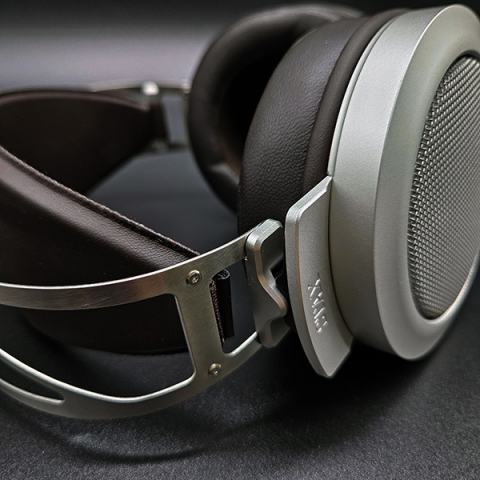
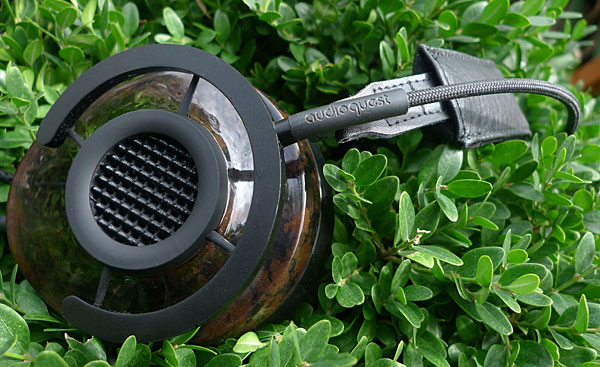
I told this story to Skylar Gray, designer of AudioQuest's NightHawk headphones ($599, footnote 5), after he'd described to me his thinking behind the paper-like bio-cellulose (footnote 6) material used to make the NightHawks' 50mm dynamic-driver cones, and the "liquid wood"—an amalgam of wood and plant fibers—used to make the driver earcups. It's best to imagine the NightHawks as sensitive little full-range speakers mounted in a damped semi-box of wood ingeniously rigged to the ends of a semicircular stainless-steel rod of precisely the right diameter to properly tension each semi-box to the listener's head. An elegant substrap precisely and comfortably positioned the "protein leather"-cushioned earcups around my ears.
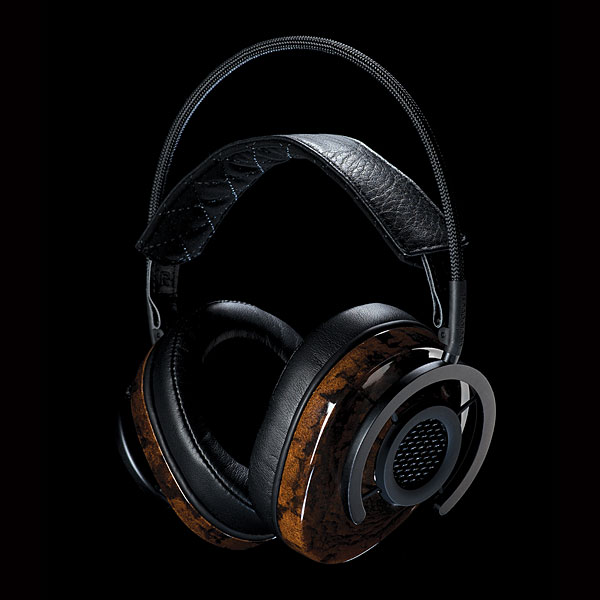 AudioQuest calls the NightHawks "semi-open": The exterior of each earcup is not entirely closed, but has a special, 3D-printed "biomimetic" diffuser grille that "mimics the latticework of a butterfly wing," says AQ. I suspect the diffuser grille functions to load (or stabilize) the dynamic driver in a very selective, controlled, perhaps "aperiodic" way.
Not surprisingly, cablemaker AudioQuest's first foray into headphone design includes a unique cord—actually, cords: the primary 8' home-listening cord is thick and rather stiff for a pair of headphones, and uses AudioQuest's best solid-copper conductors: Perfect-Surface Copper+. A second, skinnier, more flexible 8' cord is also included. Its sound had nowhere near the strength, detail, or grace of the thicker cord; the thinner cord is designed to be more durable and user-friendly on the road, in the subway, or in your backpack.
Listening: My first audition of the NightHawks was also at CES 2015, in AudioQuest's room. I don't remember the amp, but I remember the track: Paul Simon's "Graceland," which I've heard a jillion times. This time, I stood there shaking my head. Talk about speed and boogie factor: My aching bones could hardly keep up. I was also taken by its soulful, relaxed sound. I couldn't find any orchestral or choral music, so I couldn't tell much about resolution or soundstaging. And then . . .
When I received my review samples of the NightHawks, I was deep into my AKG K812 headphones, which I thought were the best I'd ever heard—along with the Abyss AB-1266 and the HiFiMan HE1000 models. By comparison, the AudioQuests sounded dull, dark, foggy, and compressed. I kept switching records, but everything sounded blah. I wrote AQ and asked if they'd changed the design since CES. Nope. I called Steve Guttenberg, and his tone got very serious. "Herb, the NightHawks are weird. They need at least 150–200 hours of break-in." He advised me to let them hang on the shelf and play 24/7 for a couple weeks, then listen again.
AudioQuest calls the NightHawks "semi-open": The exterior of each earcup is not entirely closed, but has a special, 3D-printed "biomimetic" diffuser grille that "mimics the latticework of a butterfly wing," says AQ. I suspect the diffuser grille functions to load (or stabilize) the dynamic driver in a very selective, controlled, perhaps "aperiodic" way.
Not surprisingly, cablemaker AudioQuest's first foray into headphone design includes a unique cord—actually, cords: the primary 8' home-listening cord is thick and rather stiff for a pair of headphones, and uses AudioQuest's best solid-copper conductors: Perfect-Surface Copper+. A second, skinnier, more flexible 8' cord is also included. Its sound had nowhere near the strength, detail, or grace of the thicker cord; the thinner cord is designed to be more durable and user-friendly on the road, in the subway, or in your backpack.
Listening: My first audition of the NightHawks was also at CES 2015, in AudioQuest's room. I don't remember the amp, but I remember the track: Paul Simon's "Graceland," which I've heard a jillion times. This time, I stood there shaking my head. Talk about speed and boogie factor: My aching bones could hardly keep up. I was also taken by its soulful, relaxed sound. I couldn't find any orchestral or choral music, so I couldn't tell much about resolution or soundstaging. And then . . .
When I received my review samples of the NightHawks, I was deep into my AKG K812 headphones, which I thought were the best I'd ever heard—along with the Abyss AB-1266 and the HiFiMan HE1000 models. By comparison, the AudioQuests sounded dull, dark, foggy, and compressed. I kept switching records, but everything sounded blah. I wrote AQ and asked if they'd changed the design since CES. Nope. I called Steve Guttenberg, and his tone got very serious. "Herb, the NightHawks are weird. They need at least 150–200 hours of break-in." He advised me to let them hang on the shelf and play 24/7 for a couple weeks, then listen again.
 That was two months ago: I have now put no fewer than 500 hours on the NightHawks. They're very much like those low-compliance phono cartridges that just keep getting better with age—up to a point. Every day, the NightHawks become more lively, open, and clear. Today I'm listening to Paul McCreesh directing the Gabrieli Consort & Players in Venetian Vespers: sacred music by Monteverdi, Rigatti, Grandi, and Cavalli (2 CDs, Archiv Produktion 437 552-2). The NightHawks are sorting out the voices and atmospheric cues with more clarity and grace than my current floorstanding speakers. Before full break-in, the NightHawks sounded dark and thick. Now they're transparent in a way I haven't quite experienced before. It feels pure and natural, not faux: not the result of some frequency-response anomaly.
Most headphones play the extravagant contrivances of pop, rock, and hip-hop pretty well. Most headphones kick jazz around in a very appealing way. But the NightHawks take my listening to classical, opera, and choral music to levels I can describe only as psychedelic. It is heavenly.
Balanced vs Unbalanced: My first experience of balanced headphones was with a PonoPlayer and a pair of borrowed Sennheiser HD600s with a custom cord. Instantly, I knew: I like balanced. Unlike single-ended headphones, with which images tend to stay in or near my skull, images in balanced mode seemed to expand out and away from my head. Images and the edges of soundstages were more tangible. Used with either of their standard cables, the AudioQuest NightHawks can work in balanced mode with the addition of a specially terminated AQ cable (prices start at $109.95). I listened to the AudioQuest NightHawks in both balanced and single-ended modes, and the differences were not subtle.
I spent a muggy August morning hunkered down, wearing a blindfold (I like listening to earspeakers in the dark), using the NightHawks and an Oppo HA-1 headphone amp to listen to A Venetian Coronation 1595, again with the Gabrielis conducted by the venerable McCreesh (CD, Virgin Classics VC 79110-2, 260 289-231). It's a scholarly, period-instrument reconstruction of the coronation of Marino Grimani, Doge of Venice, which took place in the gold-domed Basilica of St. Mark's. (McCreesh's version was recorded in the medieval Brinkburn Priory, in Northumberland, England.) It opens with a single microphone moving slowly toward a solitary church bell. You enter the monastery quietly, and the first and smallest of four organs begins to play. About four minutes in, the monks begin to chant the "Introit—Benedicta Sit Sancta Trinitas," which is followed by a massive, slowly approaching rendition, on drums and horns, of Cesare Bendinelli's Sonata 333.
With the NightHawks in balanced mode, I could count the drums and horns. I could hear the players' feet on the stone floor. In single-ended mode, I couldn't.
In single-ended mode, the NightHawks reproduced the sounds of this culturally complex historical reconstruction with solid, densely packed authority, but a full appreciation of the multifarious nature of this visually evocative album, which won an award from Gramophone, demands maximum spatiality and fully realized images. In balanced mode, the NightHawks put my mind right into the scene. The sonic improvements were so unsubtle that I can't imagine how balanced listening will not become the future of high-end headphoning.
Headphone amps
That was two months ago: I have now put no fewer than 500 hours on the NightHawks. They're very much like those low-compliance phono cartridges that just keep getting better with age—up to a point. Every day, the NightHawks become more lively, open, and clear. Today I'm listening to Paul McCreesh directing the Gabrieli Consort & Players in Venetian Vespers: sacred music by Monteverdi, Rigatti, Grandi, and Cavalli (2 CDs, Archiv Produktion 437 552-2). The NightHawks are sorting out the voices and atmospheric cues with more clarity and grace than my current floorstanding speakers. Before full break-in, the NightHawks sounded dark and thick. Now they're transparent in a way I haven't quite experienced before. It feels pure and natural, not faux: not the result of some frequency-response anomaly.
Most headphones play the extravagant contrivances of pop, rock, and hip-hop pretty well. Most headphones kick jazz around in a very appealing way. But the NightHawks take my listening to classical, opera, and choral music to levels I can describe only as psychedelic. It is heavenly.
Balanced vs Unbalanced: My first experience of balanced headphones was with a PonoPlayer and a pair of borrowed Sennheiser HD600s with a custom cord. Instantly, I knew: I like balanced. Unlike single-ended headphones, with which images tend to stay in or near my skull, images in balanced mode seemed to expand out and away from my head. Images and the edges of soundstages were more tangible. Used with either of their standard cables, the AudioQuest NightHawks can work in balanced mode with the addition of a specially terminated AQ cable (prices start at $109.95). I listened to the AudioQuest NightHawks in both balanced and single-ended modes, and the differences were not subtle.
I spent a muggy August morning hunkered down, wearing a blindfold (I like listening to earspeakers in the dark), using the NightHawks and an Oppo HA-1 headphone amp to listen to A Venetian Coronation 1595, again with the Gabrielis conducted by the venerable McCreesh (CD, Virgin Classics VC 79110-2, 260 289-231). It's a scholarly, period-instrument reconstruction of the coronation of Marino Grimani, Doge of Venice, which took place in the gold-domed Basilica of St. Mark's. (McCreesh's version was recorded in the medieval Brinkburn Priory, in Northumberland, England.) It opens with a single microphone moving slowly toward a solitary church bell. You enter the monastery quietly, and the first and smallest of four organs begins to play. About four minutes in, the monks begin to chant the "Introit—Benedicta Sit Sancta Trinitas," which is followed by a massive, slowly approaching rendition, on drums and horns, of Cesare Bendinelli's Sonata 333.
With the NightHawks in balanced mode, I could count the drums and horns. I could hear the players' feet on the stone floor. In single-ended mode, I couldn't.
In single-ended mode, the NightHawks reproduced the sounds of this culturally complex historical reconstruction with solid, densely packed authority, but a full appreciation of the multifarious nature of this visually evocative album, which won an award from Gramophone, demands maximum spatiality and fully realized images. In balanced mode, the NightHawks put my mind right into the scene. The sonic improvements were so unsubtle that I can't imagine how balanced listening will not become the future of high-end headphoning.
Headphone amps
Nowadays, every high-end integrated amplifier comes with a headphone jack, and behind every headphone jack is an electronic doodad—voltage divider, chipset, buffer, whatever—that most likely wasn't designed as a headphone amp. You think those things were designed by some can-jamming mad scientist, sweating away in his lab with a 'scope and a bunch of headphones, trying to make a great headphone amp? Not likely. More likely, there was a PR-marketing fellow asking some nameless amp designer if he could design a headphone amp. The nameless designer replies, via e-mail, "Sure, no problem," then proceeds to dig into a cardboard box for that old pair of Grado headphones from his college days. Which is why most headphone amps sound just okay.
For the purposes of this investigation, I used a variety of headphone-friendly integrated amplifiers, D/A headphone amplifiers, and just-plain headphone amplifiers, all recommendable, and all of which I'll discuss at length in some future column. Besides the very excellent Vinnie Rossi LIO integrated amp ($7750 as reviewed in Stereophile's September, 2015 issue), I used the smooth- and rich-sounding Burson Conductor Virtuoso ($1995); the extraordinarily detailed and transparent Simaudio Moon Neo 230HAD ($1500); the just-right–sounding, balanced-output Oppo H1-A ($1199); the incredibly well-made, user-friendly, and emotionally engaging Audeze Deckard ($699); and the too-good-to-be-true-for-the-price Asgard, from Schiit Audio ($249). Which was the best? I do not yet know. I enjoyed them all.
Conclusions
Listen, folks, I'm new to this, and not as attuned to this world of headphones as I hope someday to become. But from where I now sit, it looks as if most of the best new, high-end audio inventions are being created to generate crystalized images inside those sacred naves between our ears. I can't say one bad word about either of these extraordinary new headphones. Each plays music more enjoyably and more comfortably than I could have dreamed was possible only a few years ago. Each sounds quite different from the other. The Audeze EL-8s displayed a crisp, clear, March–April kind of light; the AudioQuest NightHawks delivered a clear but slightly darker October–November glow. The NightHawks' strong point was their testicular bass and tasty, organic richness. The EL-8s were less visceral, but more transparent and sparkly in the top five octaves. Both are less punchy, bold, or colorful than my old standby music-playing favorites, the non-Fazored Audeze LCD-2s. Both offer super audiophile sound quality that should cost at least twice as much. Both changed my perception of just how deep and exciting the experience of listening to music through headphones can be. I recommend both—every audiophile, old or young, should consider them must-auditions.
Footnote 4: The last time HR visited, my daughter fell in love with that Mercedes, which she dubbed "the avacardo"—Art Dudley Footnote 5: AudioQuest, 2621 White Road, Irvine, CA 92614. Tel: (949) 585-0111. Web: www.audioquest.com. Footnote 6: In 1989, Sony released a "statement" headphone model, the MDR-R10, which had what Sony called Bio-Cellulose Dome Diaphragms. Only 2000 were produced, at $2500/pair. Many regard the MDR-R10s as the best headphones ever made. Steve Guttenberg listened to them through a Red Wine Audio headphone amp and reviewed them for CNET. He described their sound as "effortless, unforced, yet still highly detailed and clear . . . more lifelike and natural than any other headphone I know . . . the wide-open sound-staging was exceptional."
The last car I owned was a nickel-green, 1977 Mercedes-Benz 300D (foonote 4). It was a W123 saloon that came stock with four 4" (100mm) paper-cone speakers connected to its Becker radio—to which I attached a 3.5mm male input so that my partner, bb, could plug in her iPod during long trips. The first time bb did so, she said, "You have to hear my father's favorite jazz recording!" It was Dave Brubeck's "Take Five." In like three seconds she was stammering, "Oh my god! It never sounded like this before! Not even on my dad's stereo!" Whereupon I launched into a tutorial on the virtues of full-range paper cones and pure copper wire wound around paper voice-coils. "Everything in audio sounds like the resonant nature of what it is made of; paper and copper sound more organic and natural."
AudioQuest calls the NightHawks "semi-open": The exterior of each earcup is not entirely closed, but has a special, 3D-printed "biomimetic" diffuser grille that "mimics the latticework of a butterfly wing," says AQ. I suspect the diffuser grille functions to load (or stabilize) the dynamic driver in a very selective, controlled, perhaps "aperiodic" way.
Not surprisingly, cablemaker AudioQuest's first foray into headphone design includes a unique cord—actually, cords: the primary 8' home-listening cord is thick and rather stiff for a pair of headphones, and uses AudioQuest's best solid-copper conductors: Perfect-Surface Copper+. A second, skinnier, more flexible 8' cord is also included. Its sound had nowhere near the strength, detail, or grace of the thicker cord; the thinner cord is designed to be more durable and user-friendly on the road, in the subway, or in your backpack.
That was two months ago: I have now put no fewer than 500 hours on the NightHawks. They're very much like those low-compliance phono cartridges that just keep getting better with age—up to a point. Every day, the NightHawks become more lively, open, and clear. Today I'm listening to Paul McCreesh directing the Gabrieli Consort & Players in Venetian Vespers: sacred music by Monteverdi, Rigatti, Grandi, and Cavalli (2 CDs, Archiv Produktion 437 552-2). The NightHawks are sorting out the voices and atmospheric cues with more clarity and grace than my current floorstanding speakers. Before full break-in, the NightHawks sounded dark and thick. Now they're transparent in a way I haven't quite experienced before. It feels pure and natural, not faux: not the result of some frequency-response anomaly.
Nowadays, every high-end integrated amplifier comes with a headphone jack, and behind every headphone jack is an electronic doodad—voltage divider, chipset, buffer, whatever—that most likely wasn't designed as a headphone amp. You think those things were designed by some can-jamming mad scientist, sweating away in his lab with a 'scope and a bunch of headphones, trying to make a great headphone amp? Not likely. More likely, there was a PR-marketing fellow asking some nameless amp designer if he could design a headphone amp. The nameless designer replies, via e-mail, "Sure, no problem," then proceeds to dig into a cardboard box for that old pair of Grado headphones from his college days. Which is why most headphone amps sound just okay.
Listen, folks, I'm new to this, and not as attuned to this world of headphones as I hope someday to become. But from where I now sit, it looks as if most of the best new, high-end audio inventions are being created to generate crystalized images inside those sacred naves between our ears. I can't say one bad word about either of these extraordinary new headphones. Each plays music more enjoyably and more comfortably than I could have dreamed was possible only a few years ago. Each sounds quite different from the other. The Audeze EL-8s displayed a crisp, clear, March–April kind of light; the AudioQuest NightHawks delivered a clear but slightly darker October–November glow. The NightHawks' strong point was their testicular bass and tasty, organic richness. The EL-8s were less visceral, but more transparent and sparkly in the top five octaves. Both are less punchy, bold, or colorful than my old standby music-playing favorites, the non-Fazored Audeze LCD-2s. Both offer super audiophile sound quality that should cost at least twice as much. Both changed my perception of just how deep and exciting the experience of listening to music through headphones can be. I recommend both—every audiophile, old or young, should consider them must-auditions.
Footnote 4: The last time HR visited, my daughter fell in love with that Mercedes, which she dubbed "the avacardo"—Art Dudley Footnote 5: AudioQuest, 2621 White Road, Irvine, CA 92614. Tel: (949) 585-0111. Web: www.audioquest.com. Footnote 6: In 1989, Sony released a "statement" headphone model, the MDR-R10, which had what Sony called Bio-Cellulose Dome Diaphragms. Only 2000 were produced, at $2500/pair. Many regard the MDR-R10s as the best headphones ever made. Steve Guttenberg listened to them through a Red Wine Audio headphone amp and reviewed them for CNET. He described their sound as "effortless, unforced, yet still highly detailed and clear . . . more lifelike and natural than any other headphone I know . . . the wide-open sound-staging was exceptional."