Sidebar: Measurements
The primary specification for headphones is impedance: too low and the 'phones will not sound at its best with some sources that have high output impedances; too high, and while the headphones will be easy to drive, they might not go sufficiently loud. The upper solid trace in fig.1 shows how the NightHawk's impedance varies with frequency, measured with the headphones on my head; the lower solid trace is a 10 ohm resistor. The NightHawk resembles a 24 ohm resistor at all audio frequencies, the impedance hardly varying and the phase angle (upper dotted trace) remaining close to 0°. Only at ultrasonic frequencies does the impedance start to rise, presumably due to the voice-coil inductance. So while the NightHawk has a fairly low impedance, its frequency response will not change when driven by a source with a high output impedance.—John Atkinson
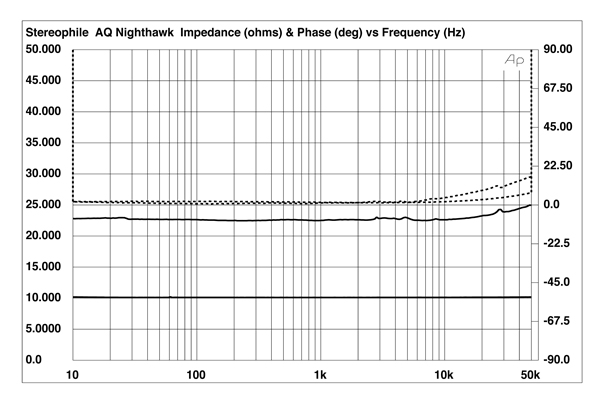
Fig.1, AudioQuest NightHawk, electrical impedance (solid, top) and phase (dashed); and of 10 ohm resistor (solid, bottom) (5 ohms/vertical div.).