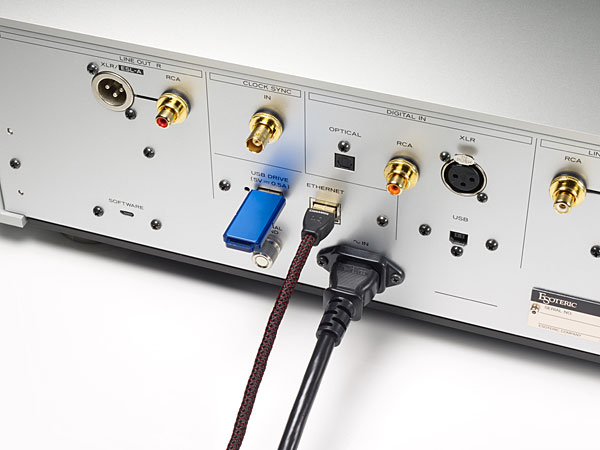
The freezing issue seemed to involve miscommunication between the USB sticks and Sound Stream. (The playback of files stored on hard drives worked just fine.) Sometimes the app would show that a file was playing, and my USB stick's status light would blink to confirm that it was being played—but the N-01 produced no sound, and wouldn't respond to presses of its Power button. Only after I'd quit the app, unplugged and plugged in the power cord, let the N-01 reboot, breathed deeply, and started from scratch could I hear music again. My dogs learned to put their paws over their ears to avoid hearing exclamations that the FCC deems unfit for the airwaves. Eventually, I recited the Serenity Prayer and got on with it. As I proofread this review before submitting it, I was informed that Esoteric's engineers had gotten on with it as well, and issued an update that addressed the problem.
Sound
Given that Esoteric provides the option of connecting an outboard clock, I compared the sound of the N-01's internal clock to that of the dCS Scarlatti clock I usually use with my reference dCS gear (footnote 1). As with both the dCS Rossini and Vivaldi DACs, adding the Scarlatti clock noticeably increased transparency and three-dimensionality. Colors deepened, far more detail and tonal shading emerged, and instruments sounded far more like the real thing. Nonetheless, given that the majority of new N-01 owners may listen without an outboard clock, I turned off the N-01's external clock input for much of my listening. I prefer to store music on external HDs in my office, and transfer individual files to portbable USB sticks. However, since far more people these days use computers (or NAS drives, which I don't have) to play music, I hauled my trusty SSD MacBook Pro into the music room, placed it atop Stein Supernatural supports, connected it to the N-01's USB Type-B port using a Nordost Valhalla 2 link, set the N-01's input to USB, and compared the sound of the same files stored on computer, played with Audirvana Plus, with those played directly from the stick using the Sound Stream app. While the computer produced far better sound than I'd expected, and interfaced with the N-01 without a hitch, bypassing all of my computer's internal chazerei by sourcing from USB stick or silver disc yielded greater color saturation and "blacker" backgrounds. From then on, I went with USB.
What I heard sounded very fine indeed. Take, for example, a classic audiophile release, Rachmaninoff's Symphonic Dances, with the Minnesota Orchestra under Eiji Oue (HDCD, Reference RR-96). What a great job recording engineer Keith O. Johnson did with this music! The soundstage, which is set back behind most of the speakers I've listened to it through, is continuous, immense, and convincing, and the colors of instruments, especially the warmth of solo woodwinds, are fully captured. These are beautiful musical and sonic performances.
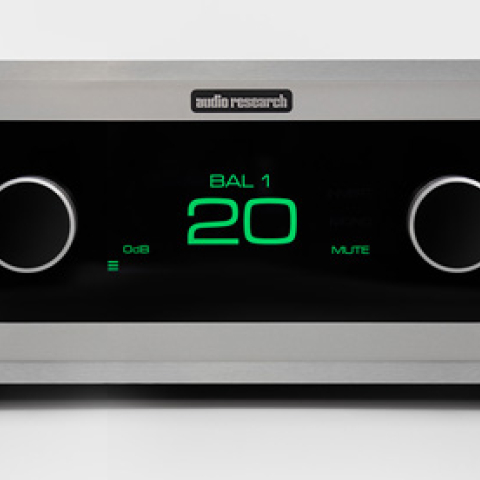
Less than 15 seconds into this recording, which I initially auditioned through the Audio Research REF 6 preamp, I was astounded by the N-01's ability to reproduce percussion and the low foundation of double basses with ear-opening strength and control. In recent listens to this recording at audio shows, I hadn't heard so strong and convincing a bass foundation. Nor, before the N-01's arrival, had I ever heard the inhalation (of conductor Oue?) that comes before the first big orchestral entrance. No matter what sort of bass-heavy music you prefer—if you're into pop, try "There's a Limit to Your Love," from James Blake's James Blake (16/44.1 WAV, A&M 949999)—you'll be convinced that, for bass, the N-01 is up there with the best.
Higher up, I thought the tambourine sounded a mite too rattly, the woodwinds beautiful but not supremely color-saturated, and the soundstage boundaries vague. There was also a pervasive grayness to the space between notes. Most of these issues greatly diminished, however, when I switched on the external clock.
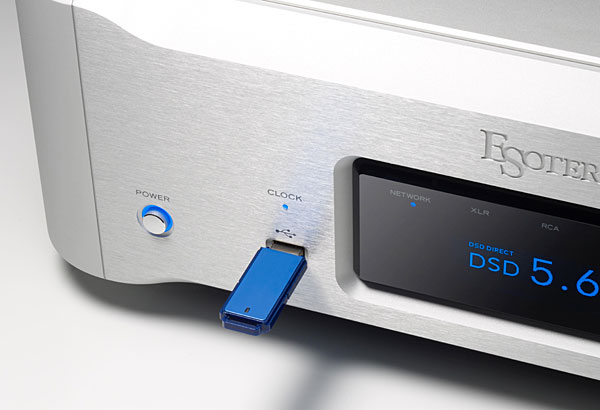
 I then inserted one of my USB drives in the N-01's front USB Type-A port and cued up the first movement of Spring, from Vivaldi's The Four Seasons, with violin soloist Rachel Podger and Brecon Baroque (SACD/CD, Channel Classics 40318; DSD128 download, NativeDSD). The N-01's excellent resolution let me easily distinguish the distinct timbres of the two different-sounding violins in one of their early exchanges. Depth was okay, but the sense of expanse was less than I'm accustomed to from DSD128 files. Strings also sounded a mite thin and glassy, and lacked warmth. (Again, an external clock mostly ameliorated these issues.) Regardless, as this joyous music continued, the fun that Podger and her ensemble were having came through loud and clear.
No matter how bright an instrument might sound in real life or as captured by microphones, its piercing brilliance was tempered by the N-01 in a way that made it eminently listenable without diminishing its power. Listening to Leo Wadada Smith's glorious trumpet and the surprise interjections of percussionist Garth Powell in "Black on White Paper," from Zen Widow's Screaming in Daytime (Makes Men Forget) (CD, pfMentum PFMCD 069), produced by Joe Harley and recorded live to two-track analog, I felt that all of the music's power and momentum hit me right in the gut—just as, I assume, the musicians and Harley intended. But while listening to it at high volume through some systems might have set my ears afire, with the N-01 I could let it rip without pain.
The same held true for the imposing voice of mezzo-soprano Jamie Barton in Sibelius's thrilling song "Var det en droöm?" (Was It a Dream?), from Barton and pianist Brian Zeger's All Who Wander, which recently won the BBC Music Magazine's Vocal Award for 2018 (24/96 WAV, Delos DE 3494). Having heard Barton in recital in a 400-seat hall, and in an opera house six times that size, I can attest that her once-in-a-lifetime voice is not only huge, but equipped with a strong leading edge that, in a small space, can overwhelm the beauty of her tone. The N-01 put her voice in ideal perspective, letting me hear the beauty that can be buried beneath the edge, while ensuring that when Barton opened up full throttle, my ears wouldn't be damaged.
I then inserted one of my USB drives in the N-01's front USB Type-A port and cued up the first movement of Spring, from Vivaldi's The Four Seasons, with violin soloist Rachel Podger and Brecon Baroque (SACD/CD, Channel Classics 40318; DSD128 download, NativeDSD). The N-01's excellent resolution let me easily distinguish the distinct timbres of the two different-sounding violins in one of their early exchanges. Depth was okay, but the sense of expanse was less than I'm accustomed to from DSD128 files. Strings also sounded a mite thin and glassy, and lacked warmth. (Again, an external clock mostly ameliorated these issues.) Regardless, as this joyous music continued, the fun that Podger and her ensemble were having came through loud and clear.
No matter how bright an instrument might sound in real life or as captured by microphones, its piercing brilliance was tempered by the N-01 in a way that made it eminently listenable without diminishing its power. Listening to Leo Wadada Smith's glorious trumpet and the surprise interjections of percussionist Garth Powell in "Black on White Paper," from Zen Widow's Screaming in Daytime (Makes Men Forget) (CD, pfMentum PFMCD 069), produced by Joe Harley and recorded live to two-track analog, I felt that all of the music's power and momentum hit me right in the gut—just as, I assume, the musicians and Harley intended. But while listening to it at high volume through some systems might have set my ears afire, with the N-01 I could let it rip without pain.
The same held true for the imposing voice of mezzo-soprano Jamie Barton in Sibelius's thrilling song "Var det en droöm?" (Was It a Dream?), from Barton and pianist Brian Zeger's All Who Wander, which recently won the BBC Music Magazine's Vocal Award for 2018 (24/96 WAV, Delos DE 3494). Having heard Barton in recital in a 400-seat hall, and in an opera house six times that size, I can attest that her once-in-a-lifetime voice is not only huge, but equipped with a strong leading edge that, in a small space, can overwhelm the beauty of her tone. The N-01 put her voice in ideal perspective, letting me hear the beauty that can be buried beneath the edge, while ensuring that when Barton opened up full throttle, my ears wouldn't be damaged.
 Throughout weeks of intensive listening that, translated into air miles, would earn me a trip to Europe, the N-01's tonal gestalt sounded remarkably similar to what I've heard from Esoteric gear at audio shows: extremely detailed, balanced, and fleshed out, with superb bass, but with a bit of gray patina that reduced sparkle. Warm and fuzzy, romantic, and lush are not terms I would ever use to describe the N-01's sound, unless it were mated to a preamp whose sound was over-effusive in those areas.
Imagine that you've finally managed to get out from in front of your speakers or between your headphones and into the great outdoors. There, you discover that the rich greens of leaves and grass take on different hues in the light of late afternoon. (I think trees, lawns, and flowers often look most beautiful when the sun sinks lower in the sky.) That's how the Esoteric N-01 sounded to me: All of music's natural beauties were there, but presented in a different aural light. And if a big storm, atmospheric or sonic, does arrive, you'll hear and feel every bit of its thunder, wind, and pounding rain.
Through the N-01, Marianne Crebassa's glorious mezzo was to die for on her recording, with pianist Fazil Say, of Debussy's Chansons de Bilitis (24/96 WAV, Erato 564483)—but it sounded different from how it does through my reference player. With the ARC REF 6 preamp in the chain, the sparkle and glow of the top notes of piano and voice were a bit toned down, with a touch of gray in what might otherwise have been "black" silences between notes. It sounded as if this performance had been recorded in a space whose acoustic was slightly darker than some.
Upsampling, MQA, and more
Throughout weeks of intensive listening that, translated into air miles, would earn me a trip to Europe, the N-01's tonal gestalt sounded remarkably similar to what I've heard from Esoteric gear at audio shows: extremely detailed, balanced, and fleshed out, with superb bass, but with a bit of gray patina that reduced sparkle. Warm and fuzzy, romantic, and lush are not terms I would ever use to describe the N-01's sound, unless it were mated to a preamp whose sound was over-effusive in those areas.
Imagine that you've finally managed to get out from in front of your speakers or between your headphones and into the great outdoors. There, you discover that the rich greens of leaves and grass take on different hues in the light of late afternoon. (I think trees, lawns, and flowers often look most beautiful when the sun sinks lower in the sky.) That's how the Esoteric N-01 sounded to me: All of music's natural beauties were there, but presented in a different aural light. And if a big storm, atmospheric or sonic, does arrive, you'll hear and feel every bit of its thunder, wind, and pounding rain.
Through the N-01, Marianne Crebassa's glorious mezzo was to die for on her recording, with pianist Fazil Say, of Debussy's Chansons de Bilitis (24/96 WAV, Erato 564483)—but it sounded different from how it does through my reference player. With the ARC REF 6 preamp in the chain, the sparkle and glow of the top notes of piano and voice were a bit toned down, with a touch of gray in what might otherwise have been "black" silences between notes. It sounded as if this performance had been recorded in a space whose acoustic was slightly darker than some.
Upsampling, MQA, and more
I systematically switched between the N-01's ORG setting (no upsampling) to one of five upsampling options (2Fs, 4Fs, 8Fs, 16Fs, and DSD), noting what I heard. Both of my test tracks were from CDs mentioned above: Zen Widow's Screaming in Daytime, replete with hairpin dynamic and rhythmic shifts, loud assaults, and timbral extremes; and the far fuller-sounding Symphonic Dances of Rachmaninoff, which punctuates heart-on-sleeve romantic lushness with a number of big whammies.
Footnote 1: Esoteric recommends two of their own clocks, either the G-01X Rubidium Clock ($20,000) and orG-02X OCXO Clock ($6500).
Given that Esoteric provides the option of connecting an outboard clock, I compared the sound of the N-01's internal clock to that of the dCS Scarlatti clock I usually use with my reference dCS gear (footnote 1). As with both the dCS Rossini and Vivaldi DACs, adding the Scarlatti clock noticeably increased transparency and three-dimensionality. Colors deepened, far more detail and tonal shading emerged, and instruments sounded far more like the real thing. Nonetheless, given that the majority of new N-01 owners may listen without an outboard clock, I turned off the N-01's external clock input for much of my listening. I prefer to store music on external HDs in my office, and transfer individual files to portbable USB sticks. However, since far more people these days use computers (or NAS drives, which I don't have) to play music, I hauled my trusty SSD MacBook Pro into the music room, placed it atop Stein Supernatural supports, connected it to the N-01's USB Type-B port using a Nordost Valhalla 2 link, set the N-01's input to USB, and compared the sound of the same files stored on computer, played with Audirvana Plus, with those played directly from the stick using the Sound Stream app. While the computer produced far better sound than I'd expected, and interfaced with the N-01 without a hitch, bypassing all of my computer's internal chazerei by sourcing from USB stick or silver disc yielded greater color saturation and "blacker" backgrounds. From then on, I went with USB.
I then inserted one of my USB drives in the N-01's front USB Type-A port and cued up the first movement of Spring, from Vivaldi's The Four Seasons, with violin soloist Rachel Podger and Brecon Baroque (SACD/CD, Channel Classics 40318; DSD128 download, NativeDSD). The N-01's excellent resolution let me easily distinguish the distinct timbres of the two different-sounding violins in one of their early exchanges. Depth was okay, but the sense of expanse was less than I'm accustomed to from DSD128 files. Strings also sounded a mite thin and glassy, and lacked warmth. (Again, an external clock mostly ameliorated these issues.) Regardless, as this joyous music continued, the fun that Podger and her ensemble were having came through loud and clear.
No matter how bright an instrument might sound in real life or as captured by microphones, its piercing brilliance was tempered by the N-01 in a way that made it eminently listenable without diminishing its power. Listening to Leo Wadada Smith's glorious trumpet and the surprise interjections of percussionist Garth Powell in "Black on White Paper," from Zen Widow's Screaming in Daytime (Makes Men Forget) (CD, pfMentum PFMCD 069), produced by Joe Harley and recorded live to two-track analog, I felt that all of the music's power and momentum hit me right in the gut—just as, I assume, the musicians and Harley intended. But while listening to it at high volume through some systems might have set my ears afire, with the N-01 I could let it rip without pain.
The same held true for the imposing voice of mezzo-soprano Jamie Barton in Sibelius's thrilling song "Var det en droöm?" (Was It a Dream?), from Barton and pianist Brian Zeger's All Who Wander, which recently won the BBC Music Magazine's Vocal Award for 2018 (24/96 WAV, Delos DE 3494). Having heard Barton in recital in a 400-seat hall, and in an opera house six times that size, I can attest that her once-in-a-lifetime voice is not only huge, but equipped with a strong leading edge that, in a small space, can overwhelm the beauty of her tone. The N-01 put her voice in ideal perspective, letting me hear the beauty that can be buried beneath the edge, while ensuring that when Barton opened up full throttle, my ears wouldn't be damaged.
Throughout weeks of intensive listening that, translated into air miles, would earn me a trip to Europe, the N-01's tonal gestalt sounded remarkably similar to what I've heard from Esoteric gear at audio shows: extremely detailed, balanced, and fleshed out, with superb bass, but with a bit of gray patina that reduced sparkle. Warm and fuzzy, romantic, and lush are not terms I would ever use to describe the N-01's sound, unless it were mated to a preamp whose sound was over-effusive in those areas.
Imagine that you've finally managed to get out from in front of your speakers or between your headphones and into the great outdoors. There, you discover that the rich greens of leaves and grass take on different hues in the light of late afternoon. (I think trees, lawns, and flowers often look most beautiful when the sun sinks lower in the sky.) That's how the Esoteric N-01 sounded to me: All of music's natural beauties were there, but presented in a different aural light. And if a big storm, atmospheric or sonic, does arrive, you'll hear and feel every bit of its thunder, wind, and pounding rain.
Through the N-01, Marianne Crebassa's glorious mezzo was to die for on her recording, with pianist Fazil Say, of Debussy's Chansons de Bilitis (24/96 WAV, Erato 564483)—but it sounded different from how it does through my reference player. With the ARC REF 6 preamp in the chain, the sparkle and glow of the top notes of piano and voice were a bit toned down, with a touch of gray in what might otherwise have been "black" silences between notes. It sounded as if this performance had been recorded in a space whose acoustic was slightly darker than some.
I systematically switched between the N-01's ORG setting (no upsampling) to one of five upsampling options (2Fs, 4Fs, 8Fs, 16Fs, and DSD), noting what I heard. Both of my test tracks were from CDs mentioned above: Zen Widow's Screaming in Daytime, replete with hairpin dynamic and rhythmic shifts, loud assaults, and timbral extremes; and the far fuller-sounding Symphonic Dances of Rachmaninoff, which punctuates heart-on-sleeve romantic lushness with a number of big whammies.
Footnote 1: Esoteric recommends two of their own clocks, either the G-01X Rubidium Clock ($20,000) and orG-02X OCXO Clock ($6500).