But wait . . . Neeno is the name of Natalie's dog. I was definitely getting hungry. I checked the time: 45 minutes till dinner. I sent Natalie a text.
ME: I'm sitting here attempting to hear differences between two very similar turntables. Frustrating. Listening to a song called "Nero's Expedition," but I keep hearing "Neeno's Expedition."
NAT: Ha! You've got Neeno on your mind.
ME: It's true, but can you blame me?
NAT: Nope, he's always on my mind.
Goddammit, I thought, that Neeno is a lucky guy.
It was time to focus, and to do that, I would have to rely on more familiar demo material. I selected Four Tet's There Is Love in You (LP, Domino WIGLP 254) and cued up "Circling," which builds layer on layer of tone and melody on the foundation of a simple, steady beat—a great demo track. At first, differences between the RP-1 and P1 were difficult to hear, but after a few plays, certain things became clear: Through the RP-1, images were more precisely placed on a cleaner, tidier soundstage. The RP-1 matched better overall rhythmic control with deeper silences, allowing the song's many layers to explode into and vanish from my room with greater force. Toward the end of "Circling," Kieran Hebden fashions some dazzling little melodies out of nothing more than seemingly discrete electronic pulses and chimes. These melodies never fully emerged through the P1—the sounds were pretty but remained disconnected—while through the RP-1 they were given meaning and life. Indeed, the RP-1 delivered more drive, better focus, and was the more confident, purposeful, authoritative player. The RP-1 attacked the grooves; the P1 remained tentative.
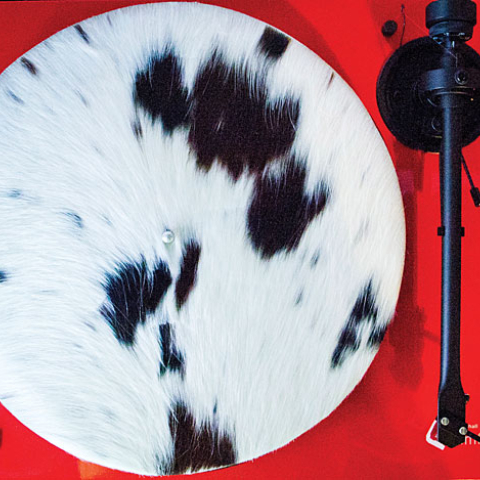
These differences were enhanced when I installed the RP-1's Performance Pack upgrade ($195), which includes Rega's improved drive belt (reviewed in a Follow-Up on Rega's P3-24 in November 2010), a platter mat of slightly thicker wool, and Rega's Bias 2 cartridge. Installing the new belt was effortless: Lift the platter from the spindle, remove the old black belt, insert the new white belt. When, in November, I noted that the white belt seemed very slightly greater in circumference than the stock belt, I'd wondered if my old belt had simply stretched with use. Does a smaller belt create a tighter fit around the pulley and platter motor? Absolutely—just as a smaller belt would create a tighter fit around Sam Tellig. And does a tighter fit produce faster revolutions? I would think so, though JA says not. After just a week of use, however, the new white belt had stretched to a point where the circumference matched that of the old black belt, putting an end to the matter and setting my mind at rest.
Even simpler than installing the new drive belt was replacing the old platter mat: Off with the old, on with the new. Replacing the cartridge took a bit more time. Everything required to properly perform the task—a miniature Allen key, small screws, a wiring diagram—is included, but it took a few tries to get it done right. When installing the Bias 2, you'll want to make sure the front edge of the cartridge body is flush with the front edge of the tonearm's headshell. The cartridge screws should be positioned as far forward in the headshell slots as possible. Tighten the screws, ensuring that the cartridge is squarely fitted in the shell. The entire process is more fiddly than difficult. Also included is a 14mm O-ring spacer, which negates the need for a tracking-force gauge or any other tools, measurements, or adjustments. Just fit the O-ring on the balance-weight shaft at the far end of the armtube, ahead of the balance weight, and move both as far forward onto the shaft as possible. The bias is already set to 1.75gm, which is the Bias 2's recommended tracking force. Brilliant.
Including the drive-belt upgrade, thicker wool mat, and Bias 2 cartridge, the RP-1 becomes a $640 record player, and I was in a whole new world of fun, exciting analog playback. Along with a wider, deeper, taller soundstage, there was now greater resolution of low-level detail—I could clearly hear that faint sax melody in the opening of "Deluge"—and greater contrast between silences and musical passages. The overall result was an intoxicating, addictive sound.
Still curious about those final lines of "Deluge," I quickly cued up the track and listened all the way through again. This time the words surrendered willingly, without hesitation:
Don't disturb me while I'm dreaming
Walk softly on my peace of mind
Though you know I'm close to waking
Leave me while the morning's breaking But what did they mean? And where had I heard them before? I checked the clock. Ten minutes till dinnertime—just enough time to return my records to their sleeves and walk over to Natalie and Nicole's place. The audiophile in me wondered if I should postpone dinner and perform a few more listening tests: More serious listening, or dinner with a couple of sweet friends? I rose from the orange couch, walked over to the window, and looked at the sky. A moment later, my question had evaporated into the white light of that strange, enormous moon. The answer was as clear as the night.
Share your stories.
Walk softly on my peace of mind
Though you know I'm close to waking
Leave me while the morning's breaking But what did they mean? And where had I heard them before? I checked the clock. Ten minutes till dinnertime—just enough time to return my records to their sleeves and walk over to Natalie and Nicole's place. The audiophile in me wondered if I should postpone dinner and perform a few more listening tests: More serious listening, or dinner with a couple of sweet friends? I rose from the orange couch, walked over to the window, and looked at the sky. A moment later, my question had evaporated into the white light of that strange, enormous moon. The answer was as clear as the night.