Photo: Paul Miller
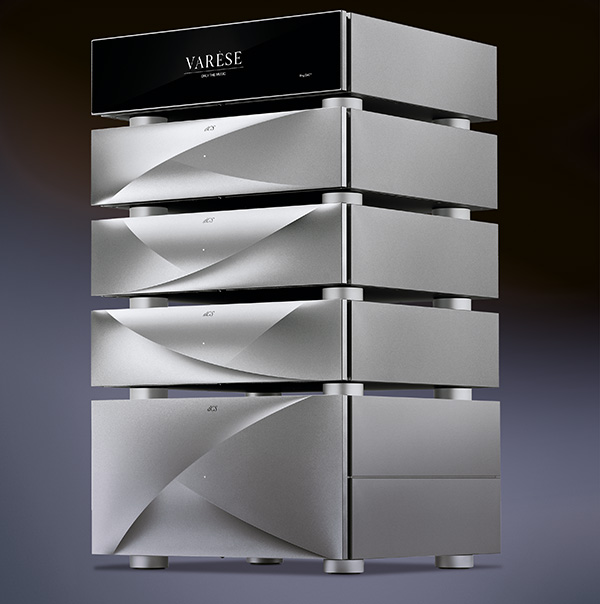
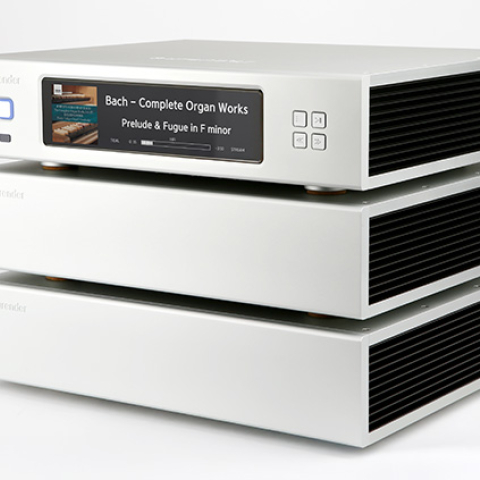
It was during a visit to my music room by five members of the small Off-Islanders Audio Society that the magic of the dCS Varèse Music System ($267,500 as reviewed; $305,000 with CD/SACD transport) became clear.
One member had requested the 24/192 version of "Splendido Sundance" from
Saturday Night in San Francisco (24/192 FLAC, Columbia-Legacy/Qobuz), performed by Al Di Meola, John McLaughlin, and Paco de Lucía and recorded live in the Warfield Theatre on December 6, 1980. I'd attended the
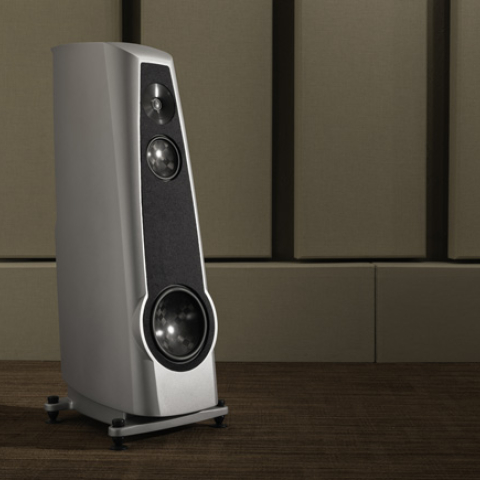
unveiling of the LP remastering of this recording, presented by the album's co-executive producer, Abey Fon, in the Audio Reference room at High End Munich 2024. The system, which was first class, included a VPI Titan turntable, D'Agostino Relentless preamplifier and Relentless 800 mono amplifiers, a VTL TP-6.5 Series II Signature phono preamplifier, Wilson Audio XVX loudspeakers, Nordost cabling, a Stromtank power generator, and an unheard three-piece dCS Vivaldi APEX music system (footnote 1).
Because many of these components or their smaller relations populate my reference system—I use
D'Agostino Momentum M400 MxV mono amplifiers and a
Relentless preamplifier, a
dCS Vivaldi APEX music system,
Wilson Audio Alexia V loudspeakers with
LōKē subwoofers, Nordost cabling, and a
Stromtank S-4000 MK II XT—I found the system's sonic signature quite familiar.
What was distinctly different about my home setup was that instead of the VPI Titan or the dCS Vivaldi APEX system, we used Qobuz to stream the 24/192 digital version of the album through the five essential boxes of the dCS Varèse Music System (footnote 2). Even more than at High End Munich, I heard three distinct guitars, each with its own uniquely identifiable color and timbre, spread across a wide soundstage. The sound may have been a bit brash—that's the nature of this singular live recording, though I may be shot dead for saying so—but every note was 100% clear and (that word again) distinct. When the three men pull out all stops in the second half of the seven-minute track, firing off more notes faster than anyone could possibly tabulate without AI assistance, every note remained clear. I heard no distortion—nothing to distract anyone from the artistry of three guitar virtuosos in their prime and the excitement they generated. It was tremendous—a revelation.
Even before he'd arrived to install the five-piece Varèse system, Emron Mangelson, director of dCS Americas, had asked if it would be possible for me to keep the Vivaldi APEX system on my double rack while he installed the Varèse system. In so many words, he told me that I might find it difficult to understand the differences between them unless I could perform direct comparisons.
Having now spent a lot of time with the Varèse, both in my music room and during an all-day factory tour at dCS headquarters in Cambridge, I must disagree with Mangelson. The more you listen to Varèse, the more obvious its distinct magic becomes.
The genesis of Varèse
When I reviewed the major
Vivaldi APEX DAC upgrade in 2022—the APEX upgrade is also available for other dCS DACs—I learned that during the COVID lockdown in the UK, dCS's two multidecade technical mainstays, Director of Product Development Chris Hales and Technical Director Andy McHarg, started exploring ways to improve dCS's proprietary Ring DAC technology. Hales told me that he didn't have a specific project in mind, but when he thought he'd found something worth pursuing, he put it on a board so that everyone at dCS could listen. The fruit of the men's efforts, he explained, was that major APEX upgrade.
What Hales did not tell me then was top secret. During the pandemic, everyone was actually hard at work on the DAC technology that eventually led to the creation of the Mono DACs in the Varèse music system. But when they put their initial technological advances, which they dubbed APEX, on a board and discovered how well it measured, they decided to make APEX available to owners of dCS's current DAC lineup well before the release of Varèse.
As dCS Product Marketing Manager James Cook explains in a
video posted on our YouTube channel, the APEX upgrade includes a completely new output stage, improvements in the transmission of clock and power supply signals, and more. Cook also explores why Mono DAC architecture eliminates crosstalk and provides other reasons why having separate Mono DACs, power supplies, and transformers for each channel results in better performance.
"All the analog output circuitry is essentially identical between an APEX version of Vivaldi and the Varèse Mono DACs," Cook said. "But the Mono DACs take Varèse performance quite a bit higher by virtue of the many improvements in the power supply and the mechanical design. For example, each chassis better isolates it from any incoming vibrations, and the ACTUS (Audio, Control & Timing Unified System) interface enables us to offload processes to the Core."
For more on the genesis of Varèse and its Mono DAC technology, see the
David Steven sidebar.
Why add Varèse to a component lineup named for the far better-known composers Bartók, Rossini, and Vivaldi (with Elgar, Delius, Verdi, Scarlatti, Paganini, and Puccini before them; footnote 3)? Multiple conversations yielded multiple responses. To summarize: Edgard Varèse's compositions, which integrated electronic and highly unusual instruments into a distinctly unusual modernist soundscape, propelled classical music into the future, inspiring future creators of classical, pop, rock, and electronic music. To dCS, naming their new flagship Varèse signified their effort to look into the digital future and examine how they could advance user experience, industrial and mechanical design, and sound.
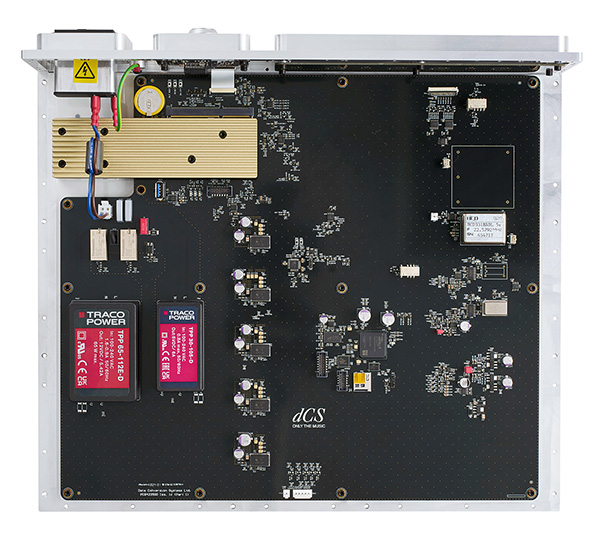
The Varèse Master Clock system is based on two OCXOs (Oven-Controlled Crystal Oscillators) centered on 88.2kHz and 96kHz (far right), a Xilinx Artix 7 DSP (center), and PSUs headed up by two Traco Power isolated AC/DC converters. (Photo: Paul Miller.)
What Varèse is
Varèse consists of up to six component boxes. Each has a single, small, thankfully unobtrusive LED on its front that blinks as the unit progresses from standby to on; a small standby/on button secreted right beneath the center of the front panel; and a major power on/off toggle switch next to its 15A IEC connector on the rear. The first two chassis hold the two Mono DACs, one for each channel, with new Differential Ring DAC (footnote 4) technology; mains transformers, regulator topology, secondary circuits, and analog output stage. Each Mono DAC's power supply was designed to provide better common mode performance on its balanced output.
Each Mono DAC houses twin transformers that are specific to Varèse. Designed in collaboration with dCS's longtime transformer builders, whose factory is located three miles away from the dCS factory, one transformer is dedicated to analog; the other, which is different, powers the digital circuits.
The Mono DACs only perform D/A conversion; all other processes are handled in the Core, Clock, or User interface/display (see below). For more detail on the Mono DACs, please see the
interview with David Steven, dCS managing director.
The third chassis is the Core, which dCS calls "the heart" of the Varèse music system. The largest component in the system, the Core handles several operations including audio input, conversion, oversampling, noise shaping, filtering, and streaming. Indeed, the Core handles most of the Varèse music system's processing and "heavy lifting," relieving the Mono DACs and their power supplies from multiple noise-inducing, power-draining processes. It includes an integrated network streamer that, together with the new dCS Mosaic ACTUS app, enables PCM rates up to 24/384 and DSD up to DSD512 (footnote 5), and automatically oversamples PCM to either DXD (24/352.8 or 384), DSD, DSD128, DSD256, or DSD512 (footnote 6).
The Core contains two i.MX 8 modules. Cook, with whom I spent considerable time at dCS headquarters in Cambridge during an all-day tour, defined i.MX 8 as "a system on a module, or a whole computer on a chipset." One i.MX 8 module deals with internet streaming and UPnP; the other runs the ACTUS interface.
Streaming within the Core is handled by bespoke dCS code; this gives dCS extra flexibility in how it handles streaming. There is no Stream Unlimited streaming card inside the Core; only the User Interface (chassis #4, above) has one. Consequently, if a new streaming service comes along that dCS wants to integrate, it can do so very quickly.
The Core's rear panel includes eight unique ACTUS connectors that allow it to act as the hub of the Varèse system. Only a single ACTUS cable connects the Core to each of the other components. Only one of these connectors—the one on the bottom left labeled "Clock"—is reserved for a specific component.
"We have extra ACTUS ports available for components coming in the future, including the forthcoming Varèse CD/SACD transport," Cook said. "It's good to have extra built-in hardware headroom."
Designed to be future-proof, the Core has extra space for future add-on modules. If new technology or features arise, dCS can issue a new module that dealers can install by removing one of the back panels from the Core and inserting the new module into a slot. All necessary code will already be within it; no manual programming will be required. As you might expect, dCS will also update its software as necessary.
My review unit contained a brand-new, add-on I/O (Input/Output) module that allowed me to connect my
Innuos Statement NG/PhoenixNet combo via USB. Early in the review period, dCS developed new software that enabled me (eventually) to compare streaming through the Statement using the Innuos Sense app and InnuOS to streaming through the Varèse using dCS's proprietary Mosaic ACTUS app and streaming software. More on that follows.
Chassis four is the User Interface. It includes a full-color touch screen to track data, album artwork, play queues, and other settings. Complete with a Bluetooth antenna, it works in tandem with the Varèse remote control and dCS Mosaic ACTUS app.
Chassis five contains the Master Clock, which utilizes new ACTUS and patented Tomix protocols to deliver dCS's best clocking performance.
Tomix clock technology arose out of the need to ensure that the Mono DACs were perfectly synchronized so that left and right digital samples were converted at the exact same time, with no delay between channels. With all audio signals passing through and processed in the Core, the Core needed to place time stamps on each audio sample. dCS's solution—Tomix—embeds a time stamp into the clock signal.
"Tomix is quite a nifty way of precisely sending time signals and unscrambling them without negatively impacting timing," Cook explained. Transmitted via Varèse's proprietary ACTUS cabling, dCS claims it superior to the Differential Manchester encoding used in traditional AES3 and dCS-developed dual AES. In Differential Manchester encoding, zeros are assigned a longer pulse and ones are assigned a shorter pulse. The problem with this encoding scheme, according to Cook, is that cable capacitance can affect pulse length, thereby creating jitter. Tomix was designed to transcend such limitations.
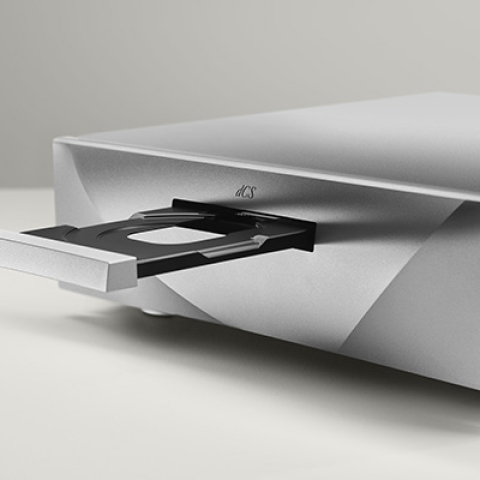
The sixth chassis contains a CD/SACD transport that had not been released at press time and so was not reviewed. The tray mechanism is the same as in the Vivaldi transport, but everything else has been redesigned.
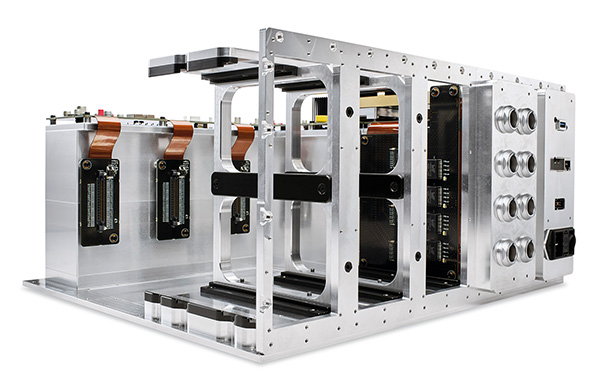
Inside the machined alloy case of the Varèse Core showing the (screened) main PSU and USB-A/Ethernet digital inputs (far right) with ruggedized bays (near left) waiting for the optional digital I/O expansion modules to be fitted. (Photo: Paul Miller.)
Beyond those basic major components, Varèse includes:
The proprietary ACTUS cable system, said to greatly reduce clutter by combining audio, control, and timing (clock) signals in a single cable with its own connectors. Its six twisted pairs of copper cable—similar to an Ethernet cable—carry asynchronous and error-corrected audio signals, control signals, and a master clock signal via the patented dCS Tomix protocol.
A new, downloadable Mosaic ACTUS app (footnote 7) for iOS or Android, designed especially for Varèse, that enables playback from streaming services, USB stick, or (with the I/O Module) external computers, streamers, and network-attached storage (NAS). Networked servers must be UPnP compatible. The app helps with setup, guiding you through initial system update and remote configuration. It also detects audio sources and controls volume. Google Cast enables streaming from phone, tablet, or computer; you can also use it for multiroom casting with Cast-compatible speakers. Apple AirPlay, Roon, and Tidal Connect are other options.
The Mosaic ACTUS app enables you to configure all system options, audio sources, streaming services, local network inputs, Digital I/O Module inputs, and signal path settings including filters, conversion modes, and mappers. dCS offers six PCM filter choices, four usable DSD filter choices, three mapper choices, five conversion mode choices (DXD oversampling or DSD/DSD2/DSD4/DSD8 oversampling), absolute phase choice at the analog output, output voltage choice, and more. Thanks to Mosaic ACTUS, it's far easier to change these than in other dCS DACs and music systems. Everything is visible on the app—no more pushing buttons on the front panel—and filter settings have been blessedly simplified.
For the record, I stuck with my Vivaldi choices—6V output, Mapper 3, and DXD oversampling—and moved between PCM filters F3, F4, and F5 (footnote 8).
A completely new remote control with "capacitive touch glass screen and illuminated icons," which charges via USB-C and connects to the system with Bluetooth. Along with an iPad or computer outfitted with the Mosaic ACTUS app, it can control volume, playback, source selection, signal path (including specialized filter choices), customizable favorite settings, and display options.
An optional I/O Module, developed just in time for this review, which can be ordered with the Core or dealer-installed. My I/O Module included three AES inputs for units with AES or Dual AES outputs (eg, Vivaldi or Rossini CD/SACD transports), WCLK Out, S/ PDIF out, USB-B for connecting servers and computers, and RS-232 for corresponding ports on Rossini and Vivaldi transports.
Footnote 1: Vivaldi APEX remains in production and will receive a series of software upgrades this year.
Footnote 2: In both cases, I've chosen to forgo a CD/SACD transport. I haven't played a silver disc at home for at least two years. Instead, I have transferred most of my collection to file format and receive all music for review in file format.
Footnote 3: Lina, the name for the product range (network DAC, headphone amplifier, master clock) introduced in 2022, is an outlier of sorts in the dCS pantheon.
Footnote 4: For a short video explanation of Ring DAC technology, see youtu.be/UY5qkK5Moyk.
Footnote 5: Only DSD64 and 128 were available at the time of this review; the higher rates may be enabled by the time you read this.
Footnote 6: DSD is neither upsampled nor converted to PCM. Because DSD256 and DSD512 do not require any digital filtering on dCS's part, dCS users who currently prefer the sound of DXD upsampling—count me amongst them—will need to re-evaluate their preference once DSD256 and DSD512 are enabled.
Footnote 7: See dcsaudio.zendesk.com/hc/en-gb/article_attachments/17728273892380 for far more.
Footnote 8: F5 automatically defaults to F3 at certain sample rates.