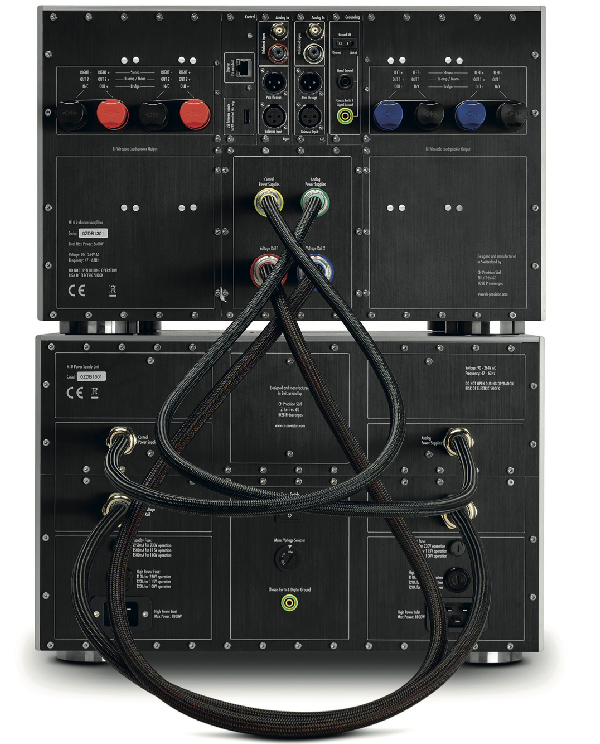
 The two units' back panels are not simple. To attempt to detail every connector would induce a soporific state in most readers and certainly this writer, so we'll just publish a photo and focus on the basics. On the back panel are two sets of speaker cable binding posts to facilitate biwiring, single sets of RCA, BNC, and XLR inputs, balanced XLR analog outputs for amplifier chain connection, an earth-ground socket, a ground-lift switch (footnote 2), and a signal-ground socket. And more.
The power supply's rear panel is simpler and less crowded. It includes a main power switch, two 20A IEC receptacles, easy-to-access fuse holders for the amp's high power and standby sections, and a few other usuals.
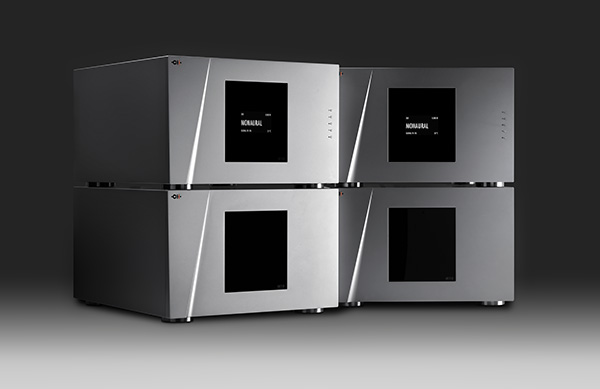
When you turn the amplifier on, the analog section's front panel displays an initializing/charging sequence. When it's complete, the "regular" user-programmable settings appear on the display.
The two units' back panels are not simple. To attempt to detail every connector would induce a soporific state in most readers and certainly this writer, so we'll just publish a photo and focus on the basics. On the back panel are two sets of speaker cable binding posts to facilitate biwiring, single sets of RCA, BNC, and XLR inputs, balanced XLR analog outputs for amplifier chain connection, an earth-ground socket, a ground-lift switch (footnote 2), and a signal-ground socket. And more.
The power supply's rear panel is simpler and less crowded. It includes a main power switch, two 20A IEC receptacles, easy-to-access fuse holders for the amp's high power and standby sections, and a few other usuals.
When you turn the amplifier on, the analog section's front panel displays an initializing/charging sequence. When it's complete, the "regular" user-programmable settings appear on the display.
 The sound
No matter what I threw at this pair of CH Precision M10s, they remained unfazed. The word "distortion" never crossed my mind. Control was so impeccable that, once I had retuned my system to its new room treatment, preamp options, and everything else, I was free to focus on the music I played. The M10s' ability to convey dynamic gradations and nuance equaled or excelled that of the best amplifiers I've had in my system. If I'm not making an absolute statement, it's for only one reason: Absolutes make little sense in the context of my room and system, which are constantly changing. Just as some opera queens speak of the evolution of operatic interpretation in the 20th century and beyond as BC and AC—Before Callas and After Callas—I can legitimately describe my system as BV/N and AV/N: Before and After dCS Varèse and Innuos Nazaré. One thing the M10 is not is an attention-seeker. While bass is well-controlled, it is not overwhelmingly powerful. Colors are true, but they are not of the strutting male peacock sort.
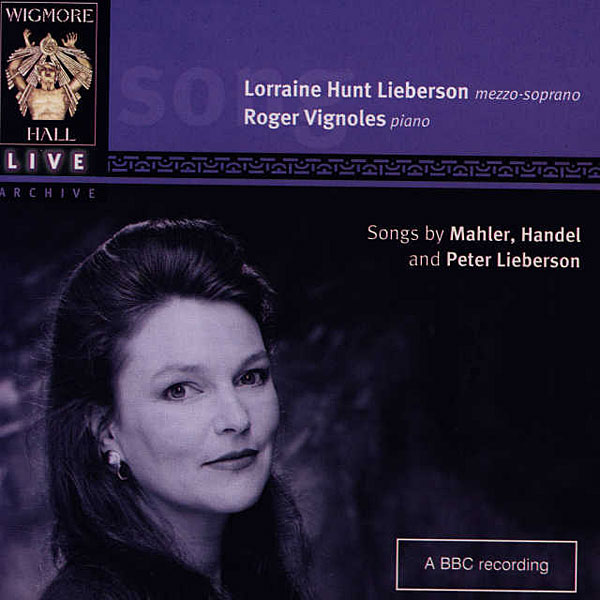 Just days before I began writing this review, I cued up Qobuz's 16/44.1 stream of her 1998 recital in London's Wigmore Hall, Songs by Mahler, Handel & Peter Lieberson (Wigmore Hall Live), accompanied by Roger Vignoles and issued by the BBC as WHLive0013. I still recall the night that, through the Gryphon Essence monoblocks I reviewed in December 2020, I was transported to what felt like another dimension by Hunt Lieberson's artistry during her performance of "Ich bin der Welt abhanden gekommen" (I am lost to the world) from Mahler's Five Rückert-Lieder. I've played this recording many times since, but it has never moved me as it did that night.
Until a few nights ago, that is, when I played all five of the Rückert Songs while stroking the only surviving member of "The Three Terrorers of Bell Street" canine clutch, the beloved Guy Luvberg. Hunt Lieberson's singing was so enrapturing, so filled with emotion and understanding, that I couldn't take notes. I sat in rapt silence hearing singer and piano so present, clear, and natural sounding that it felt as though I was sitting in one of the five front rows in Wigmore Hall. Nothing separated me from the holy reverence and sincerity that this great artist channeled through her voice and being.
Just days before I began writing this review, I cued up Qobuz's 16/44.1 stream of her 1998 recital in London's Wigmore Hall, Songs by Mahler, Handel & Peter Lieberson (Wigmore Hall Live), accompanied by Roger Vignoles and issued by the BBC as WHLive0013. I still recall the night that, through the Gryphon Essence monoblocks I reviewed in December 2020, I was transported to what felt like another dimension by Hunt Lieberson's artistry during her performance of "Ich bin der Welt abhanden gekommen" (I am lost to the world) from Mahler's Five Rückert-Lieder. I've played this recording many times since, but it has never moved me as it did that night.
Until a few nights ago, that is, when I played all five of the Rückert Songs while stroking the only surviving member of "The Three Terrorers of Bell Street" canine clutch, the beloved Guy Luvberg. Hunt Lieberson's singing was so enrapturing, so filled with emotion and understanding, that I couldn't take notes. I sat in rapt silence hearing singer and piano so present, clear, and natural sounding that it felt as though I was sitting in one of the five front rows in Wigmore Hall. Nothing separated me from the holy reverence and sincerity that this great artist channeled through her voice and being.
 I turned to another unforgettable diva of the same era, Janis Joplin. One of the greatest music experiences of my life was standing directly in front of her, maybe 50' away, as she performed an impromptu free concert under a gazebo in Lindell Park in St. Louis around 1968. Years later, after so much discussion of her vocal deterioration and early death from alcohol, drugs, and self-abuse, I'd forgotten how sweetly, softly, and subtly she could negotiate a phrase. Now, thanks to the M10s, I sat mesmerized during "Piece of my Heart (Take 6)," performed with Big Brother and the Holding Company on Sex, Dope & Cheap Thrills (24/88.2 FLAC, Columbia/Legacy/Qobuz), and her posthumously released "Me and Bobby McGee" from Pearl (24/96 FLAC, Columbia/Legacy/Qobuz). Again, nothing stood between me and the music.
That was a great night. Immediately after Janis, I played Ravel's two Mélodies hébraïques, sung by the great mezzo Cecilia Bartoli on her wonderful 30-year-old recital Chant D'Amour: Mélodies Françaises, with pianist Myung-Whun Chung (16/44.1 FLAC, Decca/Qobuz). I'd played this album many times in CD format in my prestreaming days, but I'd never heard any system maintain such a firm, effortless hold on the mezzo-soprano's voice when she opens and darkens her tone to emphasize the intense prayerful longing at the heart of "Kaddish," the Jewish prayer for the dead. The opportunity this system offered to appreciate the charge conveyed by the undertones in Bartoli's voice was remarkable.
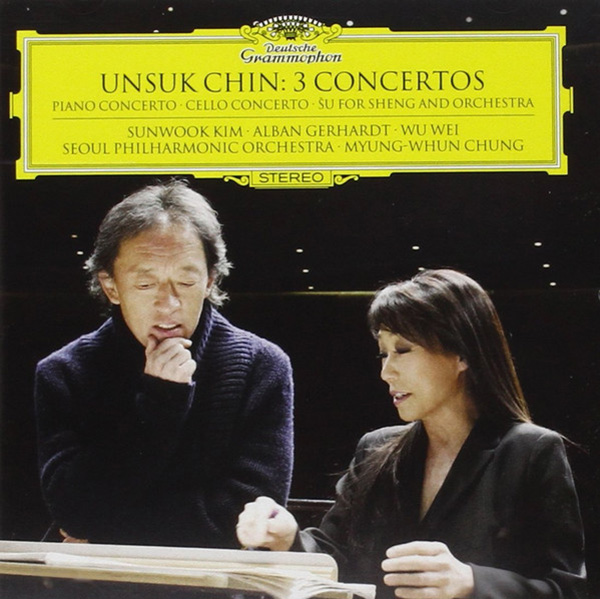
Let me not forget the startling experience of listening to the vehemence in Unsuk Chin's šu for Sheng and Orchestra, recorded live by Wu Wei and the Seoul Philharmonic Orchestra and conducted almost 20 years later by the same Myung-Whun Chung (footnote 5) (24/44.1 FLAC MQA, Deutsche Grammophon/Tidal). Want to revel in power as well as beauty? Try some heavy-duty orchestral fare through the M10s.
I turned to another unforgettable diva of the same era, Janis Joplin. One of the greatest music experiences of my life was standing directly in front of her, maybe 50' away, as she performed an impromptu free concert under a gazebo in Lindell Park in St. Louis around 1968. Years later, after so much discussion of her vocal deterioration and early death from alcohol, drugs, and self-abuse, I'd forgotten how sweetly, softly, and subtly she could negotiate a phrase. Now, thanks to the M10s, I sat mesmerized during "Piece of my Heart (Take 6)," performed with Big Brother and the Holding Company on Sex, Dope & Cheap Thrills (24/88.2 FLAC, Columbia/Legacy/Qobuz), and her posthumously released "Me and Bobby McGee" from Pearl (24/96 FLAC, Columbia/Legacy/Qobuz). Again, nothing stood between me and the music.
That was a great night. Immediately after Janis, I played Ravel's two Mélodies hébraïques, sung by the great mezzo Cecilia Bartoli on her wonderful 30-year-old recital Chant D'Amour: Mélodies Françaises, with pianist Myung-Whun Chung (16/44.1 FLAC, Decca/Qobuz). I'd played this album many times in CD format in my prestreaming days, but I'd never heard any system maintain such a firm, effortless hold on the mezzo-soprano's voice when she opens and darkens her tone to emphasize the intense prayerful longing at the heart of "Kaddish," the Jewish prayer for the dead. The opportunity this system offered to appreciate the charge conveyed by the undertones in Bartoli's voice was remarkable.
Let me not forget the startling experience of listening to the vehemence in Unsuk Chin's šu for Sheng and Orchestra, recorded live by Wu Wei and the Seoul Philharmonic Orchestra and conducted almost 20 years later by the same Myung-Whun Chung (footnote 5) (24/44.1 FLAC MQA, Deutsche Grammophon/Tidal). Want to revel in power as well as beauty? Try some heavy-duty orchestral fare through the M10s.
 Not every listening experience through the M10s was equally glorious. But even when they failed to transport, I still felt total admiration for the confidence and mastery with which they delivered what the recording engineers want us to hear.
Summing up
Not every listening experience through the M10s was equally glorious. But even when they failed to transport, I still felt total admiration for the confidence and mastery with which they delivered what the recording engineers want us to hear.
Summing upI've invoked the "A Mighty Fortress Is Our God" analogy numerous times over the years. Here, it's the only phrase that comes to mind that can encapsulate both the sheer physical presence of the M10 and its potential to convey the heavenly potential of notes on a page or screen. It's an amp capable of elevating God-given artistry to a level that countless acolytes strive to attain. If you have the means to obtain the M10, I urge you to give it the time and attention it deserves to determine if it is a match. For many financially fortunate audiophiles, it will be.
Footnote 2: We did not play with the M10's ground lift switch. Not only had we previously experimented with the L10's ground lift and found that the "Open" position sounded better, but Wolff also knew that "Open" nearly always sounded best on the M10. "You have signal ground connected to the amps by way of Pin 1 on the XLRs," he explained.