Sidebar 4: Measurements
In common with CH Precision's M1.1 amplifier, the M10 includes the facility to adjust feedback on the fly via the company's intuitive app. In the M1.1, feedback could be adjusted to the nearest 10%; in the M10, the adjustment has 1% increments. Of course, the "0% feedback" setting does not really mean "zero compensation" as there's always sufficient local feedback to manage the bandwidth, gain and stability of the M10's input and output stages.
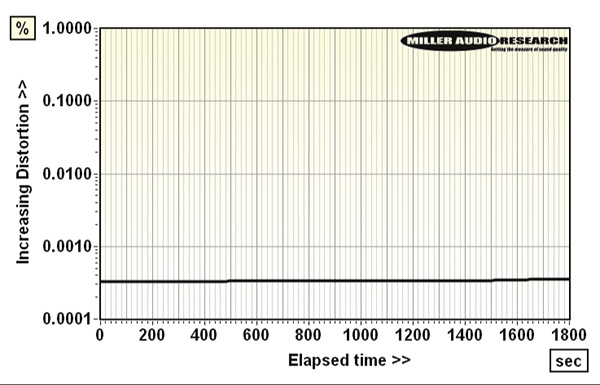
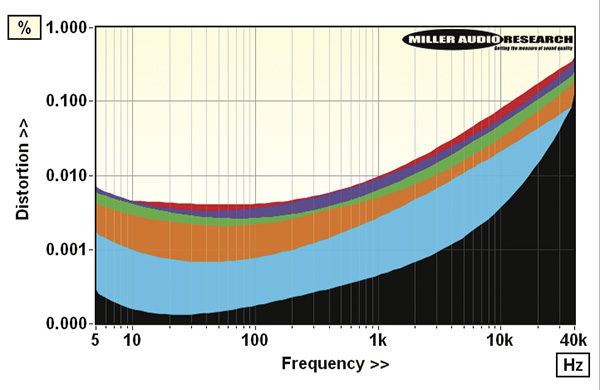
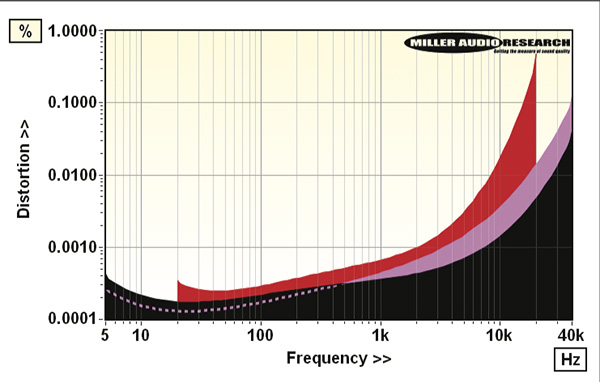
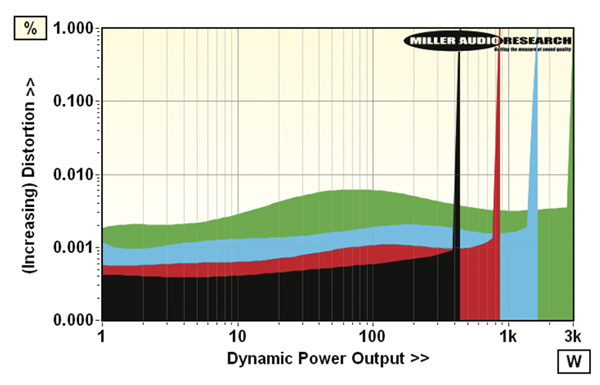
Fig.1 CH Precision M10, Distortion ref. 1kHz, 10W into 8 ohms output over 30mins (1800 seconds) from cold to 35°C internal heatsink temperature. The heatsink temperature stabilized at 43°C after one hour.
With feedback set to 100%, the M10 showed no significant sensitivity to changes in operating temperature. THD when cold was 0.00032%, increasing to 0.00034% as the temperature rose to 35°C (fig.1). Over the next 30 minutes, the heatsink temperature stabilized at 43°C, and THD settled back to 0.00032% (all ref. 1kHz/10W/8 ohms).
In the default "0.0dB" setting, overall gain is 23.5dB, requiring 3.26V from a balanced (XLR) source to raise the rated 300W into 8 ohms (24.8dBW). The M10's A-weighted S/N ratio was 106.6dB (ref. 0dBW). This is a remarkable result.
Fig.2 CH Precision M10, Distortion versus frequency, 5Hz–40kHz at 10W into 8 ohms. Black, 100% feedback; cyan, 80% feeback; orange, 60% feedback; green, 40% feedback; purple, 20% feedback; red, 0% feedback.
As expected, the "100%" global feedback setting delivered the lowest distortion (fig.2, black trace) and the lowest output impedance (0.006–0.017 ohm, 20kHz–20kHz). Switching to 80% feedback (fig.2, cyan trace) increased distortion from 0.00018–0.014% to 0.0007–0.042% (20Hz–20kHz/10W) and output impedance to 0.02–0.03 ohm. Decreasing further to 60% feedback (orange trace) gave 0.003–0.07% distortion and 0.037–0.04 ohm output impedance, respectively. At 40% (green trace) the M10's distortion is 0.004–0.1%; at 20% (purple trace), it was 0.0045–0.12%, and at 0% global feedback (red trace), distortion was 0.005–0.19% (all ref. 20Hz–20kHz, 10W into 8 ohms).
Note that fig.2 has a logarithmic Y axis, so the differences in distortion appear less significant with the lowest feedback levels. In fact there is a regular increase in THD with each 20% reduction in feedback. At the 0% feedback setting, the M10's output impedance rose to 0.075–0.086 ohm, offering roughly 11× less damping at low frequencies than with 100% feedback. All this feeds into the overall system sound.
Regardless of the feedback applied, the M10's response is flat to +0.0/–0.07dB into 8 ohms, –0.08dB into 4 ohms, and –0.10dB into 2 ohms (all ref. 20Hz–20kHz). With 0% feedback, there will be slightly more susceptibility to swings in the loudspeaker impedance. Otherwise, wideband, the frequency response has –1dB limits beyond 1Hz–100kHz into 8 ohms, while the dual-mono layout yields a superb 102dB stereo separation at 1kHz and 78dB at 20kHz.
Fig.3 CH Precision M10, Distortion versus frequency ref. 5Hz–40kHz at 1W into 8 ohms (black), 10W into 8 ohms (pink), and ref. 20Hz–20kHz at 100W into 8 ohms (red).
As a function of power output, with the M10's feedback set to 100%, distortion holds to 0.0003– 0.0006% limits from 1W to the rated 300W into 8 ohms at 1kHz and 0.0045–0.45% limits from 1W to 100W at 20kHz. Distortion is low but increases more markedly with increasing power at higher frequencies (fig.3). Talking of which, the M10's power output is generous in the extreme, comfortably exceeding its 300W rating at 395Wpc into 8 ohms (26.0dBW) and 710Wpc into 4 ohms (25.5dBW).
Fig.4 CH Precision M10, Dynamic power output (ref. 1kHz, 10ms) versus distortion into 8 ohms (black), 4 ohms (red), 2 ohms (blue), and 1 ohm (green).
Moreover, CH Precision's massive, multistage PSU has the capacity to support 435W, 850W, 1.64kW, and a full 3.04kW into 8, 4, 2, and 1 ohm loads, respectively, under dynamic conditions (fig.4). This represents a "clean" 55.1A of current (ref. 1kHz into 8 ohms for 10ms at 1% THD). Few power amplifiers are capable of higher output. Among those tested, the Gryphon Diablo 333 managed 3.1kW (55.7A), the Musical Fidelity Titan achieved 5.96kW (77.2A), the D'Agostino Relentless 800 attained 8.29kW (91.1A), and the full-blown monoblock Relentless flagship capped out in arc-welder territory at 11.325kW (106A)—all ref. 1kHz into 1 ohm, 1% THD. The M10 will surely be powerful enough to drive any loudspeaker that crosses its path.—Paul Miller