 Setup and use
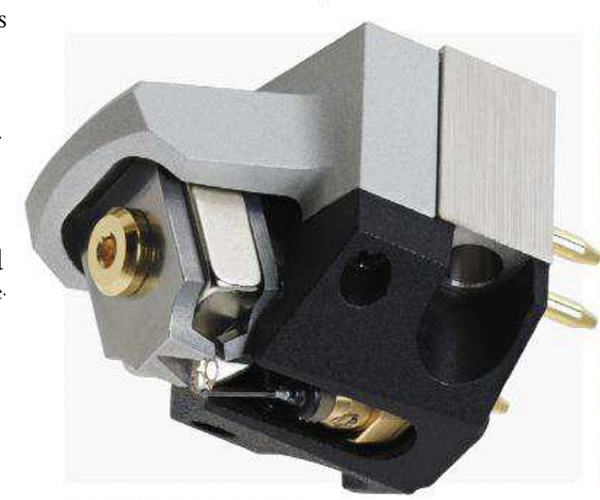
Though its headshell screws are inserted from the bottom up, threading into nuts atop the shell (as in Miyajima Laboratory cartridges), the AT-ART1000's securely locking stylus guard reduces anxiety during installation: Cleverly designed holes in the transparent-plastic guard let you install the cartridge with the guard in place. Still, setting overhang and tightly securing the cartridge to the shell with the supplied slotted screws can be tricky, unless you have a very short screwdriver. Setting zenith angle and overhang are more difficult, because the AT-ART1000's protruding pole piece/magnet structure blocks a clear view of the cantilever. It's doable, but it took me more time and care than the norm. The AT-ART1000's specified channel separation is 30dB. Using a digital oscilloscope and The Ultimate Analogue Test LP (Analogue Productions AAPT 1), and with the A-T's cantilever just shy of perpendicularity, I measured 27dB (L–R) and 27.5dB (R–L). A few dB short of spec in this regard isn't unusual, and in this case I don't consider the AT-ART1000's unusual design to be the reason. I'm happier that the excellently small difference of 0.5dB was achieved with the cantilever close to perpendicular. A stylus rake angle (SRA) of 92° was achieved with the Swedish Audio Technologies tonearm about 4mm higher than strictly parallel with the record surface. In short, the build quality was as it should be for a $5000 cartridge.
We're often mesmerized by claimed improvements in sound produced by new, unique designs such as the AT-ART1000. The benefits of generating the signal directly from the stylus movements are obvious. Coils at the cantilever's rear will exhibit far smaller movements in response to stylus deflections, and thus generate less output, than coils placed directly atop the stylus. Errors will be magnified, in ways roughly analogous to the ways longer tonearms magnify small errors in alignment. However, placing the coils and wires atop the stylus adds mass at the stylus end of the cantilever, where the action is. So, as with all things in life and audio, there are theoretical trade-offs.
The sound of Audio-Technica's AT-ART1000 was as advertised: rim-drive–like punch and authority; lightning-fast, superclean transients; and transparency that made many "normal" cartridges sound milky or foggy in the midrange. If you like a soft, warm, romantic sound, you might find the AT-ART1000 a bit in-your-face—but it wasn't at all bright, harsh, or analytical.
 In fact, its speed and precision produced the opposite effect. Lush recordings—for example, a reissue of Linda Ronstadt's What's New (LP, Asylum/Analogue Productions APP 073) mastered by the late Doug Sax—sounded sweeter and even lusher than I'd expected. And that was after playing an original UK pressing of the Clash's London Calling (UK LP, CBS Clash3) that produced spectacularly clean and crisp (a word I use rarely and cautiously) cymbals and snares, and emphatic and tautly drawn bass.
I was expecting the Ronstadt reissue to be somewhat lean and disappointing; it was anything but. The reissue is far superior to Sax's original 1983 mastering, which was thinner in the mids, leaner on bottom, less transparent, and definitely less dynamic overall. Ronstadt's voice was round, well textured, detailed, and articulate—about as convincingly there in my room as I've heard it.
In fact, its speed and precision produced the opposite effect. Lush recordings—for example, a reissue of Linda Ronstadt's What's New (LP, Asylum/Analogue Productions APP 073) mastered by the late Doug Sax—sounded sweeter and even lusher than I'd expected. And that was after playing an original UK pressing of the Clash's London Calling (UK LP, CBS Clash3) that produced spectacularly clean and crisp (a word I use rarely and cautiously) cymbals and snares, and emphatic and tautly drawn bass.
I was expecting the Ronstadt reissue to be somewhat lean and disappointing; it was anything but. The reissue is far superior to Sax's original 1983 mastering, which was thinner in the mids, leaner on bottom, less transparent, and definitely less dynamic overall. Ronstadt's voice was round, well textured, detailed, and articulate—about as convincingly there in my room as I've heard it.
 Recordings of classical and jazz were equally well served. Jascha Heifetz and cellist Gregor Piatigorsky's Heifetz-Piatigorsky Concerts (LP, RCA Living Stereo LSC-2770/Impex IMP 6025) is one of the better original RCA Dynagroove recordings from 1964. (Of course, in his remastering for this reissue, Kevin Gray didn't use the Dynagroove process.) It demonstrated just how fast, yet naturally rendered and smooth, were the AT-ART1000's transients, and confirmed its tonal neutrality and harmonic precision. Heifetz's violin had commendable sheen and woody textures, Jacob Lateiner's piano at stage left was impressively presented in every way, but especially in terms of transient clarity. Its honest reproduction of the sound of this recording should convince anyone that the AT-ART1000 can do its thing naturally and transparently, and especially without tipping up the top end. It's one of the most tonally neutral cartridges I've heard. I'm still waiting for digital to sound as convincing as LPs like this one.
The AT-ART1000 tracked well, was quiet in the groove, and, overall, was commendably transparent, producing wide swings of macrodynamics that, while perhaps not equal to those of the Lyra Atlas, managed to combine the Ortofon Anna's tonal neutrality with the Ortofon A95's retrieval of detail. In fact, as impressed as I was by the AT-ART1000's transparency, punch, and precision, I was even more impressed by its tonal neutrality and honesty—which perhaps even verged on being slightly rolled-off on top, like a properly set up Ortofon Windfeld.
Recordings of classical and jazz were equally well served. Jascha Heifetz and cellist Gregor Piatigorsky's Heifetz-Piatigorsky Concerts (LP, RCA Living Stereo LSC-2770/Impex IMP 6025) is one of the better original RCA Dynagroove recordings from 1964. (Of course, in his remastering for this reissue, Kevin Gray didn't use the Dynagroove process.) It demonstrated just how fast, yet naturally rendered and smooth, were the AT-ART1000's transients, and confirmed its tonal neutrality and harmonic precision. Heifetz's violin had commendable sheen and woody textures, Jacob Lateiner's piano at stage left was impressively presented in every way, but especially in terms of transient clarity. Its honest reproduction of the sound of this recording should convince anyone that the AT-ART1000 can do its thing naturally and transparently, and especially without tipping up the top end. It's one of the most tonally neutral cartridges I've heard. I'm still waiting for digital to sound as convincing as LPs like this one.
The AT-ART1000 tracked well, was quiet in the groove, and, overall, was commendably transparent, producing wide swings of macrodynamics that, while perhaps not equal to those of the Lyra Atlas, managed to combine the Ortofon Anna's tonal neutrality with the Ortofon A95's retrieval of detail. In fact, as impressed as I was by the AT-ART1000's transparency, punch, and precision, I was even more impressed by its tonal neutrality and honesty—which perhaps even verged on being slightly rolled-off on top, like a properly set up Ortofon Windfeld.