Denmark has probably contributed more to loudspeaker technology than any other country in the world. Vifa, Dynaudio, ScanSpeak, and Peerless driversused in a huge variety of speakersare all Danish. Products from companies such as JBL, Spendor, Linn, B&W, Celestion, KEF, Audio Physic, ProAc, and others are partially or wholly made in the little Scandinavian nation.
System Audio originated in 1984, when guitarist and electronics technician Ole Witthoft grew dissatisfied with the lack of realism he heard from most home audio systems and figured he could do better. He built some speakers for himself and for a few friends, with encouraging results. It's a familiar story: we all know competent hobbyist speaker builders. A few of them gain a bit of local notoriety, but most never venture further than making a few units for friends and relatives.
But Witthoft's reputation grew rapidly, and so did his business. Fourteen years later, his little startup has become a serious player in the loudspeaker market, with annual production in excess of 18,000 units.



 As a privileged reviewer-type person, I was sent the souped-up, all-rosewood, bi-wirable version that sells for $2905/pair. They're quite handsome and very solidly built, weighing in at a respectable 50 lbs each. At $2275$2905/pair, the Baton is Swans' most affordable speaker, and reportedly employs many of the technical refinements of their larger, more costly models.
The Baton uses the tried-and-true two-way dynamic design, with a 7" coated-paper woofer and a 1" fabric-dome tweeter. The tweeter comes with a little Marigo dot stuck to its center to shape its response. It's not a physically easy task for a woofer to reproduce (well) all the frequencies from about 60Hz up to about 2 or 3kHz. One that succeeds is a nice find, though, because the sound has a nice coherence to it when most of the music is coming from the same driver. But don't take my word for itjust look how many zillions of two-way speakers there are out there.
As a privileged reviewer-type person, I was sent the souped-up, all-rosewood, bi-wirable version that sells for $2905/pair. They're quite handsome and very solidly built, weighing in at a respectable 50 lbs each. At $2275$2905/pair, the Baton is Swans' most affordable speaker, and reportedly employs many of the technical refinements of their larger, more costly models.
The Baton uses the tried-and-true two-way dynamic design, with a 7" coated-paper woofer and a 1" fabric-dome tweeter. The tweeter comes with a little Marigo dot stuck to its center to shape its response. It's not a physically easy task for a woofer to reproduce (well) all the frequencies from about 60Hz up to about 2 or 3kHz. One that succeeds is a nice find, though, because the sound has a nice coherence to it when most of the music is coming from the same driver. But don't take my word for itjust look how many zillions of two-way speakers there are out there.
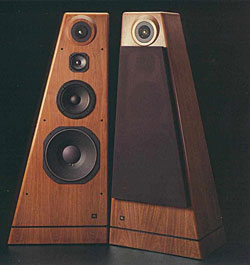 Once upon a time, in audio's infancy, anyone who wanted better than average soundaverage sound during the 1940s being rich, boomy and dullhad no choice but to buy professional loudspeakers. In those days, "professional" meant one of two things: movie-theater speakers or recording-studio speakers. Both were designed, first and foremost, to produce high sound levels, and used horn loading to increase their efficiency and project the sound forwards. They sounded shockingly raw and harsh in the confines of the typical living room.