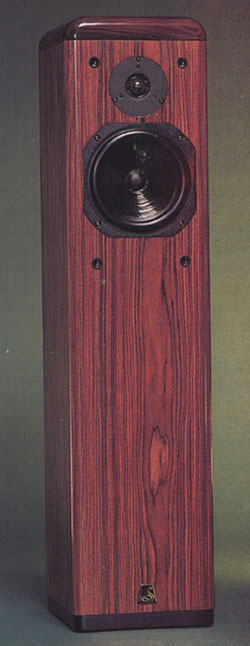
 As a privileged reviewer-type person, I was sent the souped-up, all-rosewood, bi-wirable version that sells for $2905/pair. They're quite handsome and very solidly built, weighing in at a respectable 50 lbs each. At $2275–$2905/pair, the Baton is Swans' most affordable speaker, and reportedly employs many of the technical refinements of their larger, more costly models.
The Baton uses the tried-and-true two-way dynamic design, with a 7" coated-paper woofer and a 1" fabric-dome tweeter. The tweeter comes with a little Marigo dot stuck to its center to shape its response. It's not a physically easy task for a woofer to reproduce (well) all the frequencies from about 60Hz up to about 2 or 3kHz. One that succeeds is a nice find, though, because the sound has a nice coherence to it when most of the music is coming from the same driver. But don't take my word for it—just look how many zillions of two-way speakers there are out there.
The cabinets of these speakers are quite dead, meaning they shouldn't add too much garbage to the sound coming from the drivers. The walls are 1" thick and braced on the inside, and the edges of the cabinet are rounded to reduce detrimental diffraction effects. In a nice touch, Swans puts the crossover inside a sub-compartment to isolate the components from internal sound waves. The drivers are sonically matched in pairs at the factory prior to assembly, after which the speakers are submitted to lengthy break-in calisthenics. After break-in, the speakers are tested again. Then they're shipped out, and you get to test 'em.
Sound
As a privileged reviewer-type person, I was sent the souped-up, all-rosewood, bi-wirable version that sells for $2905/pair. They're quite handsome and very solidly built, weighing in at a respectable 50 lbs each. At $2275–$2905/pair, the Baton is Swans' most affordable speaker, and reportedly employs many of the technical refinements of their larger, more costly models.
The Baton uses the tried-and-true two-way dynamic design, with a 7" coated-paper woofer and a 1" fabric-dome tweeter. The tweeter comes with a little Marigo dot stuck to its center to shape its response. It's not a physically easy task for a woofer to reproduce (well) all the frequencies from about 60Hz up to about 2 or 3kHz. One that succeeds is a nice find, though, because the sound has a nice coherence to it when most of the music is coming from the same driver. But don't take my word for it—just look how many zillions of two-way speakers there are out there.
The cabinets of these speakers are quite dead, meaning they shouldn't add too much garbage to the sound coming from the drivers. The walls are 1" thick and braced on the inside, and the edges of the cabinet are rounded to reduce detrimental diffraction effects. In a nice touch, Swans puts the crossover inside a sub-compartment to isolate the components from internal sound waves. The drivers are sonically matched in pairs at the factory prior to assembly, after which the speakers are submitted to lengthy break-in calisthenics. After break-in, the speakers are tested again. Then they're shipped out, and you get to test 'em.
SoundWhen I set up the Batons in the "minimized room modes" position that worked well with my B&W 804s, their bass was a little boomy. I realized that, since these speakers are rear-ported, I'd have to check all the wall distances to the ports, as well as to the woofers. This meant twice as much work and trickier problem-solving than was required by the Thiel CS1.5 and Unity Audio Signature Mk.3 speakers that I also review this month, whose woofers, ports, and passive units were lined up more or less vertically. Not to worry, though—an inch this way, a couple inches that way, and all the numbers worked out oh-taay.
 Steve Tibbetts' recent masterpiece The Fall of Us All (ECM 1527), is a wonderfully weird album with one of the most diverse collections of instruments I've heard: rock'n'roll guitars, New Age-y synthesizers, and ethnic Asian instruments and drums. Tibbetts' gift for composition really turns me on, and his creative and masterful use of his analog studio doesn't hurt, either. Through the Swans, I heard less detail than with my reference B&Ws. The Swans seemed to give everything a warm, wooden quality, which helped the hand drums to sound quite realistic, but metallic instruments came out sounding a bit muffled. The lower-midrange detail was actually fairly good, and the bass was fairly tight, but there appeared to be information missing from the upper mids on up.
The Batons' bass sounded less extended than that of the Thiels or B&Ws. They went down almost as low, but their midbass was a bit recessed. With Dorian Records' Sampler II (DOR-90002), I had the impression that the bass was slightly too lightweight. Though in general the Batons' bass had good speed, with little overhang, their upper bass somewhat obscured the midbass, making the bass viols and organ pedals difficult to pick out. The bass coloration overall is not that large; I'm just pointing out minor flaws.
Steve Tibbetts' recent masterpiece The Fall of Us All (ECM 1527), is a wonderfully weird album with one of the most diverse collections of instruments I've heard: rock'n'roll guitars, New Age-y synthesizers, and ethnic Asian instruments and drums. Tibbetts' gift for composition really turns me on, and his creative and masterful use of his analog studio doesn't hurt, either. Through the Swans, I heard less detail than with my reference B&Ws. The Swans seemed to give everything a warm, wooden quality, which helped the hand drums to sound quite realistic, but metallic instruments came out sounding a bit muffled. The lower-midrange detail was actually fairly good, and the bass was fairly tight, but there appeared to be information missing from the upper mids on up.
The Batons' bass sounded less extended than that of the Thiels or B&Ws. They went down almost as low, but their midbass was a bit recessed. With Dorian Records' Sampler II (DOR-90002), I had the impression that the bass was slightly too lightweight. Though in general the Batons' bass had good speed, with little overhang, their upper bass somewhat obscured the midbass, making the bass viols and organ pedals difficult to pick out. The bass coloration overall is not that large; I'm just pointing out minor flaws.
I wanted to like the Swans Baton a lot. It's so well made and looks so good, you just automatically expect great things from it. But I can't recommend the Baton for music-lovers in general. Their sound just did not offer a clear enough view into the recording—or, by extension, into the original performance—for them to be competitive at this price. Their lack of treble detail, reduced ambience, and midrange colorations take them out of contention for neutral transducer honors (footnote 1). Nevertheless, people who have very specialized collections of nothing but over-bright, over-processed rock and pop music might want to give the Batons a listen. Why should you buy the relatively wimpy Swans as your dedicated rockin' speakers, when you could have 15" woofers? Because, silly, those monstrosities are usually crossed-over too high in frequency, so that they're dragging their slow 15" butts all over the midrange. Well, not in my midrange you don't! Kickdrum, guitars, and voices all sound way better when most of their sound comes from a single, fast woofer. And remember, swans may look pretty, but they can attack if provoked. Rock On!
Footnote 1: I think Swans gave the Baton the wrong name. Can you visualize James Levine waving one of these things as the first and second cellists move to the rear of the orchestra in the interest of saving their lives? On the other hand, I could totally see Gene Simmons swinging one around his head at a KISS concert, while he spits blood and sings "What is my charisma...is it my body or my brain?" The nice "burnt wood" patterns on the speaker would go well with Gene's dragon-face makeup, too. If you were a sly little reader, you might suspect that I had other reasons to rename this speaker. You might be right.—Muse Kastanovich