Audacious Audio

Sort By:  Post Date TitlePublish Date

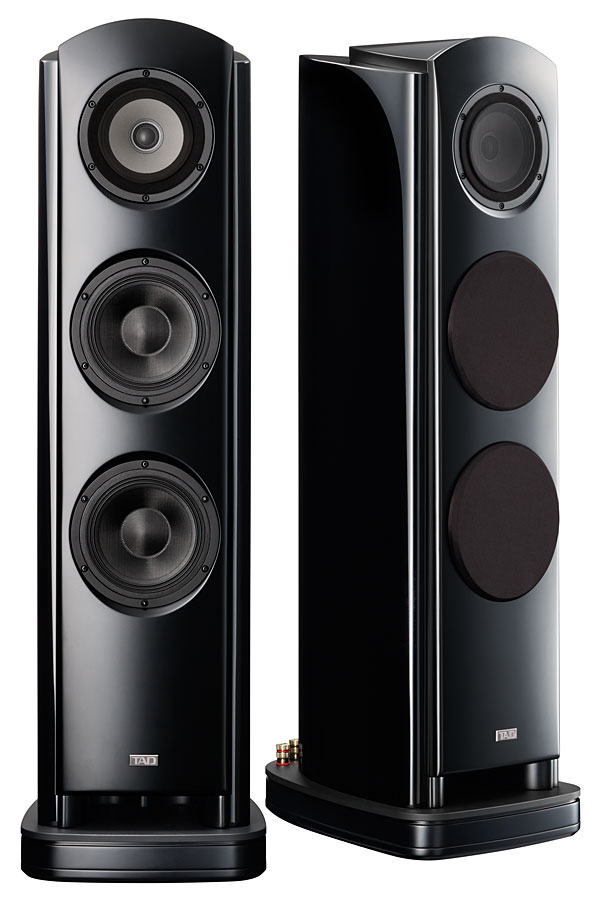
TAD Evolution One loudspeaker

I had been anticipating getting to audition a pair of TAD loudspeakers in my system since the introduction of the original TAD Model-1, in 2003. It was designed by Andrew Jones, who had recently assumed the mantle of chief designer at Technical Audio Devices Laboratories (TAD), at that time a subsidiary of Pioneer. Although TAD dates back to the mid-1970s, its research and development efforts had been focused on the professional sound market, something that continues. Jones came from a long line of speaker innovators at KEF and was assigned the goal of developing state-of-the-art speakers for the domestic market.

YG Acoustics Sonja 1.3 loudspeaker

The advertisements run by Colorado manufacturer YG Acoustics in 2008, when it launched its flagship loudspeaker model, the Anat Reference II Professional, unequivocally claimed it to be "The best loudspeaker on Earth. Period." They caused a stir. The YGA speaker cost $107,000/pair at the time of Wes Phillips's review in the March 2009 issue. Wes didn't disagree with the claim, concluding that, "Like my pappy used to say, it ain't braggin' if you can actually do it."

Simaudio Moon Evolution 880M monoblock power amplifier

In the September 2005 issue (Vol.28 No.9), I reviewed Simaudio's first reference-quality power amplifier: the 1000W, 220-lb Moon Rock monoblock ($37,000/pair). At the time, the Rock was a dramatic departure for Simaudio, then primarily known as a maker of midpriced gear that was good for the money. I found a lot to like about the Rock, concluding that while it wasn't quite up to the standard of the best superamps of the time, it was very good—and, for Simaudio, an admirable first shot at the state of the art.

TAD C600 line preamplifier

In the early 1970s, Stereophile's founder, J. Gordon Holt—a man I used to describe, with all due respect, as having been clothed by the haberdasher to the homeless—said that Audio Research's SP-3 tubed preamplifier was "the closest thing available, in fact, to the ideal straight wire with gain" ie, it would amplify the signal without editorializng in any way. Back then, the SP-3 cost $595. Today it would cost around $3500. But TAD's C600 dual-mono, solid-state, balanced preamplifier costs more than 10 times that: $42,000.

Music First Audio Baby Reference passive preamplifier

In April 1987, Anthony H. Cordesman had mixed feelings about the Mod Squad Passive Line Drive System Control Center. (Read his review here.) Introduced in 1984, the Line Drive offered volume and balance controls, five line-level inputs, and switching and monitoring for two tape decks. You didn't plug it into the wall; it provided no gain. Was it even a proper preamp? (footnote 1)

AHC demurred. "I'm not sure that I'm ready to advise anyone to take the risk of not buying a unit with a top-quality phono stage, no matter how well CD or DAT perform," he concluded, between commenting on Middle East wars.

Pass Laboratories XP-30 line preamplifier

It was the strangest thing. In the fall of 2008 I was comparing Ayre Acoustics' then-new KX-R line preamplifier with no preamplifier at all—I was feeding the power amplifier directly with the output of the Logitech Transporter D/A processor. (Levels were matched for the comparisons, of course, made possible by the fact that the Transporter has a digital-domain volume control.) Being a rational being, I knew that the active circuitry of a preamplifier, as well as the extra socketry and cables, would be less transparent to the audio signal than a single piece of wire. I wanted to determine by how much the Ayre preamp fell short of that standard.

Ypsilon Aelius monoblock power amplifier

I knew nothing of Ypsilon when I first saw its products in a room at an overseas audio show. Even though the speakers in this system were complete unknowns, I was convinced that it was the electronics that were responsible for the magical balance of what I was hearing. That was confirmed when I reviewed the VPS-100 phono preamplifier in August 2009 and PST-100 Mk.II preamplifier in July 2011.

Artemis Systems Eos Signature loudspeaker & Base Module

666Artemis_Eos.jpgThough the original Artemis Systems Eos has been around for a few years, it doesn't seem to have made a big impression on audiophiles. Judging by a brief but exciting audition of the new Eos Signature and its accompanying Base Module at HI-FI '96, I found it hard to understand how it could remain such a well-kept secret. A few weeks later, to my surprise, Wes Phillips asked me if I wanted to review a pair and, throwing caution to the winds, I jumped at the opportunity. Rash move.

The movers delivered three large boxes and two absolutely huge crates. Inside the boxes were the two Eos Signatures and their external crossovers. Each crate contained a Base Module, and their appearance struck fear into my heart. I had gone too far—each one weighed 300 lbs, and together they were more commodious than some apartments in my Manhattan neighborhood. I signed for the delivery, then panicked when I realized there was no way to get these unpacked before my wife came home. Indeed, I didn't know how I was going to do it at all.

Advertisement
Advertisement
Advertisement