

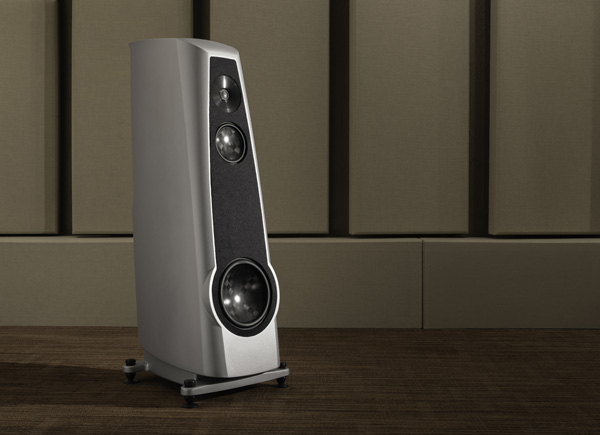
Rockport Technologies Lynx loudspeaker
Music often brings me joy, awe, and, if I'm lucky, something close to transcendence, but it's not my only route there. A few years ago, on a sunny January day in Madrid's Prado museum, I went looking for Hieronymus Bosch's The Garden of Earthly Delights.
Rockport Technologies Merak II loudspeaker & Sheritan II subwoofer
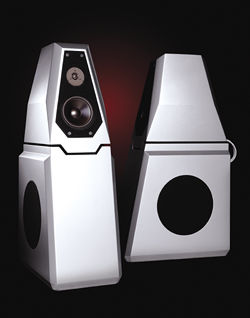
No one has ever accused Rockport Technologies' Andy Payor of under-engineering a product, and this set of gleaming black beauties is no exception. The system is available in two configurations: as the two-way Merak II for $19,500/pair, including sturdy custom cradle-stands with integrated crossover; and as the Merak II/Sheritan II, a three-way, two-box floorstander that, to afford them at $29,500, will reduce some to living in the speakers' shipping crates. You could do worse for housing than checking into the Sheritan Rockport: The wooden crates are almost exquisitely finished.
Sennheiser HD800 headphones
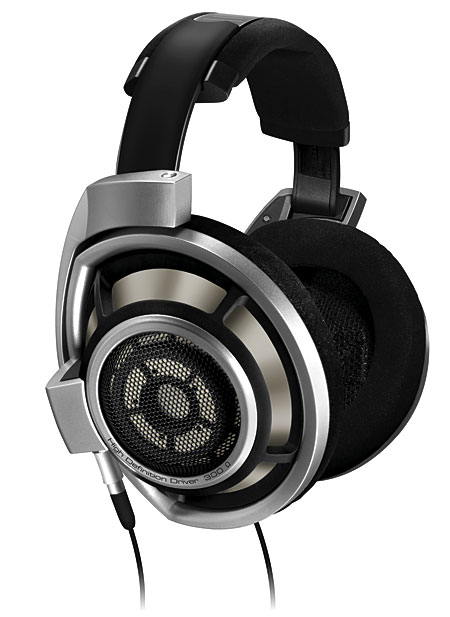
Sennheiser's long-awaited (seven years) HD800 sure isn't subtle—at least, not in appearance. The HD800's large earpieces are made from a combination of absorbing composites and functional metal accents, and are huge. Of course, they have to be to house the 56mm ring-radiator transducers—and to mount them so they're firing "back" to your ears from the front. Also not subtle is the price: $1399.95.
Sennheiser Orpheus HE 90 headphones
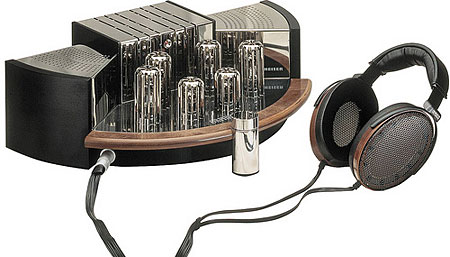
While headphone listening remains secondary to that of loudspeakers for most serious listeners, it's still an important alternative for many. And while good conventional headphones exist, electrostatics are usually considered first when the highest playback quality is required. As always, there are exceptions (Grado's headphones come immediately to mind), but most high-end headphones are electrostatic—such designs offer the benefits of electrostatic loudspeakers without their dynamic limitations. Last">http://www.stereophile.com/headphones/koss_esp950_electrostatic_stereop… year I reviewed the Koss ESP/950 electrostatics (Vol.15 No.12), a remarkable set of headphones from the company that practically invented headphones for serious home listening. Here I listen to examples from two other companies, each known for its headphones since Pluto was a pup.
Shindo Aurieges Equalizer Amplifier
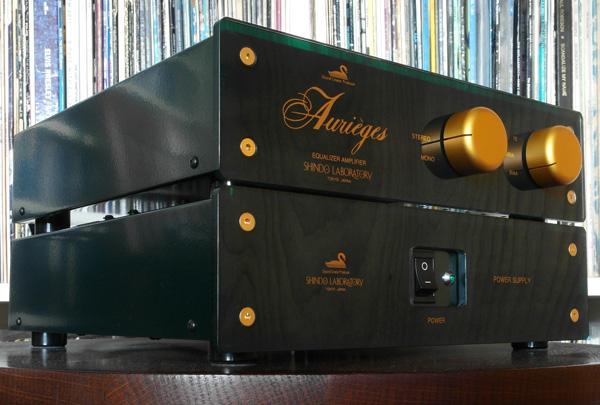
At some point within the last few years of his life, the late Ken Shindo designed an outboard phono preamplifiera decision perhaps made inevitable by his earlier decision to answer popular demand with line-only versions of the Aurieges and the more upmarket Vosne-Romanee preamps...
Shure KSE1500 electrostatic in-ear headphone system
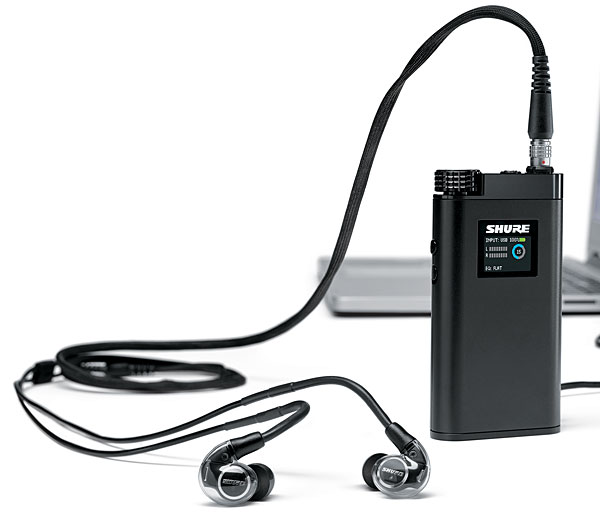
I wrote several issues back that my first high-end headphones were Koss Pro4AAs, which I bought in 1972 following a positive review in the British magazine Hi-Fi News. Although that review didn't mention that the Pro4AAs were relatively fragile (footnote 1), I nonetheless loved their sound. They were the best headphones I'd hearduntil, a couple years later, I was playing bass on some sessions for record producer Tony Cox. Tony had a pair of signal-energized electrostatic headphones, Koss ESP-6es, which were heavy and clunkybut they opened my ears to the sound quality that could be obtained from "cans." I didn't hear better until after I'd moved to Santa Fe, in 1986, and J. Gordon Holt loaned me his review samples of the Stax SR-Lambda Pros.
Siltech SAGA power amplifier
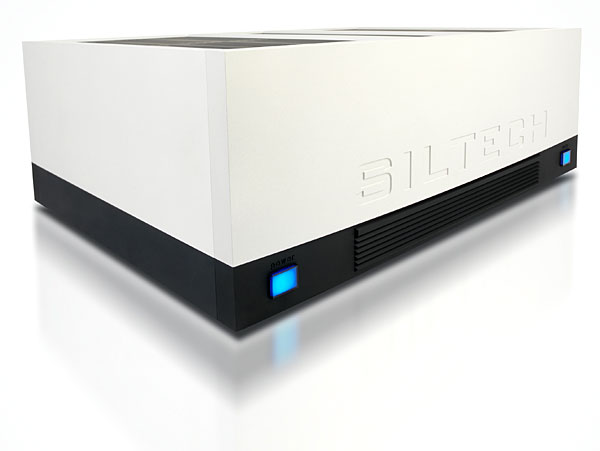
Among the biggest buzzes at the January 2013 Consumer Electronics Show, and at Munich's High End Show the following May, was the sound in the room of Siltech BV, a Dutch company best known for its high-end cables. Siltech was demonstrating an innovative new power amplifier, and using it to drive the company's glass-cabineted Arabesque loudspeakers ($90,000/pair). The sound was unmistakably lush yet also remarkably linear, notably dynamic, and seemingly free of electronic artifacts. It sounded like the sound of "nothing"which was really something!and so much of a something that it caught the attention of many reviewers. But while there's often controversy and disagreement about a given product's sound quality, this time the enthusiasm seemed unanimous.
Simaudio Moon Evolution 820S power supply

Can a power-supply upgrade produce audible sonic benefits? If you've upgraded the power supply of a phono preamplifier, you probably don't need to be convinced that it does, and those usually cost only a small percentage of the price of the model they power. But to add Simaudio's Moon Evolution 820S power supply ($8000) to the Moon Evolution 650D DACCD transport ($9000), which I reviewed in the November 2011 issue, almost doubles the latter's costthough the 820S can be used to simultaneously power two Moon Evolution components, like the 750D DAC ($14,000), 740P preamplifier ($9500), and 610LP ($7500) and 810LP phono preamplifier ($13,000).
Simaudio Moon Evolution 850P line preamplifier
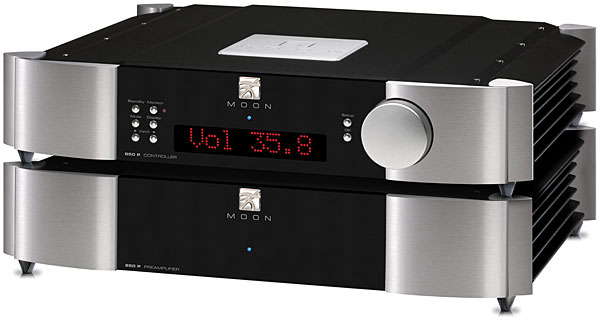
When I reviewed Simaudio's Moon Evolution 880M monoblock amplifier for the June 2013 issue, I communicated via phone and e-mail with the company's VP of marketing, Lionel Goodfield. When the topic of hearing the 880Ms at their best came up, I could almost imagine him shrugging as he said, "Just use it with the most transparent, revealing preamp you can find." Not surprisingly, he then went on to say that Simaudio's own Moon Evolution 850P would serve nicely in that role. My cynical side might normally have discounted any such suggestion from a marketing man, but I'd been hearing the same sort of thing from other sources. And, as it happened, there was an 850P at Stereophile World Headquarters . . .
Simaudio Moon Evolution 880M monoblock power amplifier

In the September 2005 issue (Vol.28 No.9), I reviewed Simaudio's first reference-quality power amplifier: the 1000W, 220-lb Moon Rock monoblock ($37,000/pair). At the time, the Rock was a dramatic departure for Simaudio, then primarily known as a maker of midpriced gear that was good for the money. I found a lot to like about the Rock, concluding that while it wasn't quite up to the standard of the best superamps of the time, it was very goodand, for Simaudio, an admirable first shot at the state of the art.