

Pathos InPoL Legacy integrated amplifier
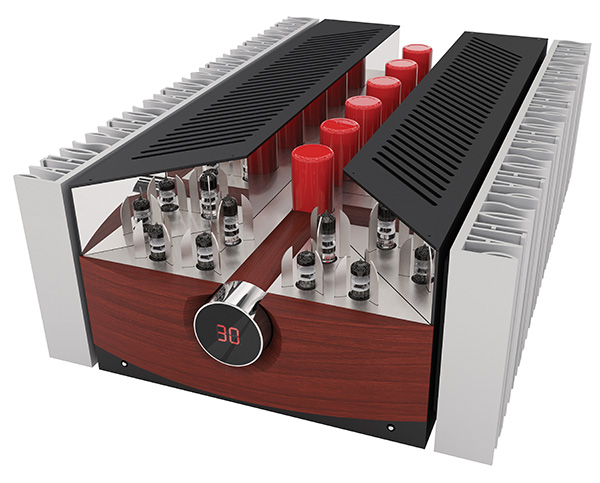
Back when gasoline had lead in it and amplifiers came with circuit diagrams in the back of the manual, there was an unspoken understanding that power meant weight. A professional camera was a Graflex Speed Graphic or a Hasselblad 1000F, built like a small battleship and nearly as heavy. Powerful car engines were cast-iron V8s with cylinders you could stick a fist in. And of course, serious amps had transformers that could double as boat anchors.
These days, amplifier design often emphasizes efficiency. Class-D amps in particular have come a long way. Many are terrific, and they're undeniably practical. But there's still something uniquely satisfying about a design that prioritizes timeless expression over economy of electricity or space.
The Pathos InPoL Legacy, a class-A design, is unapologetically massive and so gloriously overbuilt that moving it requires a tactical plan and a chiropractor.
Philips LHH1000 CD player
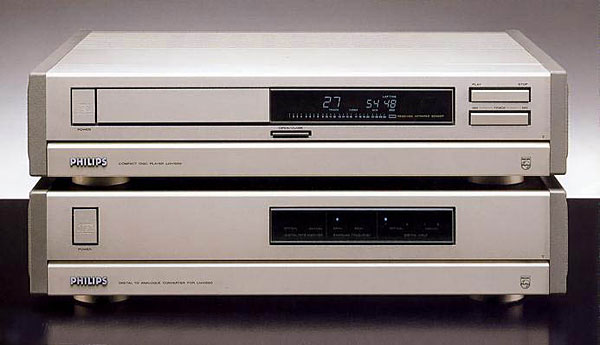
Externally, the LHH1000 came as a bit of a surprise to these jaded eyes, over-familiar with plain black or brushed-aluminum boxes. Each enclosure is finished in an almost white, anodized finish, with greenish-gray endcaps (made from zinc alloy, I believe) painted with a nubbly, crackle finishan attractively utilitarian styling with shades of military-surplus radio equipment, nicely set off by subdued blue fluorescent readouts. Internally, the units are constructed to audiophile standards. The transport uses Philips's top CDM-1 mechanism, which is fabricated from diecast aluminum, compared with the plastic CDM-4 mechanism which appears in less expensive and less well-specified players. The loading tray, too, which is made from metal, has a reassuringly solid feel to it.
Piega Coax 811 Gen2 loudspeaker
It's funny how we discover some music in unexpected, twisting ways. A friend recently sent me the real estate listing for a beautiful home in Deer Isle, Maine, about an hour from where I live. I gawked at the pictures and calculated I'd need to work for Stereophile for another 127 years before I'd have enough dough to buy it. Then I noticed something unusual on one of the walls of the place: lots of gold records. Google helped me figure out that the house had belonged to the late singer-songwriter Dan Fogelberg. I knew the name but was unfamiliar with his music. Minutes later, I was playing the studio version of "Nether Lands," seemingly named after my country of birth. A beautifully orchestrated piece with restrained woodwinds and soaring strings, it reminded me of the best of Van Dyke Parks and of some postPet Sounds Brian Wilson songs. I played it straight through three times.
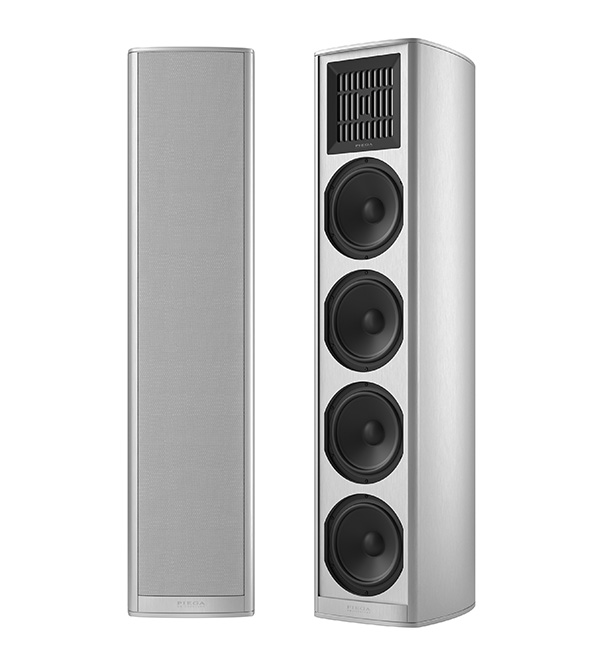
Part of the reason I was so smitten with the recording lay in the engaging, naturalistic presentation it received from the handmade-in-Switzerland Piega Gen2 811 floorstanders ($30,000/pair) that had just made their way to my listening room.
Playback Designs MPS-5 SACD/CD player
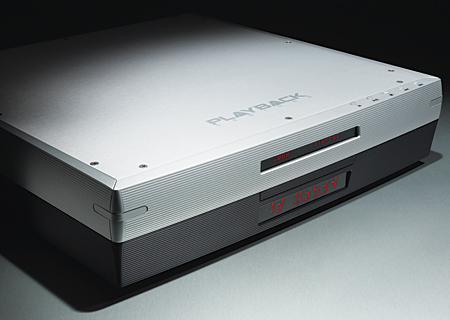
Playback Designs was founded less than three years ago. However, with the release in 2008 of its MPS-5 Music Playback System—a slim, full-featured SACD/CD player and DAC that costs $15,000 and is built in the US—the company has since established itself as a significant player in high-performance digital audio.
Plinius Reference A-150 power amplifier
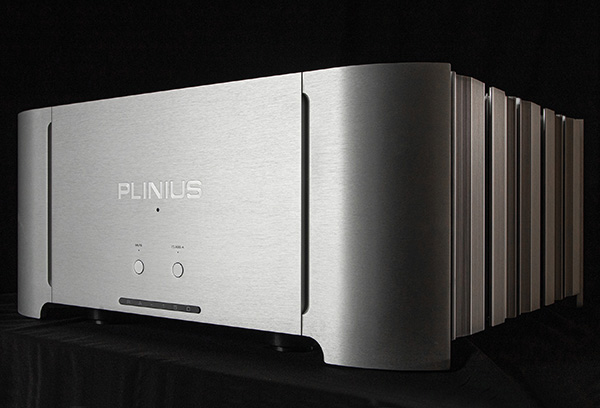
When Jim Austin offered the Plinius Reference A-150 stereo amplifier ($14,995) for review, it felt like a welcome blast from the past. Plinius has, lately, maintained a low profile in the US, likely due to several changes in US distributorship...Under the auspices of Ralph Abramo and California-based Plinius Audio Sales and Repair, Plinius's US profile seems to be rising again.
Proceed CD Library
I think I've finally figured out the secret of Stereophile's success. You, cherished reader, don't read this mag because it's chock full o' reviews of tantalizing audio gear (even though it is). And you don't read this mag because JA and RL strive so hard to keep the literary quotient as hi as the fi (even though they do). And I know you don't read this mag cuz trusting yer own sensory input is a mighty scary proposition indeed so you look to Stereophile as to a Holy Bible that eases your Earthly burden by telling you, Ah say Ah say TAILING YEW what to buy (do you?).
Raidho TD3.8 loudspeaker
In my high-school days, I visited a friend whose well-to-do dad proudly demonstrated his new Quad ESL system for us. First up was a recording of a man with heavy footsteps traversing the space from left to right. Next came a speeding police car, siren engaged, complete with Doppler tail. I found it impressive, and a little lame at the same time. My friend and I, in love with our own artsiness, preferred Fear of Music by Talking Heads and Drums and Wires by XTC, or (in a pinch) U2's Boy.
It wouldn't have occurred to me that I'd ultimately derive frequent joy from listening to sound effects (though in my case they're usually integral to the music, not apart from it). When I hear Yosi Horikawa's bouncing marbles on Wandering, I prick up my ears and smile. A panting dog on Holly Cole's Temptation, an overhead hovercar on the Blade Runner 2049 soundtrack ... bring it on. A babbling river on Andrew Bird's Echolocations; seed pods on Tom Waits's Blood Money; liquid splashes and crinkling paper on Felix Laband's Dark Days Exit ... yes, please. I don't care if it's a little gimmicky. It's also sensual in the original meaning of the word, an aural pleasure.
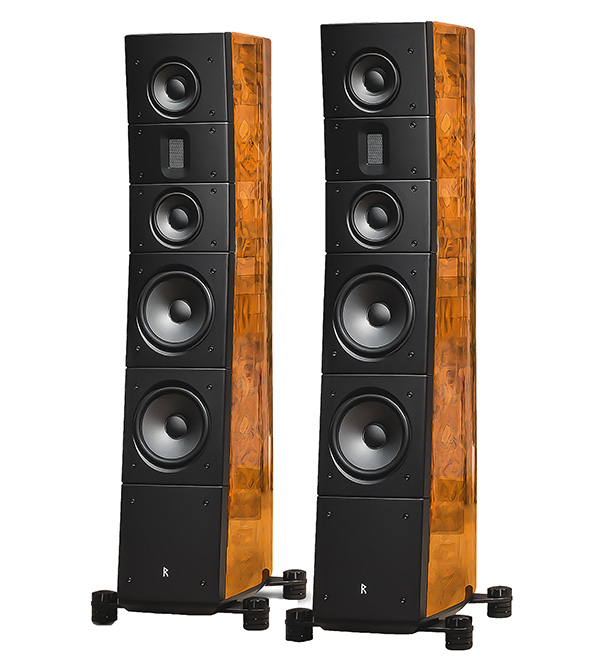
The Raidho TD3.8 speakers that, after three months, just departed my home, do the trick of conjuring points in space with great acuity.
Revel Ultima Rhythm2 powered subwoofer
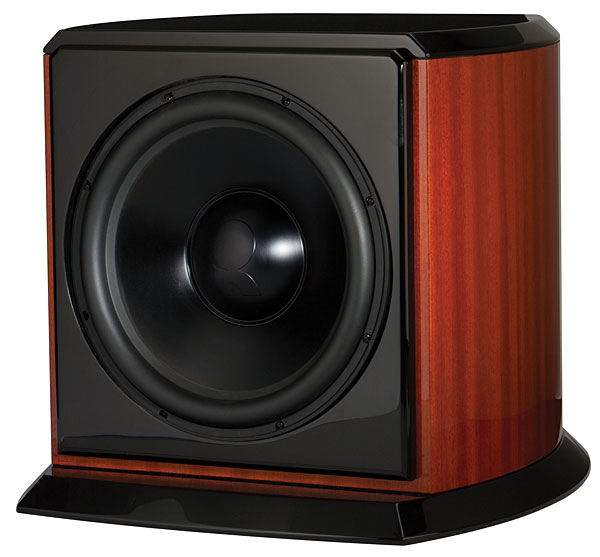
Powerful, massive, and expensive, Revel's Ultima Rhythm2 subwoofer ($10,000) swept me off my feet when I first saw it in Harman International's suite at the 2013 Consumer Electronics Show. It outsizes, by 49 lbs and 2.6 cubic feet, Revel's previous flagship model, the Ultima Sub30, which I reviewed in the November 2004 issue. Its specs read like no other sub's: 196 lbs; 18" cast-frame woofer; dual 4" voice-coils; 4kW peak power from twin internal amplifiers that generate 1kW RMS; 115dB peak acoustic output; a fully configurable, high-resolution, 10-band parametric equalizer (PEQ); an internal crossover with high- and low-pass outputs; and PC-based setup via USB. The Rhythm2's patent-pending design is said to let just enough air move in and out of the cabinet to prevent any distortion-inducing pressure due to heating of the voice-coils. And its veneer, shape, beveled top edges, and bottom plinth exude the quality found in Revel's top-of-the-line floorstanding speaker, the Ultima Salon2, with which I was familiar.
Rockport Technologies Antares loudspeaker
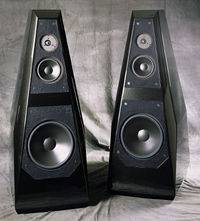
Antares is a giant red star in the constellation Scorpio. According to Rockport Technologies' Andy Payor, the $41,500/pair Antares loudspeaker is the "ultimate" reasonably sized, full-range loudspeaker, and is built to a standard "unequaled in the industry." Rockport's $73,750 System">http://www.stereophile.com//analogsourcereviews/258/">System III Sirius turntable came with equally boastful claims that turned out to be anything but hyperbole. Has Rockport done it again with the Antares?
Rockport Technologies Avior II loudspeaker
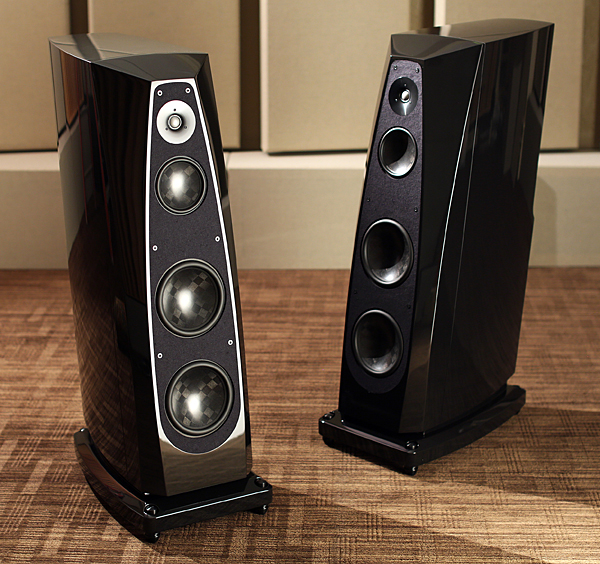
Following my review of the floorstanding Magico S5 Mk.II last February, I spent some time with two-way stand-mounted speakers from Aerial Acoustics, Bowers & Wilkins, and Dynaudio. As much as I appreciated the small speakers' virtues, I found myself missing the big Magico's bass extension and ability to play loud; my next loudspeaker review, therefore, would be of another floorstander.
It's been a while since we published a review of a Rockport Technologies loudspeaker.