

Tannoy Churchill loudspeaker
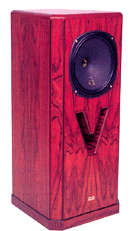
Really Big Hi-Fi came to live with me for a couple of months this past spring in the form of a pair of Tannoy Churchill loudspeakers. They were trucked directly to San Rafael, California from Kitchener, Ontario, in flight cases so bulky they could double as coffins for NFL offensive linemen. Once ensconced chez moi, the Tannoy dreadnoughts provoked bewilderment, alarm, curiosity, envy, admiration, awe, and amazement in all who heard and saw them.
Tannoy Dimension TD12 loudspeaker
My friend Harvey">http://www.stereophile.com/showarchives.cgi?409">Harvey Rosenberg, who had more clever ideas in a day than most of us have in a lifetime, was a Tannoy loudspeaker enthusiast. I, on the other hand, had little experience with the brand before 1995, when Harvey invited me to come over and hear his then-new Tannoy Westminster Royals.
Tannoy Stirling Prestige Gold Reference loudspeaker
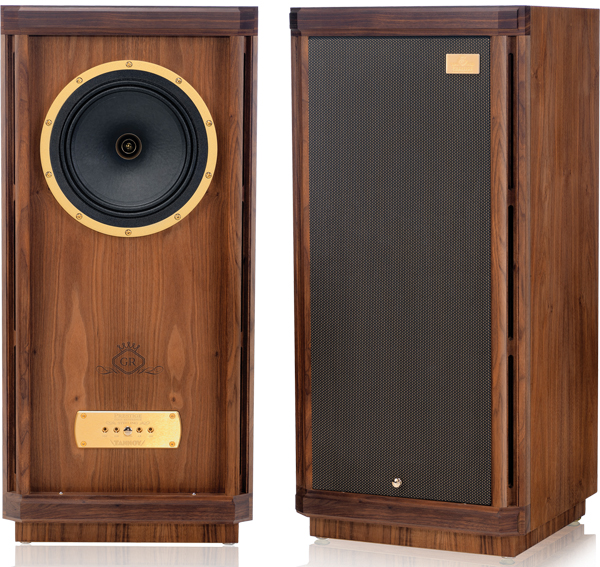
Founded in 1926 by Guy R. Fountain in London as the Tulsemere Manufacturing Company, Tannoya portmanteau (footnote 1) of "tantalum" and "alloy," after a tantalum-lead alloy used in rectifierstook on its current commercial identity in 1928. Through the war years and beyond, the company specialized in public-address (PA) systems. Indeed, today, "tannoy" is a widely recognized generic term for a PA system in the UK; there's an entry for "tannoy" in the Oxford English Dictionary.
TDL Studio 1 loudspeaker
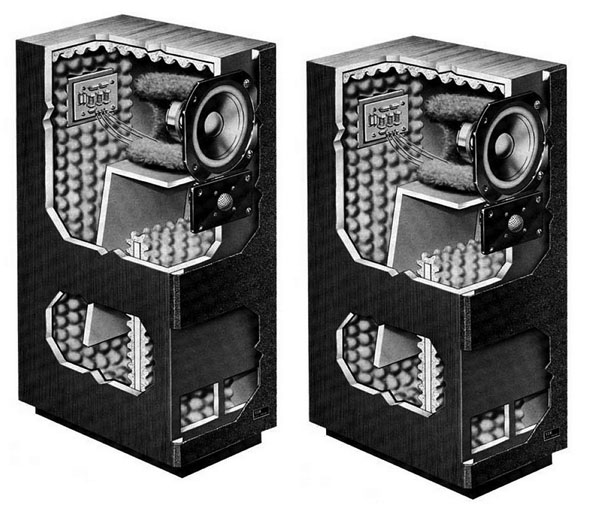
TDL is part of ELAC, one of the most successful OEM drive-unit manufacturers in the UK, particularly renowned for the 1" aluminum-dome tweeter that they make for Monitor Audio, Acoustic Energy, and British Fidelity. Perhaps of even more interest to readers of Stereophile is that the TDL system designer is one John Wright, who designed the classic series of IMF loudspeakers and who also was one of the leading equipment reviewers in the UK back in the 1960s. (For a while John was also a contributor to this magazine, his comprehensive reviews of tonearms appearing in Vol.2 Nos.10 & 12.)
Tekton Design Enzo XL loudspeaker
The CD era was well underway. Rudy Giuliani was about to sweep the crack hoes and squeegee humans off New York's garbage-filled streets. Disney was conquering Times Square. It seemed the perfect time for artists and audio weirdos like myself to go underground. Seeking economic sustainability, I hunkered down in my Seaport bunker and started a little business called Eddie Electric. I found a 23-year-old Japanese business partner named Ryochi who was dealing in big-E Levi's, bubble-back Rolexes, and antique Abarth cars. He was my Seaport, New YorkAkihabara, Tokyo connection.
Tekton Moab Be loudspeaker
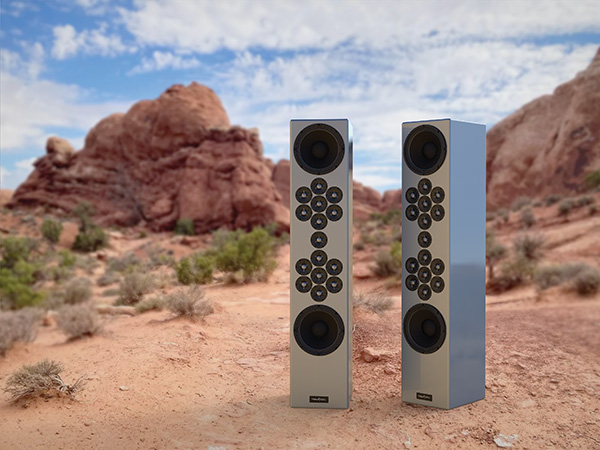
All photos by Rogier van Bakel. Compositing by David Evett.
For Christmas in 2020, a friend sent me a gift: a coffee mug decorated with a one-out-of-five-stars rating for the annus horribilis the world had just been through. The caption on the ceramic read, "VERY BAD WOULD NOT RECOMMEND."
True, the pandemic year and the lockdowns had been no fun, to put it mildly, but that doesn't mean there were no positives. Every day, rain or shine, my 10-year-old daughter and I played soccer on the field behind our house. Wepointlessly, I concedetrained our shepherd to walk backward on command. I savored having more time to read, watch movies, and take naps when the urge struck. Finally, I used the long stretch of weeks, then months, to rekindle my lifelong infatuation with music. Thousands of old and new recordings kept me balanced and tethered me to the rest of humanity during the dark days of social distancing. Rarely had music soothed and comforted me more than during the 10 months before the vaccines arrived.
My musical appreciationreverence at timeswas due in part to the new Tekton Moab floorstanders . . .Tetra 505LTD loudspeaker
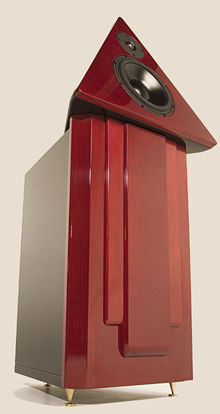
Tetra Speakers may not be a familiar name to many US audiophiles. Based in Ottawa, Ontario, the company has been around for a decade, but has taken a slow and steady approach to building its visibility in the insanely competitive and trend-conscious world of high-end loudspeakers.
The Fifth Element #35

The relationship between many audiophiles and well-sung, well-recorded female vocal tracks is like the relationship between alcoholics and alcohol—or between, apparently, quite a few congresspersons and unworked-for money. The sentence, "Thank you, but I really have had enough already," is seldom heard. In defense of our hobby, buying and setting up stereo equipment so that gorgeous singing can enthrall you does no one any harm, and arguably does much good. "Beauty is truth," and all that.
The Fifth Element #36
Were I trying to make a living by giving piano recitals, David Stanhope's new CD, A Virtuoso Recital (Tall Poppies TP184), just might tempt me to wash down a fistful of pills with a bottle of Scotch. The saving grace being that Stanhope seems to have enough things to occupy himself with in his native Australia. The risk of his showing up in New York City and playing a recital, thereby giving a lot of people existential crises and sleepless nights, seems remote.
The Fifth Element #59
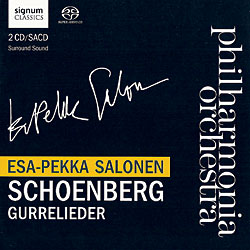
There's a fantastic new two-SACD/CD set of a demonstration-quality live recording of a rather obscure work you really should get to know, not only for its own merits, but also for what I believe is its underappreciated but major influence on music and on popular culture. The piece is by 20th-century composer Arnold Schoenberg, but trust me—it's more than "listenable." It (or, at least, the music on the first disc) is beyond engaging; it is compelling—a revelation, even. The work is Gurrelieder (Songs of Gurre), Gurre being a castle in medieval Denmark that was the setting of a real-life doomed love triangle, the story of which has since loomed large in the moodily brooding artistic consciousness of Danes. The 19th-century Danish poet Jens Peter Jacobsen wrote a collection of poems based on medieval legends, including this one, and a German translation by Robert Franz Arnold provided Schoenberg's dramatic texts.