

Thiel CS2 loudspeaker
The latest edition of Audio's annual equipment directory lists 238 speaker manufacturers. At best I can claim to have heard one product from 10–15% of the manufacturers on this list, and the top of the current product line from a far smaller percentage.
Thiel CS2.3 Loudspeaker
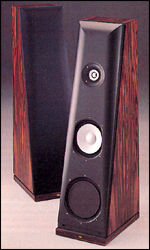
On the occasion of a recent major birthday, my significant other, Bonnie, gave herself a "mid-life crisis" present—a beautifully restored, bright yellow Porsche 911. She'd spent the previous several weeks wading through reference books to figure out exactly which year and model she wanted, and each night we'd discuss the pros and cons of various models, options, and points in the 911's +30-year evolution. Bonnie explained to me that, throughout its production run, the 911 maintained the same basic design and a consistent set of engineering goals, but was continually updated and refined. In her mind, the 1973 Targa was the one to have, the last and fastest of the lightweight 2.4-liter models.
Thiel CS2.4 loudspeaker
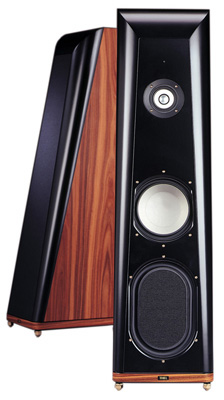
Jim Thiel sounded almost bored. "Almost everything about the CS2.4 is pretty standard stuff—short-coil, long-gap, low-distortion drivers, aluminum diaphragms, polystyrene capacitors, spatial coherence, time coherence, reduced diffraction baffles, reduced cabinet vibration, etc., etc. Of course, I think the execution of the 2.4 is more successful than our previous models, but in terms of what's really different, that mechanical crossover is what's special."
Thiel CS3 loudspeaker
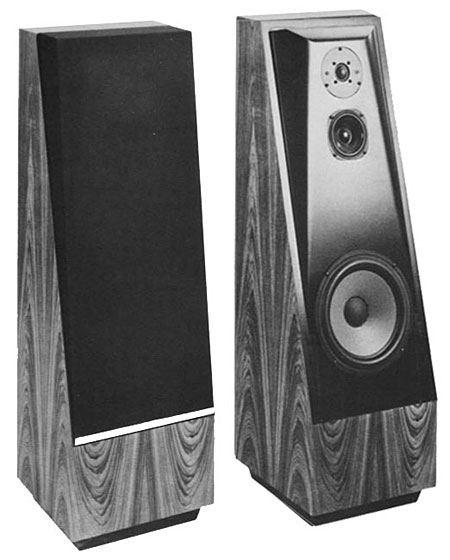
Thiel is one of those loudspeaker manufacturers, like Spica and Dahiquist, among others, that pay close attention to detail.
Thiel CS3.5 loudspeaker
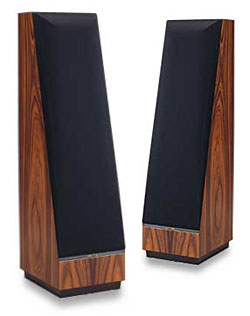
Frankly it's a bit nutty for me to be doing this review. First, as Publisher of this esteemed journal, my primary duties involve financial and personnel management, as well as a good bit of public relations; I don't need and am not required to perform the exacting tedium of product reviews. Second, Jim">http://www.stereophile.com/interviews/221">Jim Thiel and Kathy Gornik of Thiel are friends of mine. So what, you ask? Well, if this were going to be a uniformly positive review, I would therefore be ruled out as the reviewer; if it's to be wholly or partially negative, it will surely put a strain on one of my best audio friendships.
Thiel CS3.6 loudspeaker
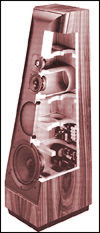
Choosing a loudspeaker can be difficult. Although it is easy to be seduced by a certain model's special qualities, that exceptional performance in one area is often at the expense of other important characteristics. Go with high-quality minimonitors for their spectacular soundstaging, but give up bass, dynamics, and the feeling of power that only a large, full-range system can provide. If you choose an electrostatic for its delicious midrange transparency, you may have to forgo dynamics, impact, and the ability to play loudly. Pick a full-range dynamic system for its bass and dynamics, but lose that edge of palpability and realism heard from ribbon transducers.
Thiel CS3.7 loudspeaker
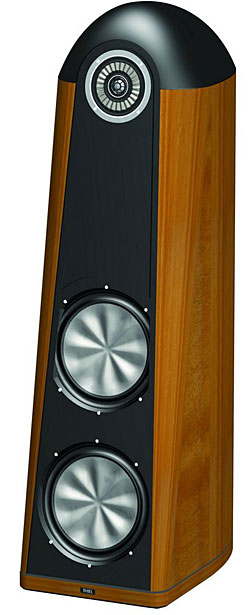
One might argue that Thiel Audio's 3-series loudspeakers are the audio equivalents of BMW's 3-series sports cars: relatively affordable, but 100% about performance. Thiel has made bigger, more expensive loudspeakers than the 3s, as well as smaller, less expensive models—but the iconic Thiels are the 3s.
Thiel CS5 loudspeaker
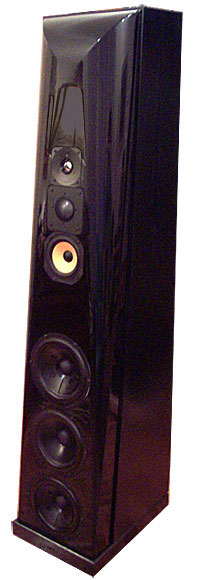
John Atkinson Opens
I've said it before and I'll say it again: a would-be loudspeaker designer shouldn't even start to think about the possibility of maybe designing a full-range, multi-way loudspeaker until he (and they do all appear to be men) has cut his teeth on a small two-way design. There is still as much art as science in designing a successful loudspeaker, even with all the computer-aided this and Thiele-and-Small that, that even a two-way design requires a designer either to be possessed of a monster talent or of the willingness to undergo months, even years, of tedious and repetitive work—or of both. For a would-be speaker engineer to start his career with a wide dynamic-range, multi-way design, intended to cover the entire musical spectrum from infra-bass to ultra-treble, seems to me to be a perfect case of an admittedly well-intentioned fool rushing in where any sufficiently self-critical angel would fear to tread.
I've said it before and I'll say it again: a would-be loudspeaker designer shouldn't even start to think about the possibility of maybe designing a full-range, multi-way loudspeaker until he (and they do all appear to be men) has cut his teeth on a small two-way design. There is still as much art as science in designing a successful loudspeaker, even with all the computer-aided this and Thiele-and-Small that, that even a two-way design requires a designer either to be possessed of a monster talent or of the willingness to undergo months, even years, of tedious and repetitive work—or of both. For a would-be speaker engineer to start his career with a wide dynamic-range, multi-way design, intended to cover the entire musical spectrum from infra-bass to ultra-treble, seems to me to be a perfect case of an admittedly well-intentioned fool rushing in where any sufficiently self-critical angel would fear to tread.
Thiel CS6 Loudspeaker
A reviewer's life is not all fame and fortune. There are downsides, too, one of which is that, while many great-sounding components pass through your listening room, only a few get to stay there on anything like a permanent basis. (And that involves money changing hands, as in [gasp!] "purchase.") Before I bought my long-term reference loudspeakers—a pair of B&W John Bowers Silver Signatures—back in 1994, the speakers that had spent the most time in my 2900-cubic foot listening room were a pair of Thiel CS2 2s. I reviewed the '2 2 in the January 1993 issue of Stereophile (Vol.16 No.1), and although it was relatively affordable ($2250/pair at the time of the review), it did most of what I wanted a speaker to do. Other than a limited dynamic range in the bottom audio octave and a slightly exaggerated top octave, the CS2 2 sounded effortlessly smooth and free from coloration throughout the midrange and treble. It was also a real imaging champ.
Thiel CS7.2 loudspeaker
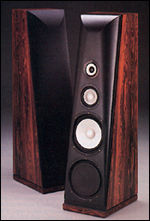
When I describe the Thiel CS7.2 to friends, the word that gets the biggest reaction is "simple." Veteran audiophiles protest, noting the big Thiel's multiple drivers, complex cabinet, and elaborate, zillion-element crossover. Nonaudiophiles just glance at the 5'-tall speaker, smile sympathetically at Bonnie, and roll their eyes.