

The Mission System
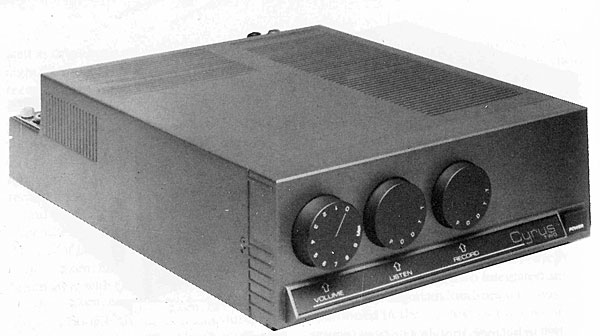
Since its founding just over ten years ago, Mission Electronics has grown to become one of the largest "real" hi-fi companies in the UK. Although their product line originally consisted of three relatively conventional loudspeakers, it rapidly grew to encompass high-end pre- and power amplifiers, cartridges, tonearms, and turntables, and, in the mid 1980s, a system concept based on CD replay and relatively inexpensive electronics: the Cyrus amplifiers and tuner.
The Waveform Loudspeaker
John Ötvös, the father of Waveform Research Inc. and The Waveform Loudspeaker, hesitates not at inviting ultracritical examination: "The Waveform is the most accurate, the best, forward-firing loudspeaker in the world." Period. Reviewers, of course, welcome such statements, and I'll be examining that one, but I'll also try to answer the inherent reviewing question of whether the Waveform is a good place for you to park $9800 on your way to "the highest of high-end sound" (that was our slogan for the first Santa Monica High End Hi-Fi Show).
Thiel Audio SCS4T loudspeaker
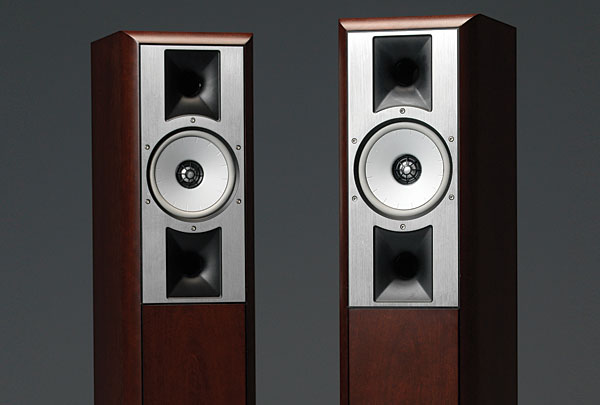
Sometimes, the words of the prophets are written on the subway walls and tenement halls. Other times, their words and ideas are made manifest through a lifetime of diligent and thoughtful work. As an audio prophet, the late Jim Thiel was one of the latter type. For decades he stood in his pulpit, quietly preaching to the audio world the importance of time and phase coherence in loudspeakers. His commitment to these ideas led to speaker designs that exclusively used first-order crossover networks, and driver designs and layouts that made possible time- and phase-coherent response. The speakers he created in turn built his company, Thiel Audio, into one of the more recognizable fixtures of high-end audio.
Thiel Audio TT1 loudspeaker
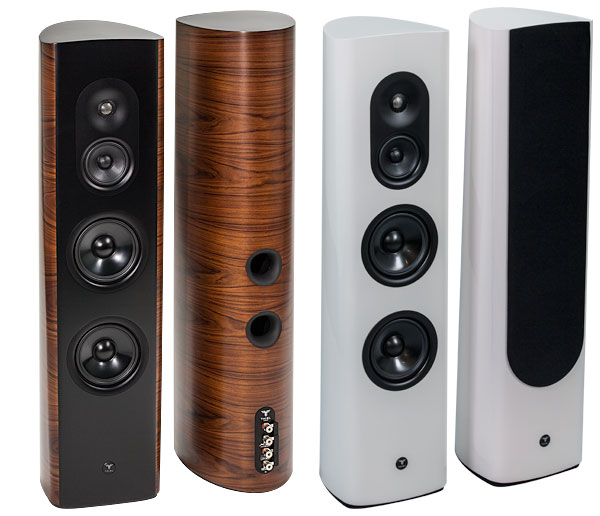
Thiel Audio's CS3.7 loudspeaker was launched, to much fanfare, in 2006. Like most of Jim Thiel's designs, the CS3.7 received universal praise, but it was Jim's swan song. No one could predict that he would pass away in 2009, undoubtedly leaving on his desk many future designs.
But more was in the cards forand fromThiel Audio. The company was sold in 2012 to a private equity company based in Nashville; soon thereafter Thiel Audio moved to that city from Lexington, Kentucky, where Jim had co-founded it in 1977. Thiel's longtime president, Kathy Gornik, left, and for a while the company's directors came and went as if through a revolving door.
Thiel CS.5 loudspeaker
That's right, that's no typo; the name of this speaker is the Thiel CS.5—not 1.5, not 8.5, just point five. The CS.5 is the smallest of Thiel's floorstanding CS (Coherent Source) loudspeaker family, and is likely to remain so—a name like CS.125, for example, is a bit unwieldy. If you're familiar with the rest of Thiel's CS line, then you can imagine what the CS.5 looks like: it resembles the other CS speakers, except it's smaller (footnote 1). And, being a typical smartypants 'ender (as in "high-ender"), I bet you think you know 'zactly how these sound, too, don't you? Well? I thought so.
Thiel CS1 loudspeaker
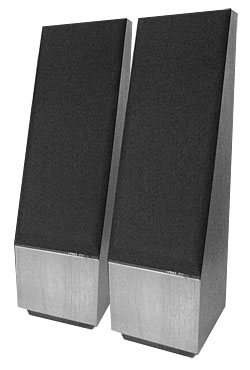 Kentucky manufacturer Thiel has acquired a reputation for the coherence of sound presented by its range of distinctive, sloping-baffle, floor-standing loudspeakers. Designer 221/index.html">Jim Thiel gives a high priority to linearity of phase response; as a result, he chooses to use phase-linear, first-order crossovers in his designs, the target response being the combination of electrical and mechanical filtering. As the out-of-band rejection is then only 6dB/octave, it places demands on his chosen drive-units to be well-behaved, not only in their passbands, but also outside of them. In effect, the loudspeaker has to be designed as a whole system, the interaction between the drive-units and crossover being considerable.
Thiel CS1.2 loudspeaker
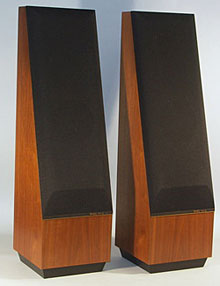
Thiel Audio, headed up by Jim">http://www.stereophile.com/interviews/221">Jim Thiel (President and chief designer) and Kathy Gornik (Marketing Director), sets itself apart from other speaker manufacturers not only by making what I feel to be almost uniformly excellent products, but also by serving as a kind of hallmark for the good dealer: Although not all good dealers sell Thiel, just about every Thiel dealer is a good one. This comes about because, in spite of just about uniformly positive reviews and excellent customer relations, Thiel (primarily in the person of Ms. Gornik) has insisted on limited distribution through retailers they know will give their product a good demonstration. There are a few other such companies performing this hallmark function, though only Mark Levinson Audio Systems readily comes to mind. Most other successful companies prefer as wide a geographical distribution as possible, in spite of the occasional necessary compromises in dealer quality.
Thiel CS1.5 loudspeaker
"Pssst, Sam. I've got this great speaker for you."
Thiel CS1.6 loudspeaker
In the past year, Stereophile has reviewed a number of cost-no-object flagship loudspeakers. B&W's">http://www.stereophile.com//loudspeakerreviews/600/">B&W's Signature 800, MartinLogan's">http://www.stereophile.com//loudspeakerreviews/390/">MartinLogan's Prodigy, Burmester's">http://www.stereophile.com//loudspeakerreviews/601/">Burmester's B-99, Snell's">http://www.stereophile.com//loudspeakerreviews/556/">Snell's XA Reference Tower, Krell's">http://www.stereophile.com//loudspeakerreviews/382/">Krell's LAT-1, Linn's">http://www.stereophile.com//loudspeakerreviews/555/">Linn's Komri, Dynaudio's">http://www.stereophile.com//loudspeakerreviews/501/">Dynaudio's Evidence Temptation, Sony's">http://www.stereophile.com//loudspeakerreviews/391/">Sony's ES SS-M9ED, and Rockport's">http://www.stereophile.com//loudspeakerreviews/644/">Rockport's Antares have all passed through the review mill. Manufacturers like to submit their flagships for review for a number of reasons, not the least of which is the pride they take in showing what their engineers can do when given a blank check. However, while all these models do indeed provide great (if different) sound for the tens of thousands of dollars they demand from their owners, they are out of reach of the majority of audiophiles. It is important, therefore, for reviewers to spend time with real-world designs; when I heard the $1990/pair CS1.6 from Kentucky's Thiel at the 2002 CES last January, I requested a pair for review.
Thiel CS2 2 loudspeaker
"Well, Sam, are there any speakers you are really excited about?"