Sidebar 3: Measurements
I measured the Topping Pre90's performance with my Audio Precision SYS2722 system (see the January 2008 As We See It), repeating some tests with the magazine's higher-performance APx555 system.
The Pre90's volume control operated in accurate 0.5dB steps. The maximum gain at the unbalanced outputs was the specified 10dB for both the balanced and unbalanced inputs; the maximum gain at the balanced outputs was the specified 16dB for both types of inputs. The preamplifier preserved absolute polarity (ie, was noninverting) with both balanced and unbalanced inputs and outputs. (Its XLR jacks are wired with pin 2 hot, the AES convention.)
The Pre90's unbalanced input impedance was 9.9k ohms at 20Hz and 1kHz and 9.6k ohms at 20kHz. The balanced input impedance was low, at 2k ohms from 20Hz to 20kHz, which might give a bass-light balance with source components that have a tubed output stage. The balanced output impedance was the specified 40 ohms at all audio frequencies, which is usefully low. The unbalanced output impedance was 21.5 ohms, again from 20Hz to 20kHz.
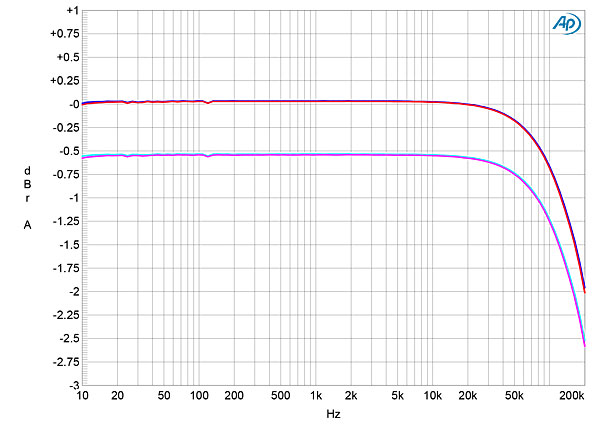
The preamplifier's audioband frequency response was flat in balanced mode (fig.1, blue and red traces), with the ultrasonic rolloff reaching –0.5dB at 100kHz. Fig.1 was taken with the Pre90's volume control at its maximum setting of "16." Both the frequency response and the superb channel matching were preserved in unbalanced mode, at lower settings of the control, and into low impedances (fig.1, cyan and magenta traces).
 The Pre90 preamplifier's measured performance is simply superb. The fact that that performance can be achieved in such a small chassis and for such a low price suggests that Topping has some serious audio engineering talent in-house.—John Atkinson
Fig.1 Topping Pre90, balanced frequency response with volume control set to "+16.0" at 2V into 100k ohms (left channel blue, right red), 600 ohms (left cyan, right magenta) (0.5dB/vertical div.).
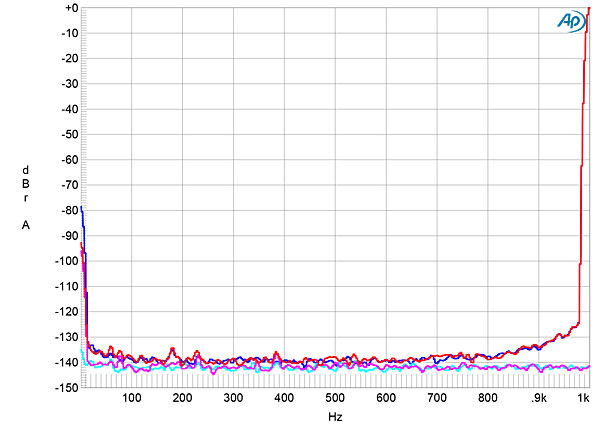
The Topping preamp's channel separation was superb, at 110dB in both directions below 2kHz, and decreased only slightly, to 90dB at the top of the audioband (not shown). The Pre90 offered extremely low noise in both balanced and unbalanced modes, with no power-supply–related spuriae in its output even with the volume control set to its maximum (fig.2). The wideband, unweighted signal/noise ratio, measured at the balanced outputs with the unbalanced inputs shorted to ground and the volume control set to "+16," was 66.5dB in the left channel, 73.8dB in the right, both ratios ref. 2V output. Restricting the measurement bandwidth to the audioband increased the S/N ratio to a superb 118.8dB in both channels, while switching an A-weighting filter into circuit further improved this ratio, to 121.5dB. The Pre90 is one of the quietest preamplifiers I have encountered.
Fig.2 Topping Pre90, balanced spectrum of 1kHz sinewave, DC–1kHz, at 2V into 100k ohms (left channel blue, right red) and at 0V (left cyan, right magenta) (linear frequency scale).
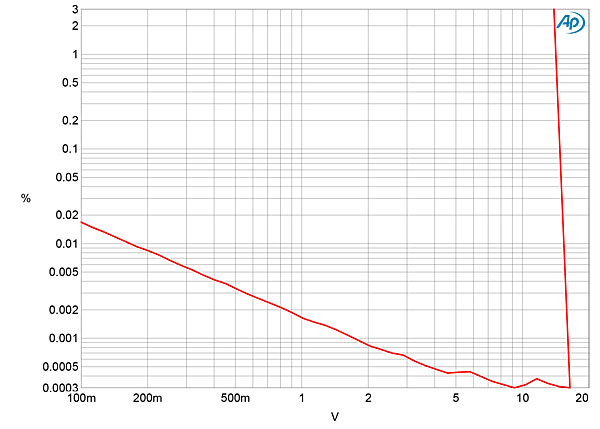
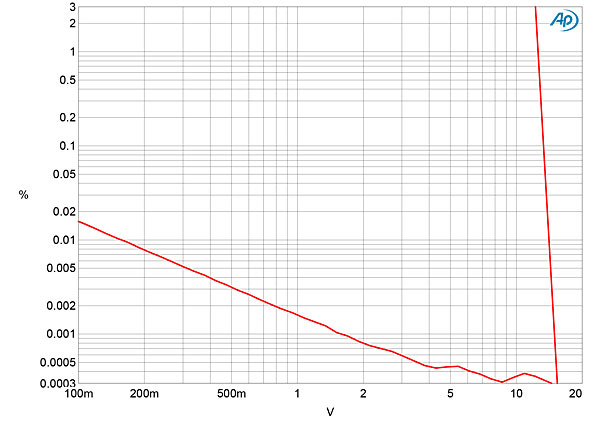
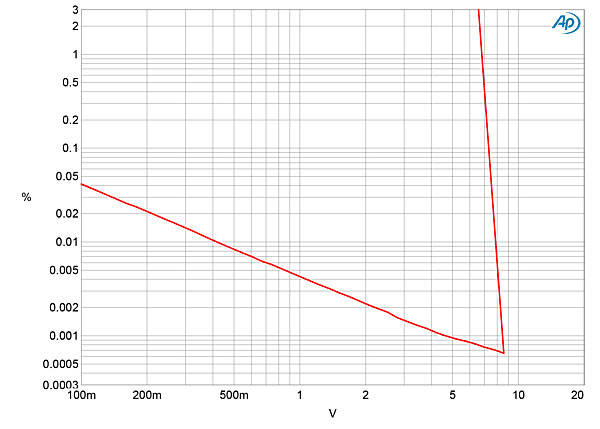
Fig.3 plots the percentage of THD+noise in the Pre90's balanced output against the output voltage into 100k ohms. We usually specify clipping voltage as when the THD+N reaches 1%. However, as you can see from this graph, the output voltage actually decreases as the input voltage increases after the abrupt rise in distortion at 17V. The same behavior was apparent with the Pre90's balanced output driving 600 ohms (fig.4) and with the unbalanced output (fig.5). According to Topping, this behavior is due to the Pre90's protection circuit operating when the volume exceeds a preset limit.
Fig.3 Topping Pre90, balanced distortion (%) vs 1kHz output voltage into 100k ohms.
Fig.4 Topping Pre90, balanced distortion (%) vs 1kHz output voltage into 600 ohms.
Fig.5 Topping Pre90, unbalanced distortion (%) vs 1kHz output voltage into 100k ohms.
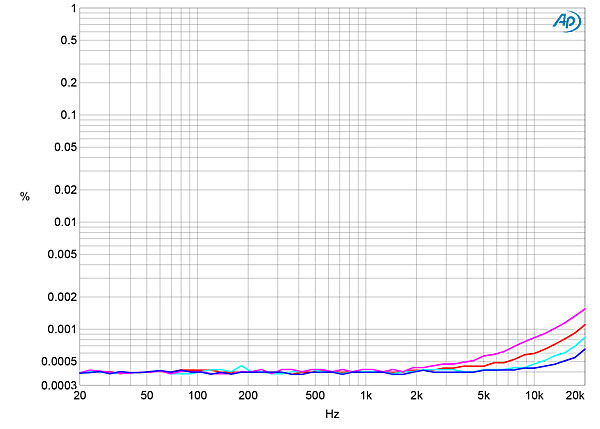
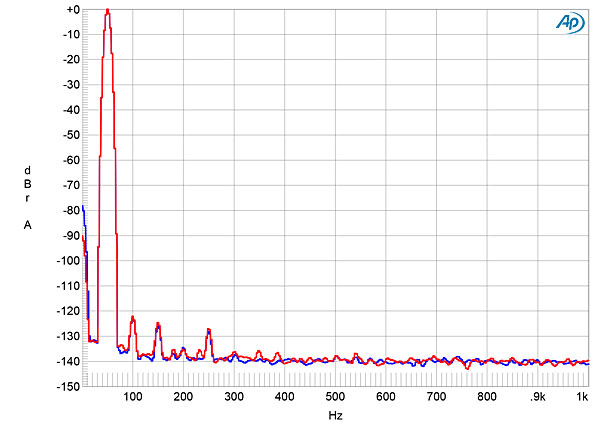
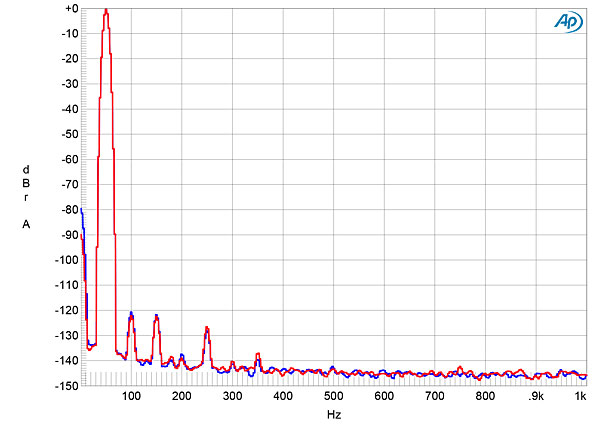
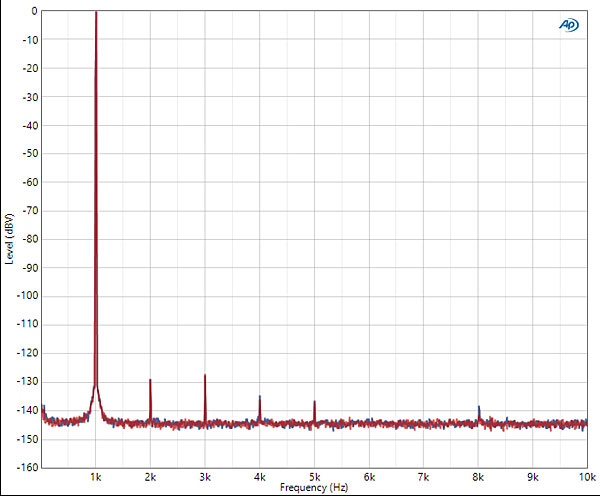
The THD+N was extraordinarily low at normal output levels of a few volts, so I measured how the Pre90's distortion changed with frequency at 11V. Despite the very high voltage level, the THD+N percentage was extremely low into both 100k ohms and 600 ohms, at 0.0004% (fig.6), with a slight increase in the top audio octaves. With a 50Hz tone at 2V into 100k ohms (fig.7), the harmonics at 100Hz, 150Hz, and 250Hz were close to the residual levels in the Audio Precision SYS2722's signal generator. I therefore repeated the spectral analysis at 10V into 600 ohms (fig.8). Despite the stressful conditions, the second and third harmonics each lie close to –120dB (0.0001%). At higher frequencies (fig.9), the third harmonic was slightly higher than the second, but both are still vanishingly low in level.
Fig.6 Topping Pre90, balanced distortion (%) vs frequency at 11V into 100k ohms (left channel blue, right red), 600 ohms (left cyan, right magenta).
Fig.7 Topping Pre90, balanced spectrum of 50Hz sinewave, DC–1kHz, at 2V into 100k ohms (left channel blue, right red; linear frequency scale).
Fig.8 Topping Pre90, balanced spectrum of 50Hz sinewave, DC–1kHz, at 10V into 600 ohms (left channel blue, right red; linear frequency scale).
Fig.9 Topping Pre90, balanced spectrum of 1kHz sinewave, DC–1kHz, at 3V into 200k ohms (left channel blue, right red; linear frequency scale).
Tested for intermodulation distortion with an equal mix of 19 and 20kHz tones at a peak level of 10V into 100k ohms, the second-order difference product at 1kHz lay at –130dB (0.00003%), and the higher-order products were all below –115dB (fig.10).
Fig.10 Topping Pre90, balanced HF intermodulation spectrum, DC–30kHz, 19+20kHz at 10V into 100k ohms (left channel blue, right red; linear frequency scale).