Sidebar 3: Measurements
I used DRA Labs' MLSSA system and a calibrated DPA 4006 microphone to measure the Tekton Enzo XL's frequency response in the farfield; and an Earthworks QTC-40, with its small, ¼"-diameter capsule, for the nearfield responses.
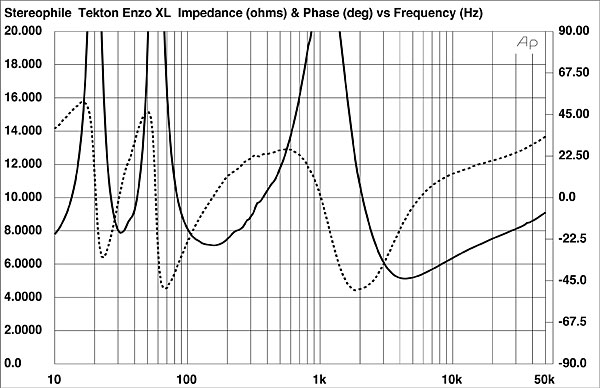
The Enxzo XL's specified sensitivity is an extraordinary 96.5dB/W/m; my estimated value was 90.6dB(B)/2.83V/m, which is much lower but still significantly and usefully higher than the average of all the speakers I have measured, which is between 87 and 88dB(B). Other than a small region in the mid-treble, the Tekton speaker's impedance magnitude (fig.1, solid trace) remains above 6 ohms at all frequencies, and the electrical phase angle (dotted trace) reaches extreme values only when the magnitude is high. The Enzo XL is therefore well suited for use with low-powered tube amplifiers.
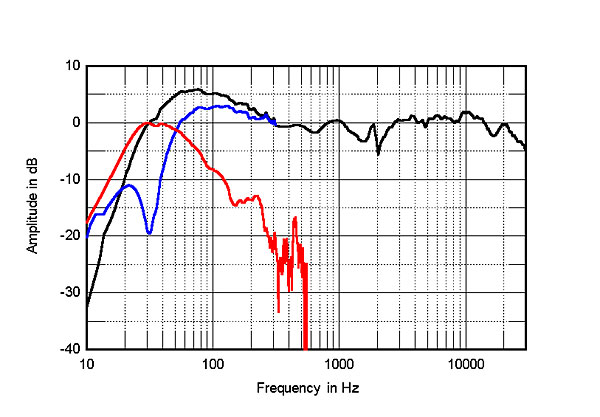 The complex sum of the woofer and port responses, which takes into account acoustic phase, is shown as the black trace below 300Hz in fig.3. Although HR felt the Enzo XL had a low-Q bass alignment, the apparent peak in the midbass, which is primarily due to the nearfield measurement technique, does suggest that the Q is a little higher than he conjectured.
Higher in frequency in fig.3, the black trace shows the Enzo XL's farfield response on the middle-tweeter axis, averaged across a 30° horizontal window. Overall, the balance on this axis is impressively even, though a slight lack of energy in the upper midrange and low treble probably correlates with the lower-than-specification measured sensitivity. It might well also correlate with HR's finding that the Tekton's "overall sound leaned a tiny bit more toward the Puritan, the restrained, and the businesslike than I prefer."
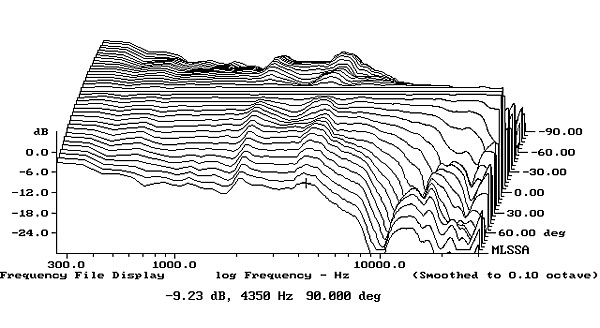
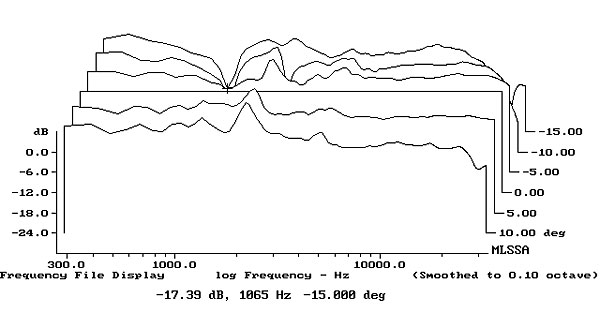
With the Enzo XL's larger-than-usual woofers, whose radiation pattern will narrow at the top of their passband, it was not surprising to find a slight off-axis flare in the tweeters' passband (fig.4). But this will also be due to the lack of energy on axis mentioned earlier filling in somewhat to the speaker's sides. It might, therefore, be worth experimenting with toe-in to get the most neutral treble balance. However, with that wide baffle, the tweeters' radiation pattern narrows considerably above the cursor position in this graph, 4.35kHz, and this is not compensated for by any rise in the top-octave response. Though this will not be a problem in small rooms such as HR's, the Enzo XL might sound a bit too mellow in large or heavily damped rooms. In the vertical plane (fig.5), a suckout develops more than 5° above the middle-tweeter axis. This will not be a problem, given the fact that that axis is 42" above the floor. The suckout in the on-axis response around 2kHz does tend to fill in below this axis, and to my surprise—given the vertical array of three tweeters—the Tekton's vertical dispersion in the top octave is wide.
The complex sum of the woofer and port responses, which takes into account acoustic phase, is shown as the black trace below 300Hz in fig.3. Although HR felt the Enzo XL had a low-Q bass alignment, the apparent peak in the midbass, which is primarily due to the nearfield measurement technique, does suggest that the Q is a little higher than he conjectured.
Higher in frequency in fig.3, the black trace shows the Enzo XL's farfield response on the middle-tweeter axis, averaged across a 30° horizontal window. Overall, the balance on this axis is impressively even, though a slight lack of energy in the upper midrange and low treble probably correlates with the lower-than-specification measured sensitivity. It might well also correlate with HR's finding that the Tekton's "overall sound leaned a tiny bit more toward the Puritan, the restrained, and the businesslike than I prefer."
With the Enzo XL's larger-than-usual woofers, whose radiation pattern will narrow at the top of their passband, it was not surprising to find a slight off-axis flare in the tweeters' passband (fig.4). But this will also be due to the lack of energy on axis mentioned earlier filling in somewhat to the speaker's sides. It might, therefore, be worth experimenting with toe-in to get the most neutral treble balance. However, with that wide baffle, the tweeters' radiation pattern narrows considerably above the cursor position in this graph, 4.35kHz, and this is not compensated for by any rise in the top-octave response. Though this will not be a problem in small rooms such as HR's, the Enzo XL might sound a bit too mellow in large or heavily damped rooms. In the vertical plane (fig.5), a suckout develops more than 5° above the middle-tweeter axis. This will not be a problem, given the fact that that axis is 42" above the floor. The suckout in the on-axis response around 2kHz does tend to fill in below this axis, and to my surprise—given the vertical array of three tweeters—the Tekton's vertical dispersion in the top octave is wide.
Footnote 1: See "The Sound of Surprise."
Fig.1 Tekton Enzo XL, electrical impedance (solid) and phase (dashed) (2 ohms/vertical div.).
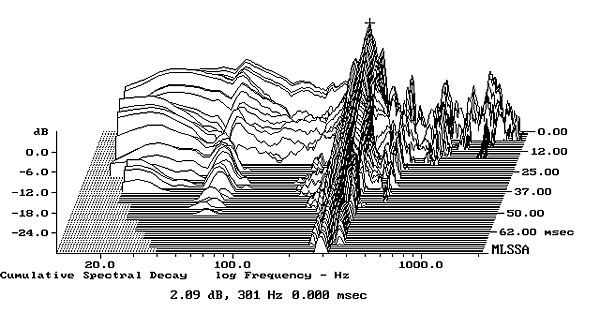
Some small wrinkles in the impedance traces suggest the presence of panel resonances in the large cabinet, which did indeed sound lively when subjected to the traditional knuckle-rap test. A more scientific version of that test is to excite the enclosure by feeding the speaker high-level MLS (Maximum-Length Sequence) noise, and plot a cumulative spectral-decay or waterfall graph from the output of an accelerometer fastened to one of the panels (footnote 1). Doing so, I found several high-level resonant modes on all cabinet surfaces, with one at 301Hz the strongest on the sidewalls level with the bottommost tweeter (fig.2) and on the rear panel. Another mode, at 262Hz, was strongest on the top panel, while a mode at 414Hz dominated on the bottom half of the side panels. All of these modes are of high Quality Factor (Q), so may measure worse than they sound. Also, the Enzo's high sensitivity will work against these resonances being as fully excited as they are in my measurements. It's appropriate to note that HR didn't comment on any coloration or midrange congestion that could be laid at the feet of this measured behavior.
Fig.2 Tekton Enzo XL, cumulative spectral-decay plot calculated from output of accelerometer fastened to center of side panel level with bottom tweeter (MLS driving voltage to speaker, 7.55V; measurement bandwidth, 2kHz).
The saddle centered just above 30Hz in the impedance-magnitude trace (fig.1, solid) suggests that this is the tuning frequency of the twin large, 2"-diameter ports on the Enzo's front baffle. As expected, therefore, I found that the minimum-motion notch in the woofers' combined output (fig.3, blue trace) occurred at 31Hz, the frequency at which the back pressure from the port resonance holds the cones stationary. The combined output of the ports peaks between 20 and 60Hz, confirming HR's finding that this speaker offers excellent bass extension. Though I've shown the combined outputs of the woofers and ports, each behaved slightly differently, the lower woofer having a double notch in its low-frequency response, and the upper port a much lower response peak at 230Hz.
Fig.3 Tekton Enzo XL, anechoic response on central tweeter axis at 50", averaged across 30° horizontal window and corrected for microphone response, with nearfield responses of woofer (blue), port (red), and their complex sum (black), respectively plotted below 300Hz, 1kHz, 300Hz.
Fig.4 Tekton Enzo XL, lateral response family at 50", normalized to response on central tweeter axis, from back to front: differences in response 90–5° off axis, reference response, differences in response 5–90° off axis.
Fig.5 Tekton Enzo XL, vertical response family at 50", normalized to response on central tweeter axis, from back to front: differences in response 15–5° above axis, reference response, differences in response 5–10° below axis.
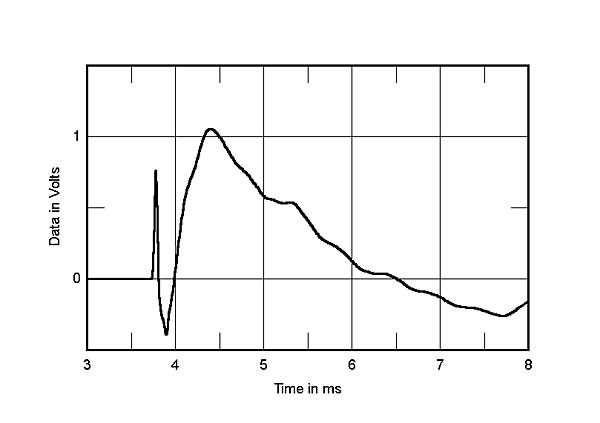
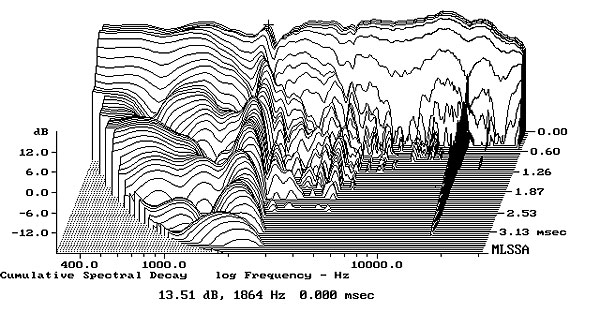
The Enzo XL's step response (fig.6) indicates that all five drive-units are connected in positive acoustic polarity, with the arrival of the tweeters leading that of the woofers by about 400µs. However, the decay of the tweeters' step smoothly blends with the start of the woofers' step, implying good crossover design. There are some undulations in the decay of the woofers' step, which the cumulative spectral-decay plot (fig.7) shows are associated with a high-Q resonance at 1864Hz. I would have thought that this resonance, perhaps due to a problem with the termination of the woofer cones' surrounds, would add hardness to the sound. HR didn't comment on an audible problem in the presence region, but did say that the Tektons "got not only the tone, the attack, and the decay, but the plucked-string pulling-up emphasis of the bass player's art"—just the kind of tonal emphasis I would expect from such a low-treble resonance. (Bass guitarists often use a presence-region boost to emphasize the "ping" in their instruments' sound—at least, I do.)
Fig.6 Tekton Enzo XL, step response on central tweeter axis at 50" (5ms time window, 30kHz bandwidth).
Fig.7 Tekton Enzo XL, cumulative spectral-decay plot on central tweeter axis at 50" (0.15ms risetime).
Overall, the Tekton Enzo XL measured much better than I was expecting, given its idiosyncratic design: three tweeters in a vertical array, two large-diameter, paper-cone woofers, and that lively enclosure. Its combination of high sensitivity and extended low frequencies is rare in speakers in this price class, and, other than that resonance just below 2kHz, seems to have been achieved with little compromise elsewhere.—John Atkinson
Footnote 1: See "The Sound of Surprise."