

Sidebar 5: Phono Stage Measurements
Out of the box, the T+A Symphonia streaming integrated amplifier Rogier van Bakel reviewed in the November 2025 issue has two pairs of single-ended analog line inputs. The second pair can be used as a moving magnet–compatible phono input by selecting an internal phono module with the front-panel Menu buttons.
As RvB is a digital-only guy, he wasn't able to audition the Symphonia's phono stage, but before I shipped the amplifier to Tom Fine for a phono audition, I performed a complete set of measurements on the phono input with my Audio Precision SYS2722 system. I controlled the amplifier with the T+A Music Navigator G3 app, which I installed on my iPad mini after connecting the amplifier's Ethernet port to my network. To minimize noise, I connected a wire from the grounding terminal on the amplifier's rear panel to the analyzer's ground.
With the volume control set to the maximum, the gain was 71.2dB from the loudspeaker output, 44dB from the Preamplifier output, and 56.25dB from the headphone output. The phono input preserved absolute polarity from all three outputs. The input impedance was 45k ohms at 20Hz and 1kHz, dropping inconsequentially to 39k ohms at 20kHz.
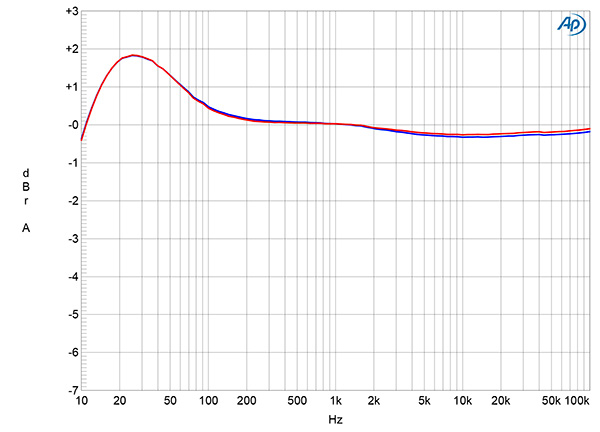
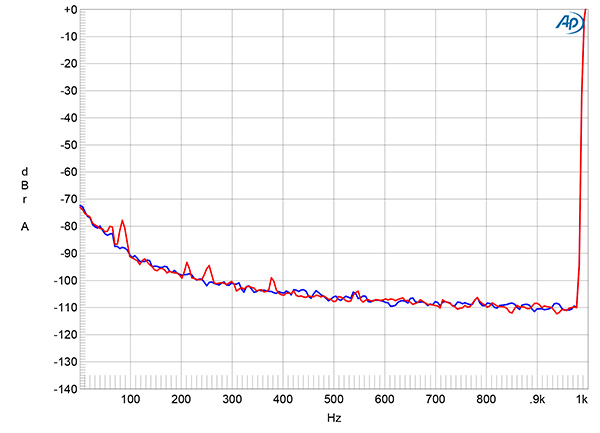
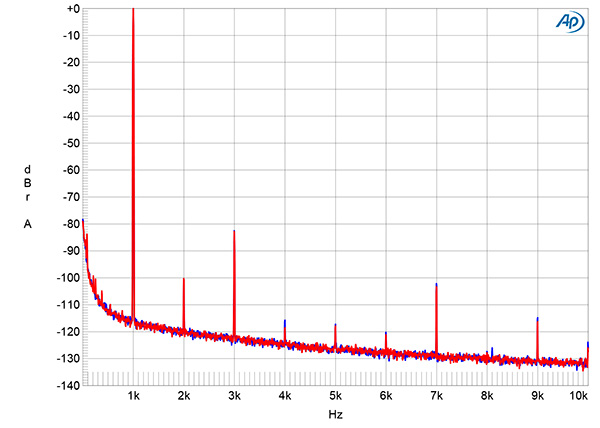
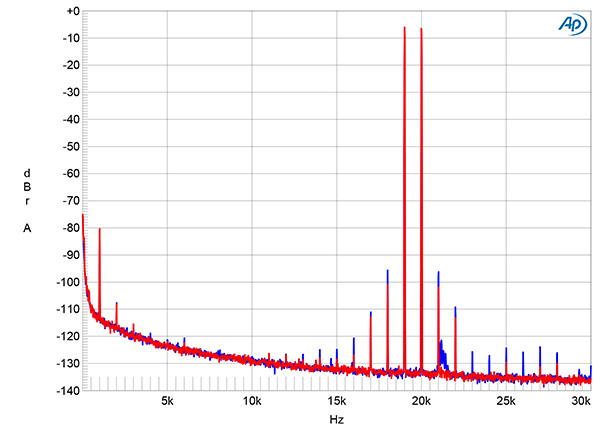
Fig.1 T+A Symphonia, response with RIAA correction (left channel blue, right red) (1dB/vertical div.).
The error in the Symphonia's RIAA equalization (fig.1) was very low from the upper bass upwards, but there was a boost of almost 2dB in the low bass. Channel matching was superb. Channel separation (not shown) was 70dB in both directions across the audioband.
Fig.2 T+A Symphonia, spectrum, spectrum of 1kHz sinewave, DC–1kHz, for 5mV input (left channel blue, right red, linear frequency scale, 20dB/vertical div.).
The Symphonia phono stage's unweighted, wideband S/N ratio, measured at the Preamplifier output with the single-ended input shorted to ground and the volume control set to the maximum, was a good 68.3dB (average of both channels) ref. 1kHz at 5mV. Restricting the measurement bandwidth to 22Hz–22kHz increased the ratio to 71.9dB, while the A-weighted ratio was a superb 84.9dB. Spectral analysis of the Symphonia's low-frequency noisefloor (fig.2) revealed no power supply–related spuriae.
Fig.3 T+A Symphonia, spectrum, spectrum of 1kHz sinewave, DC–10kHz, for 10mV input (left channel blue, right red, linear frequency scale, 20dB/vertical div.).
I measured the Symphonia's overload margins at the Preamplifier output with the volume control set to –15dB to make sure I was looking at input overload rather than output stage clipping. The margins ref. 1kHz at 5mV were excellent, at 22.5dB across the audioband. Fig.3 shows the spectrum at the Preamplifier output with a 1kHz signal at 10mV. The highest-level distortion harmonic was the third, at –82dB (0.008%); the other harmonics all lay at or below –100dB (0.001%). Intermodulation distortion with an equal mix of 19kHz and 20kHz tones at a peak input level of 100mV was very low (fig.4). The difference product at 1kHz lay at –80dB (0.01%) with the higher-order products almost 20dB lower in level.
Fig.4 T+A Symphonia, HF intermodulation spectrum, DC–30kHz, 19+20kHz for 100mV peak input (left channel blue, right red, linear frequency scale, 20dB/vertical div.).
Other than the small boost in the low bass, the T+A Symphonia phono module's measured performance is excellent, with otherwise accurate RIAA equalization and very low noise and distortion.—John Atkinson















