Tom Fine mentioned in his review of the T+A R 2500 R in the August 2024 issue that a phono module would be available for this multi-source receiver (footnote 1). After that issue's content had been sent to the printer, TF received a phono module, which he forwarded to me to install in the review sample of the R 2500 R and measure before he started his auditioning. (His Follow-Up will appear in the February issue.)
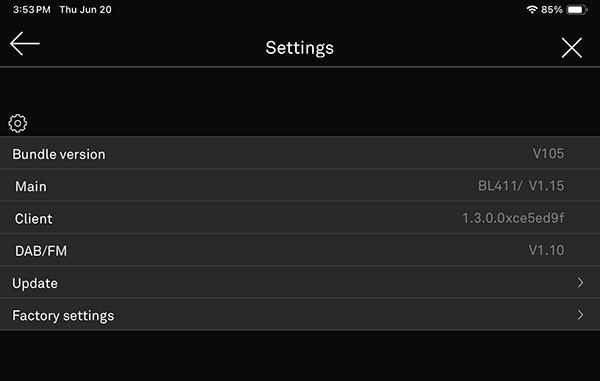
Following the supplied instructions, installing the phono module was straightforward: it replaces a multi-pin jumper cable behind the input jacks on the rear panel, and a new jumper cable connects it to the output board. Both the R 2500 R's display and the T+A Navigator G3 app on my iPad Mini now recognized input 2 as "Phono," and I set the rotary switches on the top of the module to Tom Fine's preferences: sensitivity set to "2" (4.0–6.5mV); no subsonic filter; capacitance set to 170pF. I measured the module with my Audio Precision SYS2722 system, and I connected a wire from the grounding terminal on the receiver's rear panel to the analyzer's chassis ground to minimize noise.
I immediately encountered problems. First, while the level at the Loudspeaker output with 1kHz at 1mV and the volume control set to "77" was 6.23V, when I increased the volume control to "78," the level jumped to 40V! Second, when I measured the response at the Preamplifier output with the volume control set to "77," while the RIAA error was low at high and middle frequencies, it rose in the bass, reaching +13dB at 10Hz.
Although I had a grounding strap attached to my wrist to eliminate any static when I installed the module, I suspected that the phono module might have been damaged. I let T+A's Dave Nauber know about the problems. He recommended I update the R 2500 R's firmware, which I did, but it didn't make a difference.
 Nauber then had a replacement phono module shipped to me, which I installed and started the testing. My usual practice when testing a phono preamplifier is to have the grounds connected on the Audio Precision's single-ended outputs. However, on a hunch I floated the grounds on these outputs. The RIAA correction was now accurate at low frequencies and the speaker output was stable at settings up to the maximum of "85." But when the AP's single-ended outputs were referenced to ground, my standard practice, the bass boost reappeared and I got the same increase in the speaker output level between volume control settings that I got with the original module. It is important, therefore, not to have the cartridge and tonearm wiring connected to ground with this phono module.
Accordingly, I continued the testing with the analyzer output grounds floating. The phono module preserved absolute polarity at both the Loudspeaker and Preamplifier outputs. There are seven gain settings; the gain at the Preamp output with the volume control set to the maximum varied from 42.6dB to 67.1dB. The gain with TF's preferred settings was 52.2dB, Preamp output, and 83.6dB, Loudspeaker output.
Nauber then had a replacement phono module shipped to me, which I installed and started the testing. My usual practice when testing a phono preamplifier is to have the grounds connected on the Audio Precision's single-ended outputs. However, on a hunch I floated the grounds on these outputs. The RIAA correction was now accurate at low frequencies and the speaker output was stable at settings up to the maximum of "85." But when the AP's single-ended outputs were referenced to ground, my standard practice, the bass boost reappeared and I got the same increase in the speaker output level between volume control settings that I got with the original module. It is important, therefore, not to have the cartridge and tonearm wiring connected to ground with this phono module.
Accordingly, I continued the testing with the analyzer output grounds floating. The phono module preserved absolute polarity at both the Loudspeaker and Preamplifier outputs. There are seven gain settings; the gain at the Preamp output with the volume control set to the maximum varied from 42.6dB to 67.1dB. The gain with TF's preferred settings was 52.2dB, Preamp output, and 83.6dB, Loudspeaker output.
Footnote 1: The R 2500 R costs $18,880; the optional phono preamp module (either MM or MC) costs $920. T+A elektroakustik GmbH & Co. KG, Planckstrasse 9-11, D-32052 Herford, Germany. Tel: +49 (0) 5221-7676-0. Email: info@ta-hifi.de. Web: ta-hifi.de/en.
Nauber then had a replacement phono module shipped to me, which I installed and started the testing. My usual practice when testing a phono preamplifier is to have the grounds connected on the Audio Precision's single-ended outputs. However, on a hunch I floated the grounds on these outputs. The RIAA correction was now accurate at low frequencies and the speaker output was stable at settings up to the maximum of "85." But when the AP's single-ended outputs were referenced to ground, my standard practice, the bass boost reappeared and I got the same increase in the speaker output level between volume control settings that I got with the original module. It is important, therefore, not to have the cartridge and tonearm wiring connected to ground with this phono module.
Accordingly, I continued the testing with the analyzer output grounds floating. The phono module preserved absolute polarity at both the Loudspeaker and Preamplifier outputs. There are seven gain settings; the gain at the Preamp output with the volume control set to the maximum varied from 42.6dB to 67.1dB. The gain with TF's preferred settings was 52.2dB, Preamp output, and 83.6dB, Loudspeaker output.
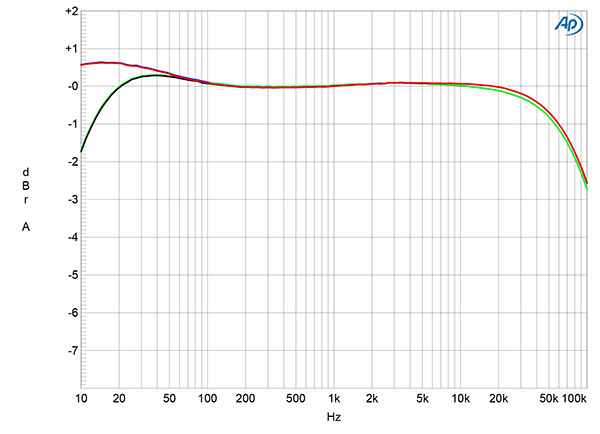
Fig.1 T+A R 2500 R, response with RIAA correction into 100k ohms (left channel blue, right red) and with the subsonic filter engaged (left green, right gray) (1dB/vertical div.).
The input impedance was 44.1k ohms at 20Hz and 1kHz, 38.3k ohms at 20kHz. The error in the R 2500 R's RIAA equalization (fig.1, blue and red traces) was extremely low in the audioband, though there was a slight boost below 100Hz peaking at +0.65dB at 15Hz and an ultrasonic rolloff that reached –1dB at 60kHz. With the subsonic filter selected, the response was down by 1.7dB at 10Hz (green and gray traces). The channel matching was excellent, overall. Channel separation (not shown) was 60–65dB in both directions across the audioband.
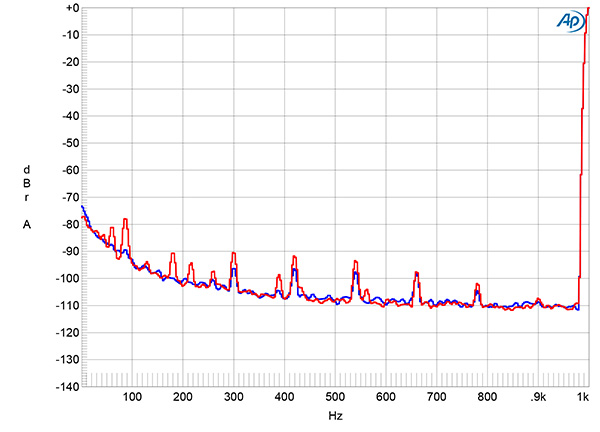
Fig.2 T+A R 2500 R, gain "2," spectrum, DC–1kHz, of output ref. 5mV input (left channel blue, right red, linear frequency scale, 20dB/vertical div.).
With the gain set to "2," the T+A phono module's unweighted, wideband S/N ratio, measured at the Preamp output and ref. 1kHz at 5mV, was a good 72dB in both channels. Restricting the measurement bandwidth to 22Hz–22kHz increased the ratios to 75.5dB, and inserting an A-weighting filter gave further improvement to an excellent 82.3dB, left, and 83.5.1dB, right. As expected, the ratios were lower by 7dB when I increased the gain setting by the same 7dB (gain setting "4"). Spectral analysis of the R 2500 R phono module's low-frequency noisefloor at the Preamp output with the gain set to "2" and ref. 1kHz at 5mV (fig.2) revealed low levels of AC supply–related spuriae and random noise.
To examine the Phono module's overload margins, I reduced the volume control setting to "60" as the receiver went into protection mode with input signals >6mV at higher volume settings. With TF's preferred gain setting, the margin ref. 1kHz at the standard moving magnet level of 5mV was a good 14dB from 20Hz to 20kHz. At the highest gain setting of "7," the overload margin reduced by the same 10dB as the increase in gain, but the margin ref. the standard moving coil level of 500µV increased by 10dB. This gain setting would be appropriate for MC cartridges.
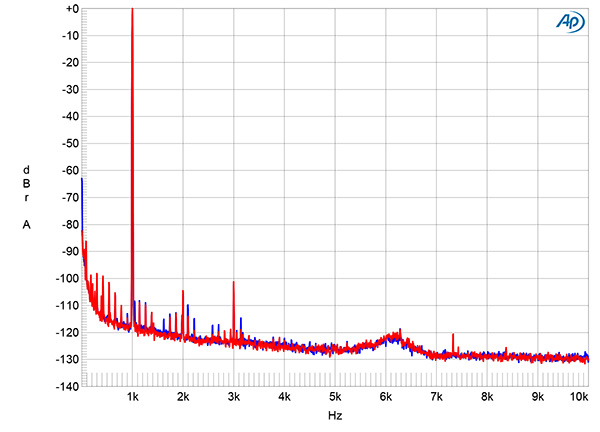
Fig.3 T+A R 2500 R, gain "2," spectrum of 1kHz sinewave, DC–10kHz, into 100k ohms for 12.5mV input (left channel blue, right red, linear frequency scale).
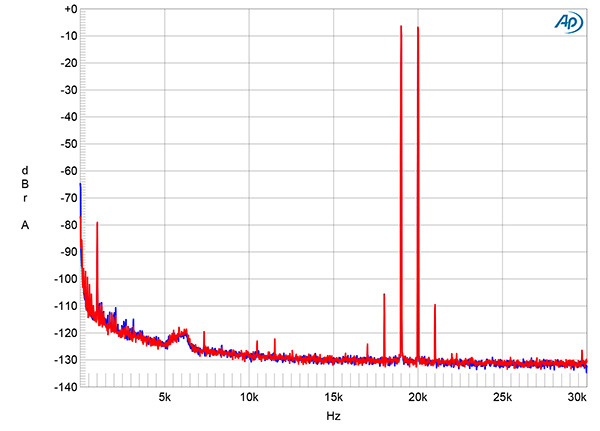
Fig.4 T+A R 2500 R, gain "2," HF intermodulation spectrum, DC–30kHz, 19+20kHz into 100k ohms for 120mV peak input (left channel blue, right red, linear frequency scale).
The R 2500 R's phono module offered very low distortion. Fig.3 shows the spectrum of the Preamp output reproducing an input signal of 1kHz at 12.5mV with the gain set to "2" and the volume control set to "60." Despite this input voltage being just 6dB below the input overload level, the only distortion harmonics that can be seen above the noisefloor are the second, at –106dB (0.0005%), and the third, at –100dB (0.001%). With an equal mix of 19kHz and 20kHz tones at 20mV peak voltage, which is again 6dB below the overload level, the second-order difference product at 1kHz lay at just –80dB (0.01%) and the higher-order intermodulation products were 25–30dB lower in level (fig.4).
Other than the need not to use a tonearm connection that references the cartridge output to ground—would-be purchasers of the module should check with their dealer—the T+A R 2500 R's phono module offers accurate RIAA equalization, low noise, and very low distortion.—John Atkinson
Footnote 1: The R 2500 R costs $18,880; the optional phono preamp module (either MM or MC) costs $920. T+A elektroakustik GmbH & Co. KG, Planckstrasse 9-11, D-32052 Herford, Germany. Tel: +49 (0) 5221-7676-0. Email: info@ta-hifi.de. Web: ta-hifi.de/en.