Because 8x oversampling puts very stringent demands on aperture timing and sample-and-hold settling speed (the time required for a switched voltage to overshoot the mark and return to its new setting), the DAS-R1 employs four D/A converters in what Sony calls a staggered overlap configuration. The 352.8kHz samples for each channel are switched alternately between two of the converters, so that each gets twice as much processing time as it would otherwise. The outputs from both converters are then averaged, as are noise and (in theory) distortion, resulting in 3dB reductions in both. In addition, the paralleled outputs of the DACs draw twice as much current from the voltage rails as would a single DAC, providing an additional (theoretical) 6dB of noise reduction, which totals 9. Of course, all this extra S/N goes out the window when you play a CD that has been dithered (footnote 1) (and you wouldn't want to listen to one that hasn't), so the reduced noise is academic anyway. (The reduced distortion isn't, though.)
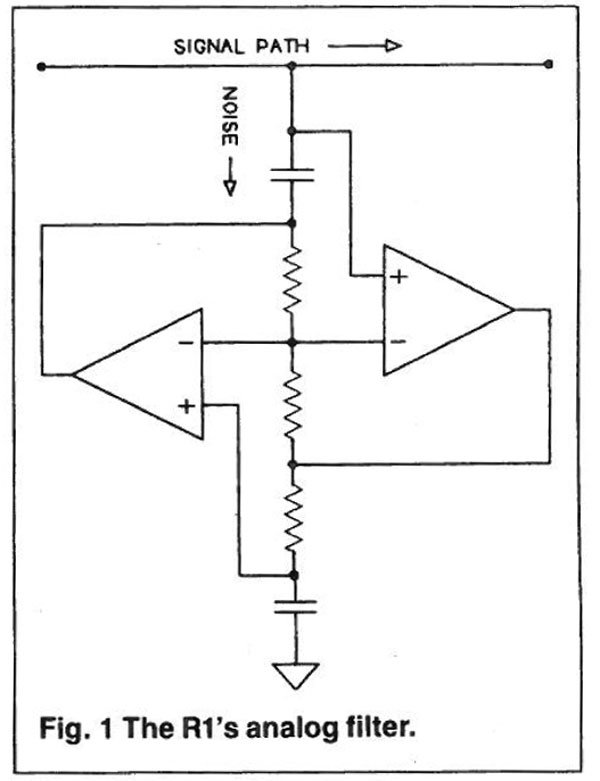
The 352.8kHz sampling allows the digital filter to get rid of practically all out-of-band spuriae but itself, but the concept of overkill demands more, so an analog filter has been added too. Located between the signal path and ground, this behaves as if it is a virtual short-circuit to ground for all frequencies above the system's 20kHz signal limit. Two operational amplifiers are arranged in what amounts to an active negative feedback circuit (fig.1), so their output cancels their input—with the necessary crossover components to ensure that nulling takes place only above 20kHz. Below that frequency, the filter circuit is not "seen" by the signal at all.
 Also unusual in the R1 is the way anti-corrosion protection is applied to the circuit boards. Usually, this thin layer of nonconductive material is applied over the entire surface of the board, covering traces and land areas alike. In the land areas, the coating acts like a dielectric, and according to Sony, this adversely affects the sound. In the DAS-R1, the protective coating is applied only over the copper traces where it is needed, leaving land areas of the board clear.
At Last, the Sound
Also unusual in the R1 is the way anti-corrosion protection is applied to the circuit boards. Usually, this thin layer of nonconductive material is applied over the entire surface of the board, covering traces and land areas alike. In the land areas, the coating acts like a dielectric, and according to Sony, this adversely affects the sound. In the DAS-R1, the protective coating is applied only over the copper traces where it is needed, leaving land areas of the board clear.
At Last, the Sound
I allowed the R1 48 hours of warmup before starting to listen. Tests were conducted using both the two-way fiberoptic connector and the coaxial electrical cable, but if there was any difference, I was unable to hear it. First, it must be said that this is unquestionably the best-sounding CD player Sony has ever made. That, of course, is only fitting, since it is by far the most costly CD player Sony has ever made. And, yes, I would say it is also one of the best CD players I have heard from any manufacturer. But only one of the best? Come on now, this is a state-of-the-art, almost-no-holds-barred price. It should be head-and-shoulders above its cheaper competition. It isn't, altogether.
While no one is yet claiming that CD reproduction is as good, yet, as it has the potential to be, there are many—myself included—who do believe it is getting pretty damned close. What this means is that perfection, in terms of the medium's potential, may be close enough now that no new player is going to be able to sound dramatically better than the best we've had to date. The second thing to consider is that, in high-end audio, increasingly small increments of sonic improvement come at increasingly large increments of price. Much of the apparently extreme price of the R1 is simply another example of a known and accepted phenomenon.
The R1 falls into that category of players whose sound is most easily described in terms of what it does not add to or subtract from the program material. Overall, it is one of the most suave-sounding CD players I have heard—as smooth and effortless as LA described the similarly priced Accuphase as sounding, yet with (apparently) significantly more detail and snap. Unlike previous Sony players, which many listeners felt to be too bright and forward-sounding, the R1 seems neither forward nor laid-back, and it has a much more relaxed quality to its sound than the earlier players had. Highs are gorgeously open and delicate, with a sweetness more tubelike than solid-state, yet more detailed than tubes.
Soundstaging and ambience reproduction are stunning! I do not usually consider either to be of overwhelming importance in sound reproduction, yet the excellence of both from the R1 was so startling that they were the first things that struck me when I started listening to it. This was the first time I have heard the room behind Amanda McBroom's second recording (Growing Up in Hollywood Town) sound exactly the way she described it during a conversation some years ago. The Mod Squad Prism player, which JA loaned me for comparison purposes, did very nearly as well, but the impression of a bounded space with a unique acoustical flavor was slightly less definite.
Only at the low end—where previous Sony players were unsurpassed—did the R1 fall noticeably short of state-of-the-art performance. It heavies-up the bass. Not conspicuously, and certainly not annoyingly (most of us prefer too much bass to too little), but unquestionably. How can I be so sure about that? Because I have on hand, and routinely use for listening tests, four other signal sources which, over time, have proven to be reliably middle-of-the-road in LF balance: original open-reel tapes, original PCM tapes, and good analog discs played on the Versa Dynamics record player. All of these hew to a LF-balance center which is lighter than that of the R1.
I made a number of comparisons between CDs and their vinyl counterparts played on the Versa Dynamics, and the results were consistent. The whole low end was heavier from the Sony than from the analog playbacks. Not boomy, or soggy, just more. This had not been the case with previous Sony players, and it was not the case with the Mod Squad unit with which I was comparing the R1. Other sources—open-reel tapes, original PCM tapes—confirmed that the analog discs, and the CDs from the Mod Squad, had pretty close to neutral balance, being neither too much nor too little.
Of course, there was no measured LF rise from the R1, and I didn't expect there to be. But in the absence thereof, I can only conclude that the power supply for the audio section is somehow inadequate, maybe in regulation. I cannot think of anything else that would cause the low-end heaviness (footnote 2).
Extreme highs on the R1 were quite simply superb—silky and open, yet immensely detailed and focused, like the minute details revealed by a very fine camera lens. Because of this and the effortlessly liquid midrange, the R1's sound wears very well. Perhaps LA could not enjoy listening to CDs for three hours straight through the R1, but I have for many days since I started using the R1.
Conclusions
Assuming I could afford the R1 system, which I can't, would I buy it? Though the R1 is the best CD player I have heard at the time of writing, I don't think so. First, as I do not own a DAT machine and satellite audio downlinks are at present nonexistent in the US, the DAS-R1's ability to handle these would be irrelevant. Second, though the rate of improvement of CD playback technology has slowed down, it is still fast enough that it is almost certain the DAS-R1 will be surpassed by something else within a year or so. And third, despite all the things it does unprecedentedly well, I feel that the R1 is not as sonically neutral as it should be at the price. At this price level, the R1 should do everything better than the cheaper competition, not just most things. It is possible that the R1's bass balance is accurate and all my other signal sources are inaccurate. Possible, yes, but unlikely, in my opinion. However, it does disturb me to shoot down such an otherwise excellent CD player as the R1 on the basis of that single questionable trait. I must also draw readers' attentions to our current recommendation (in Class A of "Recommended Components") of another similarly priced player, the Accuphase DP-80/DC-81, which was described (by JA) as having much the same LF balance as the R1. So I can only sum up this review on a note of cowardly ambiguity: If the Accuphase is Class-A-recommended, then the R1 must certainly be likewise Class-A-recommended (and may, in fact, be a bit better in some areas).
Footnote 1: Dithering involves the addition to the signal, prior to A/D conversion, of a small amount of white noise (hiss). This raises the CD system's noise floor by about 6dB, reducing it to 90dB, but it also extends the dynamic range to about 15dB below the system's normal capability, and drastically reduces quantization noise and distortion. Without dithering, digital reproduction sounds raw and grainy.—J. Gordon Holt Footnote 2: Interestingly, I found the fiberoptic connection to give more LF than the coaxial data link.—John Atkinson
Fig.1 Sony DAS-R1, analog low-pass filter block diagram.
The audio section uses discrete transistors—a first time for Sony—and is almost but not quite DC-coupled throughout. There is a capacitor only at the output, and this too is of a special design. Manufactured by Sony, it incorporates a unique hybrid construction: The dielectric is a "compound" of polypropylene and polycarbonate. The idea, presumably, is to get the best sonic qualities of both. The dielectric is coupled to the pigtail lead-outs by gold foil, and the entire unit is hermetically sealed in a resin material for low microphonics and isolation from atmospheric contaminants.
I allowed the R1 48 hours of warmup before starting to listen. Tests were conducted using both the two-way fiberoptic connector and the coaxial electrical cable, but if there was any difference, I was unable to hear it. First, it must be said that this is unquestionably the best-sounding CD player Sony has ever made. That, of course, is only fitting, since it is by far the most costly CD player Sony has ever made. And, yes, I would say it is also one of the best CD players I have heard from any manufacturer. But only one of the best? Come on now, this is a state-of-the-art, almost-no-holds-barred price. It should be head-and-shoulders above its cheaper competition. It isn't, altogether.
Assuming I could afford the R1 system, which I can't, would I buy it? Though the R1 is the best CD player I have heard at the time of writing, I don't think so. First, as I do not own a DAT machine and satellite audio downlinks are at present nonexistent in the US, the DAS-R1's ability to handle these would be irrelevant. Second, though the rate of improvement of CD playback technology has slowed down, it is still fast enough that it is almost certain the DAS-R1 will be surpassed by something else within a year or so. And third, despite all the things it does unprecedentedly well, I feel that the R1 is not as sonically neutral as it should be at the price. At this price level, the R1 should do everything better than the cheaper competition, not just most things. It is possible that the R1's bass balance is accurate and all my other signal sources are inaccurate. Possible, yes, but unlikely, in my opinion. However, it does disturb me to shoot down such an otherwise excellent CD player as the R1 on the basis of that single questionable trait. I must also draw readers' attentions to our current recommendation (in Class A of "Recommended Components") of another similarly priced player, the Accuphase DP-80/DC-81, which was described (by JA) as having much the same LF balance as the R1. So I can only sum up this review on a note of cowardly ambiguity: If the Accuphase is Class-A-recommended, then the R1 must certainly be likewise Class-A-recommended (and may, in fact, be a bit better in some areas).
Footnote 1: Dithering involves the addition to the signal, prior to A/D conversion, of a small amount of white noise (hiss). This raises the CD system's noise floor by about 6dB, reducing it to 90dB, but it also extends the dynamic range to about 15dB below the system's normal capability, and drastically reduces quantization noise and distortion. Without dithering, digital reproduction sounds raw and grainy.—J. Gordon Holt Footnote 2: Interestingly, I found the fiberoptic connection to give more LF than the coaxial data link.—John Atkinson