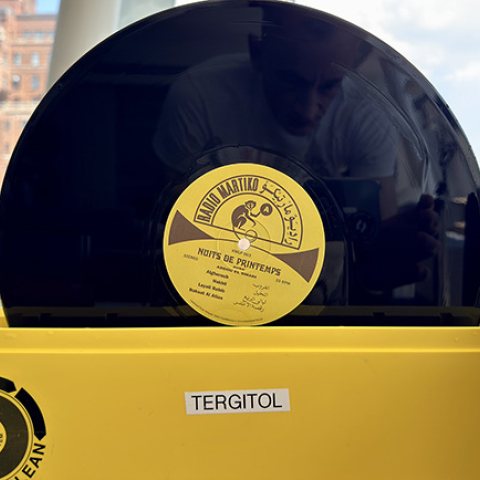
Acoustic guitar strumming stood out more in the mix, but overall presentation was not quite as immersive. For the first time, I noticed a female backup singer "woo-oohing" behind Bird's whistling.
On the blues-tinged "Bloodless," with loading set to 200 ohms, Bird's five-string violin pizzicato plucking shone with substance and body. But with loading at 400 ohms, an increased sense of air gave most instruments pleasing purity, without excessive politesse. Piano key strikes sounded clean and refined. Bird's pizzicato felt more exciting on the attacks—so present and convincing it gave me goosebumps.
Next, I spun Talking Heads' Stop Making Sense (Sire 25186-1), the soundtrack to their 1984 concert film directed by Jonathan Demme. Their off-kilter rendition of Al Green's "Take Me to the River" is hyper and amusing. Tina Weymouth's bass riff, taut and funky, kicks off soon into the track. Weymouth's bass notes sounded plump and punchy with the loading at 200 ohms with more energy and impact on the attacks. Loading at 400 tightened up some bass and other details, and the soundstage seemed to expand slightly while seemingly pushing back several rows—similar to the Bird album. Cowbell strikes in the upper left were clearer. David Byrne's mimicking it, and his banter, were more decipherable: "Are you ready everybody? C'mon, let's go!" Audience applause faded slightly into the background and seemed quieter.
I took in another fun, funky bassline on Manu Dibango's "Electric Africa" on the Celluloid label's 1986 New Africa 2 compilation (CELL 6119), featuring Herbie Hancock on piano and a (very '80s-sounding) Yamaha DX-7. This track's heavily produced vibe came through with the RS2. It benefited from loading at 400 ohms. Dibango's sax swelled; its interjections had punch. His signature chuckles seemed believable.
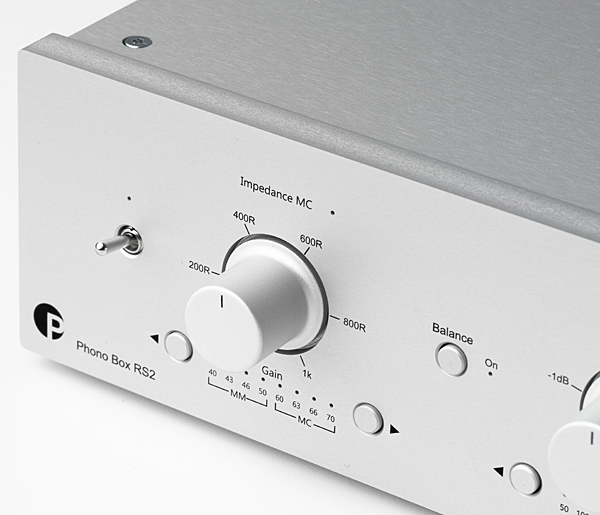 Madeleine Peyroux's rendition of Leonard Cohen's "Dance Me to the End of Love," on her reissued Careless Love album (Mobile Fidelity MFSL 1-284), makes me want to foxtrot every time I hear it, so clear and tight is its rhythm section. Adjusting the impedance to about halfway between the 10 and 200 ohms settings delivered some pleasant surprises: I heard a trill I hadn't heard before. At 400 ohms, the instruments seemed better separated, with more air and expansion between them. The presentation felt more grounded and solid with better dimensionality, yet freed up with lively energy.
For the MM setup, the MoFi UltraDeck+ with the RS2 shone on Paris-based Gotan Project's 2001 debut, La Revancha del Tango (XL Recordings XLLP 148). With gain at 46dB, capacitance at 150pF, "Santa Mar°a (del Buen Ayre)" displayed midrange warmth on vocal samples amid crisp percussive attacks and a clear bassline. Even the cricket chirps sounded lively and inviting. Layers of instruments and samples seemed distinct. The accordion sounded realistic in timbre, its bellows sustaining and shifting. The pace and rhythm conveyed tango's tension and timing as deftly as a skilled partner leading the dance. I detected slight ground noise, so I dialed the gain back to 40dB and increased capacitance to 250pF. Soundstaging deepened a bit. Accordion and crickets sounded slightly more distant. But some spark was missing.
I tried the balance control, which worked fine for its described subtle soundstage shifts, but I didn't use it much.
I mainly stuck to the RIAA curve setting but did try the Decca EQ—not with old mono Decca records, since I don't own any, but just for fun, to see how it would alter the sound. I chose "Libra" from Gerhard's Astrological Series performed by London Sinfonietta with David Atherton conducting—a Decca record from 1977 (Decca Head.11). This odd, modal track has a very expansive soundstage with several instruments coming in and out from all over, striking an uneasy balance between improvisation and careful calculation. Images can be spookily realistic. With the RIAA EQ, some instruments that are spread out appeared squeezed together in the right channel. With the Decca EQ, the snare and other percussion were placed farther back. Timbre and tone color seemed more natural. Those EQ differences were pretty subtle, but here was a case where to me the Decca curve sounded better.
Power and noise
Madeleine Peyroux's rendition of Leonard Cohen's "Dance Me to the End of Love," on her reissued Careless Love album (Mobile Fidelity MFSL 1-284), makes me want to foxtrot every time I hear it, so clear and tight is its rhythm section. Adjusting the impedance to about halfway between the 10 and 200 ohms settings delivered some pleasant surprises: I heard a trill I hadn't heard before. At 400 ohms, the instruments seemed better separated, with more air and expansion between them. The presentation felt more grounded and solid with better dimensionality, yet freed up with lively energy.
For the MM setup, the MoFi UltraDeck+ with the RS2 shone on Paris-based Gotan Project's 2001 debut, La Revancha del Tango (XL Recordings XLLP 148). With gain at 46dB, capacitance at 150pF, "Santa Mar°a (del Buen Ayre)" displayed midrange warmth on vocal samples amid crisp percussive attacks and a clear bassline. Even the cricket chirps sounded lively and inviting. Layers of instruments and samples seemed distinct. The accordion sounded realistic in timbre, its bellows sustaining and shifting. The pace and rhythm conveyed tango's tension and timing as deftly as a skilled partner leading the dance. I detected slight ground noise, so I dialed the gain back to 40dB and increased capacitance to 250pF. Soundstaging deepened a bit. Accordion and crickets sounded slightly more distant. But some spark was missing.
I tried the balance control, which worked fine for its described subtle soundstage shifts, but I didn't use it much.
I mainly stuck to the RIAA curve setting but did try the Decca EQ—not with old mono Decca records, since I don't own any, but just for fun, to see how it would alter the sound. I chose "Libra" from Gerhard's Astrological Series performed by London Sinfonietta with David Atherton conducting—a Decca record from 1977 (Decca Head.11). This odd, modal track has a very expansive soundstage with several instruments coming in and out from all over, striking an uneasy balance between improvisation and careful calculation. Images can be spookily realistic. With the RIAA EQ, some instruments that are spread out appeared squeezed together in the right channel. With the Decca EQ, the snare and other percussion were placed farther back. Timbre and tone color seemed more natural. Those EQ differences were pretty subtle, but here was a case where to me the Decca curve sounded better.
Power and noise
Sometimes I kept both turntables connected to the RS2. When I checked each turntable for noise at higher volumes and/or gain settings, I disconnected the other 'table, but it didn't matter: It didn't seem to affect the noise I heard.
The Phono Box RS2 is powered by an external switching power supply—not a wall wart but a small power brick with its own mains cable. I also received a power-supply upgrade: the Pro-Ject Power Box RS Uni 4-Way linear outboard power supply ($799). Wow, what a difference a power supply can make! The slight noise I'd heard at the MC's two highest gain levels and on the MM rig was significantly decreased, if not gone. More potent sonic information emerged from those silent backgrounds. As the noisefloor lowered, sound improved across all criteria.
With the RS Uni power supply added, I returned to Joy Division's Unknown Pleasures (Factory Records Factus 1), an influential early post-punk classic on which recording engineer/producer Martin Hannett used some experimental techniques, found sounds, and AMS 15–80S digital delays. The rough-hewn recording creates a distinct spatial atmosphere, compelling yet sinister, like wandering through an old, abandoned warehouse.
Its sonics are heavy and dark, then crystalline, then metallic. It conjures images of shards of metal or glass—literally. With the RS Uni power supply and the RS2, everything seemed heightened. The shattering bottle on "I Remember Nothing" startled me. Peter Hook's jaunty bassline cut through the rubble on "Disorder," sounding fresh with unexpected buoyancy—a first for this foreboding album.
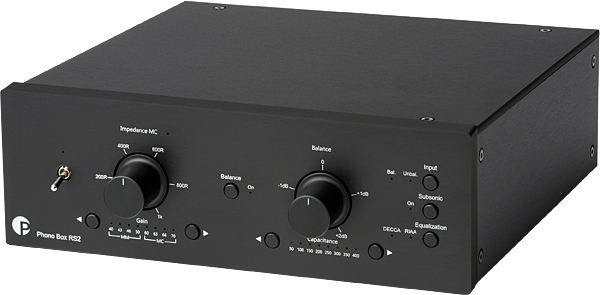 On U2's "Bad" from The Unforgettable Fire (Island 90231-1), the sounds through the sequencer flickering across the channels, right to left, were less clear than usual. Was it a cymbal? A tambourine? (Mostly the latter, but later, also the former.) Each became more distinct with the RS Uni. Brushed cymbals later in the song had shown hints of sibilance; this went away, too.
Tori Amos has said she plays her Bösendorfer's sustain pedal "like it's a whole 'nother instrument." The 20th anniversary half-speed remaster of Under the Pink (Atlantic RI-82567) contained some complexities. On "Icicle," the icy-cool tinkling intro sounds like a toy piano. Subtle dynamic changes, pianissimo to forte, and shifts from sweetness to atonal discord—all emerged from a far quieter background with the RS Uni power supply. On "Cornflake Girl," I increased gain from 63dB to 66 (which could increase noise) and adjusted the loading from 400 ohms to 450. I'd noticed slight sibilance on vocals, cymbals, and sleigh bells; dialing the loading back to 200 ohms helped. But swapping in the upgraded power supply removed sibilance and most noise. The track sounded richer and fuller. The piano's lower notes became more apparent.
Having the RS Uni power supply enable more silent backgrounds allowed sustains and decays to linger longer. The buildup through the piano solo's climactic moments and Merry Clayton's backing vocals sounded powerful as ever. Goosebumps again.
I recently rediscovered Brooklyn-based chamber pop group Dirty Projectors' 2009 breakout album Bitte Orca (Domino DNO217LP) and picked up a reissue. It's full of warbling, bird references, and oddball time signatures. Angel Deradoorian's idiosyncratic singing on "Two Doves" grabbed my attention before I sat down for critical listening.
The darker backgrounds from adding in the Uni power supply heightened and sharpened details such as breath intakes, a small shaker I'd never noticed before, and some slight studio echo. The leading edges and texture on the acoustic guitar plucking sounded precise and realistic. I could almost feel the tension in the strings as if they were beneath my own fingertips. The string quartet took on more body.
Comparisons
On U2's "Bad" from The Unforgettable Fire (Island 90231-1), the sounds through the sequencer flickering across the channels, right to left, were less clear than usual. Was it a cymbal? A tambourine? (Mostly the latter, but later, also the former.) Each became more distinct with the RS Uni. Brushed cymbals later in the song had shown hints of sibilance; this went away, too.
Tori Amos has said she plays her Bösendorfer's sustain pedal "like it's a whole 'nother instrument." The 20th anniversary half-speed remaster of Under the Pink (Atlantic RI-82567) contained some complexities. On "Icicle," the icy-cool tinkling intro sounds like a toy piano. Subtle dynamic changes, pianissimo to forte, and shifts from sweetness to atonal discord—all emerged from a far quieter background with the RS Uni power supply. On "Cornflake Girl," I increased gain from 63dB to 66 (which could increase noise) and adjusted the loading from 400 ohms to 450. I'd noticed slight sibilance on vocals, cymbals, and sleigh bells; dialing the loading back to 200 ohms helped. But swapping in the upgraded power supply removed sibilance and most noise. The track sounded richer and fuller. The piano's lower notes became more apparent.
Having the RS Uni power supply enable more silent backgrounds allowed sustains and decays to linger longer. The buildup through the piano solo's climactic moments and Merry Clayton's backing vocals sounded powerful as ever. Goosebumps again.
I recently rediscovered Brooklyn-based chamber pop group Dirty Projectors' 2009 breakout album Bitte Orca (Domino DNO217LP) and picked up a reissue. It's full of warbling, bird references, and oddball time signatures. Angel Deradoorian's idiosyncratic singing on "Two Doves" grabbed my attention before I sat down for critical listening.
The darker backgrounds from adding in the Uni power supply heightened and sharpened details such as breath intakes, a small shaker I'd never noticed before, and some slight studio echo. The leading edges and texture on the acoustic guitar plucking sounded precise and realistic. I could almost feel the tension in the strings as if they were beneath my own fingertips. The string quartet took on more body.
Comparisons
I normally pair the UltraDeck+ with the MoFi Electronics' StudioPhono phono preamp, which was created for MoFi's turntables (footnote 2). It costs $350 but is limited to a single pair of RCA inputs and outputs and a basic wallwart power supply. Tiny DIP switches allow for some gain and loading adjustments. Compared with the RS2 at similar settings, the StudioPhono possibly had an edge in body and imaging, while the RS2 seemed keener at soundstaging and fine detail.
Before the RS2 arrived, I'd been using the VAC Sigma 170i integrated amplifier's phono stage for the MC setup. Before, I'd also had a Boulder 508 (footnote 3), which was heavy-duty, dead silent, and sounded wonderfully natural and full-bodied with MC and MM. However, it only had balanced connections and didn't have user-adjustable settings for gain or resistive loading. It also costs two-and-a-half times what the RS2 costs, so not a fair comparison.
Conclusion
The compact Pro-Ject Phono Box RS2 does a lot—or rather, it does one thing with great versatility. The RS2 works with most MM or MC cartridges and could partner well with a setup with two tonearms and cartridges. It offers features—discrete electronics, balanced inputs, a balance control—and gain and loading options seldom seen near this price. Audiophiles and music lovers have been developing a taste for and expecting more user-customization options, from room correction/EQ to tonal balance, bass control, etc. The RS2 could be viewed as an analog equivalent response to those desires for system tweaking: You can tailor your recordings' sound "on the fly" without DSP.
Despite my setup's imperfections, usually I was able to land on a familiar balance of what I'm used to hearing—or want to hear—on my reference system. Given its design, I'd especially recommend the RS2 for MC-cartridge use. If you can handle the extra cost, spring for a Pro-Ject Power Box RS Uni power supply upgrade, especially if, like me, you don't have a Pro-Ject or other turntable with a true balanced tonearm output. It resolved some rare, minor noise issues or at least greatly reduced them.
It's good to have adjustment options. They're practical and fun to play with. But you have to be fine with getting off your tuchus—which you already are because you're playing records!
Footnote 2: The late Tim de Paravicini assisted with the StudioPhono's internal circuitry. He was also the designer behind the Mobile Fidelity Gain2 Ultra Analog system.
Footnote 3: Boulder is a maker committed to balanced circuitry. The Boulder 508 phono pre came with RCA-to-XLR converters, as it only has XLR inputs.
Madeleine Peyroux's rendition of Leonard Cohen's "Dance Me to the End of Love," on her reissued Careless Love album (Mobile Fidelity MFSL 1-284), makes me want to foxtrot every time I hear it, so clear and tight is its rhythm section. Adjusting the impedance to about halfway between the 10 and 200 ohms settings delivered some pleasant surprises: I heard a trill I hadn't heard before. At 400 ohms, the instruments seemed better separated, with more air and expansion between them. The presentation felt more grounded and solid with better dimensionality, yet freed up with lively energy.
For the MM setup, the MoFi UltraDeck+ with the RS2 shone on Paris-based Gotan Project's 2001 debut, La Revancha del Tango (XL Recordings XLLP 148). With gain at 46dB, capacitance at 150pF, "Santa Mar°a (del Buen Ayre)" displayed midrange warmth on vocal samples amid crisp percussive attacks and a clear bassline. Even the cricket chirps sounded lively and inviting. Layers of instruments and samples seemed distinct. The accordion sounded realistic in timbre, its bellows sustaining and shifting. The pace and rhythm conveyed tango's tension and timing as deftly as a skilled partner leading the dance. I detected slight ground noise, so I dialed the gain back to 40dB and increased capacitance to 250pF. Soundstaging deepened a bit. Accordion and crickets sounded slightly more distant. But some spark was missing.
Sometimes I kept both turntables connected to the RS2. When I checked each turntable for noise at higher volumes and/or gain settings, I disconnected the other 'table, but it didn't matter: It didn't seem to affect the noise I heard.
On U2's "Bad" from The Unforgettable Fire (Island 90231-1), the sounds through the sequencer flickering across the channels, right to left, were less clear than usual. Was it a cymbal? A tambourine? (Mostly the latter, but later, also the former.) Each became more distinct with the RS Uni. Brushed cymbals later in the song had shown hints of sibilance; this went away, too.
Tori Amos has said she plays her Bösendorfer's sustain pedal "like it's a whole 'nother instrument." The 20th anniversary half-speed remaster of Under the Pink (Atlantic RI-82567) contained some complexities. On "Icicle," the icy-cool tinkling intro sounds like a toy piano. Subtle dynamic changes, pianissimo to forte, and shifts from sweetness to atonal discord—all emerged from a far quieter background with the RS Uni power supply. On "Cornflake Girl," I increased gain from 63dB to 66 (which could increase noise) and adjusted the loading from 400 ohms to 450. I'd noticed slight sibilance on vocals, cymbals, and sleigh bells; dialing the loading back to 200 ohms helped. But swapping in the upgraded power supply removed sibilance and most noise. The track sounded richer and fuller. The piano's lower notes became more apparent.
Having the RS Uni power supply enable more silent backgrounds allowed sustains and decays to linger longer. The buildup through the piano solo's climactic moments and Merry Clayton's backing vocals sounded powerful as ever. Goosebumps again.
I normally pair the UltraDeck+ with the MoFi Electronics' StudioPhono phono preamp, which was created for MoFi's turntables (footnote 2). It costs $350 but is limited to a single pair of RCA inputs and outputs and a basic wallwart power supply. Tiny DIP switches allow for some gain and loading adjustments. Compared with the RS2 at similar settings, the StudioPhono possibly had an edge in body and imaging, while the RS2 seemed keener at soundstaging and fine detail.
The compact Pro-Ject Phono Box RS2 does a lot—or rather, it does one thing with great versatility. The RS2 works with most MM or MC cartridges and could partner well with a setup with two tonearms and cartridges. It offers features—discrete electronics, balanced inputs, a balance control—and gain and loading options seldom seen near this price. Audiophiles and music lovers have been developing a taste for and expecting more user-customization options, from room correction/EQ to tonal balance, bass control, etc. The RS2 could be viewed as an analog equivalent response to those desires for system tweaking: You can tailor your recordings' sound "on the fly" without DSP.
Footnote 2: The late Tim de Paravicini assisted with the StudioPhono's internal circuitry. He was also the designer behind the Mobile Fidelity Gain2 Ultra Analog system.