Back when the CD was a pup, I used to hear people say, "I refuse to buy a CD player until they can record." Ha ha, I thought, smart-ass audiophile that I was, they're gonna wait for a long time—that's never gonna happen. I was half right—it has been a long time coming. But I was also, as my football coach used to insist, half-fast. "Never" has arrived.
Of course, CD-R "burners" are de rigueur these days in the PC power user community, and there have been other standalone CD recorders—Stereophile reviewed the Meridian CDR (way back in Vol.15 No.11 and Vol.16 No.11) and, more recently, the Pioneer PDR-99 (Vol.19 Nos.1 and 4). The high prices of these machines kept them out of the hands of average-Joe audiophiles, however. By contrast, the Philips CDR880, priced at $695, is aimed solidly at the consumer market. Is this, as one Philips official claimed, the final step in the evolution of the CD?
We stand at the edge of a new frontier
The Philips CDR880 is a consumer CD recorder. That means it will recognize and record only on "consumer audio"–grade CD blanks. These are somewhat more expensive than the computer-grade CD blanks available at most stationery stores, since their price includes a royalty designed to reimburse musicians, composers, lyricists, et al for the lost revenues that recording CDs is supposed to cost them. How much more expensive? Well, Philips quotes consumer audio-grade discs at between $5 and $7 each, whereas Office Depot sells 10-packs of computer discs for $19.99, and I've seen them in computer catalogs for as little as $0.99 each, after rebate. As a consumer machine, the '880 also includes the Serial Copy Management System (SCMS)—a system that "allows" users to make first-generation copies from original copyright-protected CDs, but prevents them from making copies of copies.
The CDR880 also includes CD-rewritable (CD-RW) capability, which requires special discs with an alloy recording layer that can be recorded and erased (see Sidebar, "Two Types of Discs"). CD-RW blanks cost a lot more—between $25 and $30 each—but, according to Philips, they can be recorded and rerecorded thousands of times.
The '880 is the second-generation consumer CD recorder that Philips has released. Their first attempt, the CDR870, performed an unnecessary sample-rate conversion when recording 44.1kHz-sampled digital signals (footnote 1), which created high enough jitter levels that Martin Colloms found the difference between recorded discs and the originals puzzlingly audible when he reviewed the unit in Hi-Fi News & Record Review in January 1998—a subjective finding that Paul Miller's measurements, also in that issue, supported. The '880 corrects that flaw through its Direct Line Recording (DLR) feature, which recognizes the 44.1kHz sampling rate of a CD source and bypasses the sampling-rate converter. For analog sources, or digital sources recorded at different sampling rates, the sampling-rate converter is used.
New occasions teach new duties
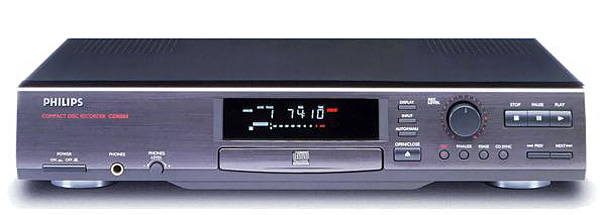
Compared to the Meridian CDR and the Pioneer PDR-99, the CDR880 is a lightweight, weighing in at well under 10 lbs. At first glance it looks like just another mass-market CD player—only the recording-level knob to the right of the display hints at any unusual capabilities. But a closer examination reveals that a lot of thought has gone into making the recorder easy to use. The controls are kept to a minimum; other than the necessary Play, Pause, Stop, Scan Forward, Reverse, and drawer Open/Close buttons, the '880 sports a mere seven buttons dedicated to the recording process: Auto/Manual track allocation, Display, Input select, Record, Finalize, Erase, and CDSYNC. Some of these are not obvious, but they're simple to use.
Auto/Manual track allocation allows you to set the machine to create a new track every time it senses a three-second pause; or, if you're recording from an analog source, to manually mark the beginning of each track by pressing the Record button. Input select allows you to choose between optical or coax digital inputs, or analog. Record is self-explanatory, except that pressing it puts the machine into Record standby—you must then press Play to start recording. Finalize performs the "cleanup" function once you've recorded all the data onto your disc—it writes the ToC (Table of Contents) so that other CD players can recognize and play the disc. CDSYNC is a convenient function that allows the consumer to copy whole CDs, DATs, or DCCs down to including track markers.
The '880 has gold-plated RCA jacks for coaxial S/PDIF input and output, as well as inputs and outputs for analog signals. TosLink input and output are also available. The mains connection is not the larger three-pin IEC type, but rather the smaller two-wire plug-in sort sometimes found on home appliances such as electric mixers.
The CDR880 utilizes a new Philips laser pickup/drive mechanism, the CDM36, which employs a heavy die-cast chassis, complete with suspension. It also has a high-density magnetic clamping mechanism and a low-noise, high-torque motor. Philips' TDA1305 D/A chip converts digital data to analog signal. S/PDIF input and output chores are handled by a TDA1315 chipset. If necessary, the signal is sample-rate-converted by a TDA1373 chip.
Teach us delight in simple things
Recording couldn't be simpler. Pop in a consumer-audio CD-R or CD-RW disc and close the drawer—then wait. The player reads the disc to determine whether it is a conventional CD, CD-R, or CD-RW, and, when it recognizes a blank of either type, performs an Optimal Power Calibration (OPC). During the OPC, the '880 calculates the required laser-energy level by performing a trial recording. This is made necessary by the number of different materials that can be used for the recording layer of a CD-R disc—each, of course, requires a different recording laser-beam power. After the OPC, the machine is ready: Choose your input, press Record, then press Play, and you're in business. Before you can play the CD-R on another machine, however, you must finalize it. This, too, is simple—just press Finalize followed by Record within two seconds, and the '880 will write a ToC. The process takes about two minutes. Be warned, however, that not every CD player will recognize finalized CD-Rs. I went to New York recently and played my CD-R of John Atkinson's 1997 recording of the Marc Copland Quartet on the systems of several Stereophile reviewers without incident, but when I tried to play it on my pal Ruben's CAL Icon II, the machine wouldn't acknowledge the disc's existence. Like other older CD players, it requires greater contrast between the land and the pits than the 40–70% reflectivity of CD-Rs. It also appears that DVD players that use a single-beam, multifocus laser will not recognize them either. Philips is being cautious about making claims for compatibility for CD-RWs, but when I tried a finalized disc in an Arcam Alpha 9, it played. I walked from room to room trying the CD-RW in other players I had in the house—neither the Meridian 508.24 nor the Audio Research CD2 recognized it. Intrigued, I went door-to-door around my neighborhood, trying it in players wherever they'd let me in. (Would you?) A Sony CDP-C535 played it, but a Denon DCM-360 and DCM-30 did not. Given the high price of the discs in the first place, I can't imagine anyone just handing them out like the mythical five-cent seegar, but I recommend checking playback compatibility before making any CD-RWs for friends.
To ask the hard question is simple
How well did the CDR880 perform? "As what?" I ask. As a CD player, I'd call the '880 competent but not too ambitious. It sounded like a lot of other mid-priced players: better than some, but not the pick of the litter. It had good, punchy bass, although truly deep bass seemed MIA, and it got the midrange essentially right. Voices and guitars sounded natural and focused. Further up the frequency band it ran into some hard going, however, as I felt string overtones and other HF information was slightly lackluster—not screechy, certainly, but not particularly sweet or extended either. Nor was it a soundstaging champ. But once I'd gotten used to its somewhat flattened perspective, I could distinguish layers of information from the front to the somewhat farther back. Good performance, but certainly not up to the best affordable CD players I've heard—like the Marantz CD63SE, for instance. But then, most people who buy an CDR880 will already own another CD player. The real question is, How did it perform as a recorder?
Footnote 1: Presumably a nod of the head to the concerns of the recording industry, this sample-rate conversion would ensure copyright owners that "the numbers were different," that a CD-R made on the '870 would not be a bit-for-bit clone of the CD being copied.—John Atkinson
The Philips CDR880 is a consumer CD recorder. That means it will recognize and record only on "consumer audio"–grade CD blanks. These are somewhat more expensive than the computer-grade CD blanks available at most stationery stores, since their price includes a royalty designed to reimburse musicians, composers, lyricists, et al for the lost revenues that recording CDs is supposed to cost them. How much more expensive? Well, Philips quotes consumer audio-grade discs at between $5 and $7 each, whereas Office Depot sells 10-packs of computer discs for $19.99, and I've seen them in computer catalogs for as little as $0.99 each, after rebate. As a consumer machine, the '880 also includes the Serial Copy Management System (SCMS)—a system that "allows" users to make first-generation copies from original copyright-protected CDs, but prevents them from making copies of copies.
Compared to the Meridian CDR and the Pioneer PDR-99, the CDR880 is a lightweight, weighing in at well under 10 lbs. At first glance it looks like just another mass-market CD player—only the recording-level knob to the right of the display hints at any unusual capabilities. But a closer examination reveals that a lot of thought has gone into making the recorder easy to use. The controls are kept to a minimum; other than the necessary Play, Pause, Stop, Scan Forward, Reverse, and drawer Open/Close buttons, the '880 sports a mere seven buttons dedicated to the recording process: Auto/Manual track allocation, Display, Input select, Record, Finalize, Erase, and CDSYNC. Some of these are not obvious, but they're simple to use.
Recording couldn't be simpler. Pop in a consumer-audio CD-R or CD-RW disc and close the drawer—then wait. The player reads the disc to determine whether it is a conventional CD, CD-R, or CD-RW, and, when it recognizes a blank of either type, performs an Optimal Power Calibration (OPC). During the OPC, the '880 calculates the required laser-energy level by performing a trial recording. This is made necessary by the number of different materials that can be used for the recording layer of a CD-R disc—each, of course, requires a different recording laser-beam power. After the OPC, the machine is ready: Choose your input, press Record, then press Play, and you're in business. Before you can play the CD-R on another machine, however, you must finalize it. This, too, is simple—just press Finalize followed by Record within two seconds, and the '880 will write a ToC. The process takes about two minutes. Be warned, however, that not every CD player will recognize finalized CD-Rs. I went to New York recently and played my CD-R of John Atkinson's 1997 recording of the Marc Copland Quartet on the systems of several Stereophile reviewers without incident, but when I tried to play it on my pal Ruben's CAL Icon II, the machine wouldn't acknowledge the disc's existence. Like other older CD players, it requires greater contrast between the land and the pits than the 40–70% reflectivity of CD-Rs. It also appears that DVD players that use a single-beam, multifocus laser will not recognize them either. Philips is being cautious about making claims for compatibility for CD-RWs, but when I tried a finalized disc in an Arcam Alpha 9, it played. I walked from room to room trying the CD-RW in other players I had in the house—neither the Meridian 508.24 nor the Audio Research CD2 recognized it. Intrigued, I went door-to-door around my neighborhood, trying it in players wherever they'd let me in. (Would you?) A Sony CDP-C535 played it, but a Denon DCM-360 and DCM-30 did not. Given the high price of the discs in the first place, I can't imagine anyone just handing them out like the mythical five-cent seegar, but I recommend checking playback compatibility before making any CD-RWs for friends.
How well did the CDR880 perform? "As what?" I ask. As a CD player, I'd call the '880 competent but not too ambitious. It sounded like a lot of other mid-priced players: better than some, but not the pick of the litter. It had good, punchy bass, although truly deep bass seemed MIA, and it got the midrange essentially right. Voices and guitars sounded natural and focused. Further up the frequency band it ran into some hard going, however, as I felt string overtones and other HF information was slightly lackluster—not screechy, certainly, but not particularly sweet or extended either. Nor was it a soundstaging champ. But once I'd gotten used to its somewhat flattened perspective, I could distinguish layers of information from the front to the somewhat farther back. Good performance, but certainly not up to the best affordable CD players I've heard—like the Marantz CD63SE, for instance. But then, most people who buy an CDR880 will already own another CD player. The real question is, How did it perform as a recorder?
Footnote 1: Presumably a nod of the head to the concerns of the recording industry, this sample-rate conversion would ensure copyright owners that "the numbers were different," that a CD-R made on the '870 would not be a bit-for-bit clone of the CD being copied.—John Atkinson