Sidebar 2: Measurements (from March 1989, Vol.12 No.3)
We have started to include in Stereophile's CD player reviews the 1/3-octave analyzed spectrum of a player's output while it reproduces the dithered –90.31dB tone from the CBS CD-1 test CD. With an undithered signal, a tone at this level only crosses three quantizing levels and therefore is not sufficiently described for it to be reproduced as a sinewave. However, as the code representing this tone on track 19 on the CBS disc has had an appropriate amount of dither noise added when the CD was cut, it should reproduce as a pure, if noisy, sinewave. Any distortion components present can therefore be laid at the door of the individual player's decoder and electronics.
A 1/3-octave spectrum analyzer obviously does not have sufficient resolving power to reveal individual distortion harmonics of a 1kHz tone higher than the 8th, and the Audio Control SA3050A analyzer we use has too limited a dynamic range to reveal the presence of harmonics that are significantly lower than –20dB with respect to the fundamental. Nevertheless, it is good enough to reveal major differences between CD players, giving an approximate idea of the levels of low-order distortion components present at low levels, as well as the level of power-supply–related noise. The graphical representation of a player's low-level performance is more informative, therefore, than a straight statement of by how many dB it compresses or expands the level at –90.31dB. (The rising level in the two octaves above 5kHz in all the spectra is, I presume, due mainly to the dither noise on the CD. However, as its level is not quite constant from player to player, it must also contain a contribution from decoder-generated spuriae.)
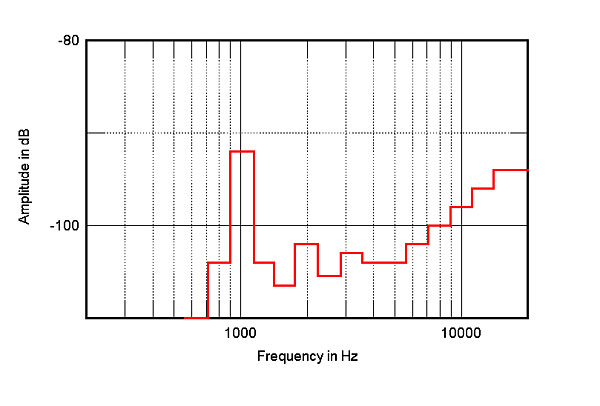 The spectrum for the Mod Squad Prism can be seen in fig.1. Using the TD1541 16-bit DAC chip, this player shows an expansion error at –90dB, –90.31dB reproducing as –92dB. (Measured levels are accurate to 0.5dB.) Even-order distortion is evidenced by the raised levels of the 2kHz and 4kHz bands, 10dB and 12dB below the level of the fundamental respectively, but the sinewave is relatively pure, nonetheless. Note the absence of mains-related products.—John Atkinson
Fig.1 The Mod Squad Prism, 1/3-octave spectrum of dithered 1kHz tone at –90.31dBFS, with noise and spuriae (16-bit data).