Sidebar 3: Measurements
I measured the Jadis Orchestra Black using my Audio Precision SYS2722 system (see the January 2008 "As We See It").
The Orchestra Black appears to be very similar to the Orchestra Reference Mk.II that Art Dudley reviewed in December 2015. I had various issues measuring the earlier amplifier, including a broken tube, and the fact that as the Orchestra Reference is a fixed-bias design I needed to reset the bias for each of the four new output tubes.
The output impedance was even higher than that of the Reference Mk.II, at close to 3.5 ohms across the audioband. The variation in response due to the interaction between the output impedance and that of my standard simulated loudspeaker was therefore a very audible ±1.9dB (fig.1, gray trace). The audioband response into purely resistive loads is flat to 30kHz, though it gently rolls off in the low bass. There is a steep rolloff above 40kHz, reaching –3dB at 50kHz into 8 ohms (fig.1, blue and red traces). A low-level resonant peak at 100kHz gives rise to a single damped cycle of ringing with a 10kHz squarewave (fig.2). The responses and the excellent channel balance in fig.1, which were taken with the volume control set to its maximum, didn't change at lower settings.
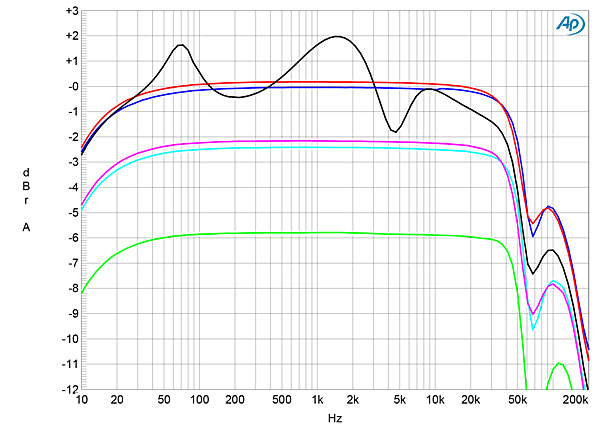
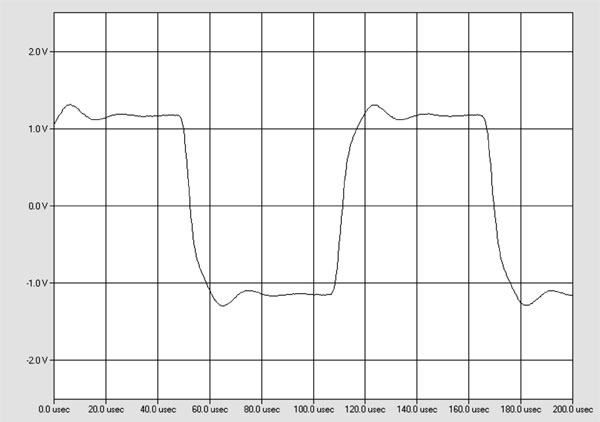
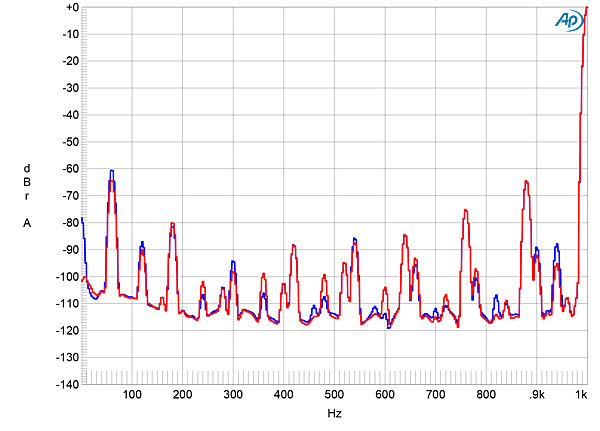 Fig.4 plots how the percentage of THD+noise changes with output power into 8 ohms. The THD begins to rise above the noise around 2W, confirming that the Orchestra Black uses only a modest amount of negative feedback. The THD+N reaches 1% (our normal definition of clipping) at 14Wpc into 8 ohms (11.5dBW); at 3% THD+N the amplifier delivered 49W (16.9dBW). Repeating this test into 4 ohms (fig.5) indicated a slightly higher level of distortion at low powers into this load. The Orchestra Black's THD+N reached 1% at 6Wpc into 4 ohms (4.8dBW) and delivered the specified 40Wpc into this load (13dBW) at 3.8% THD+N.
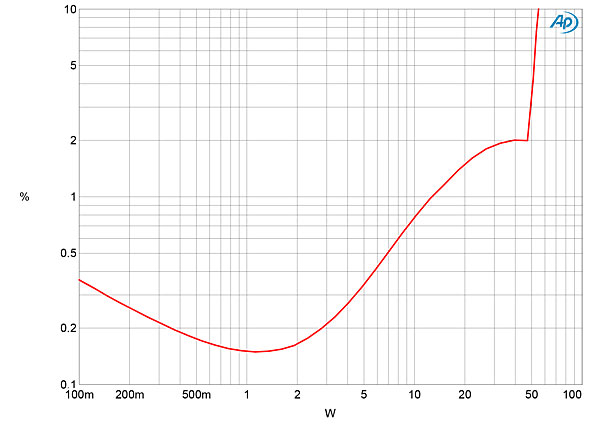

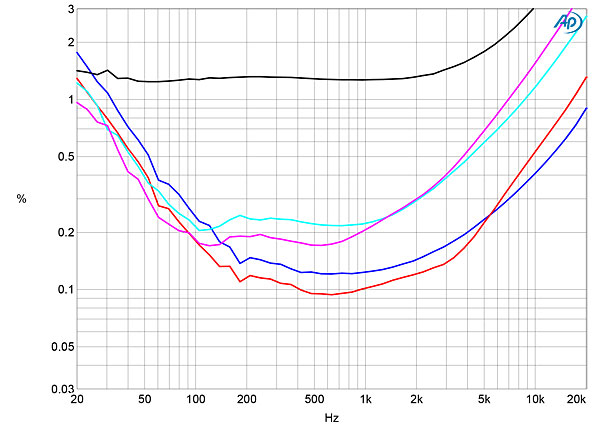
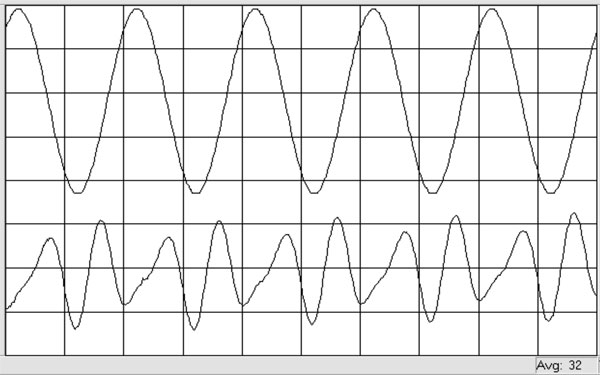
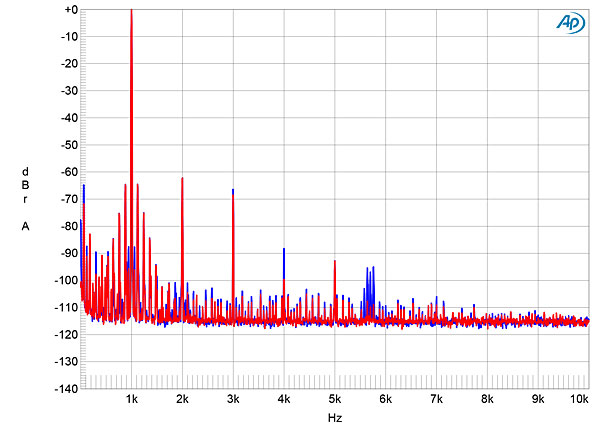
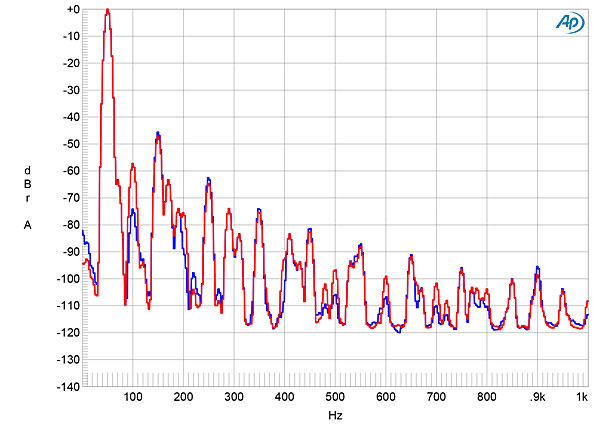
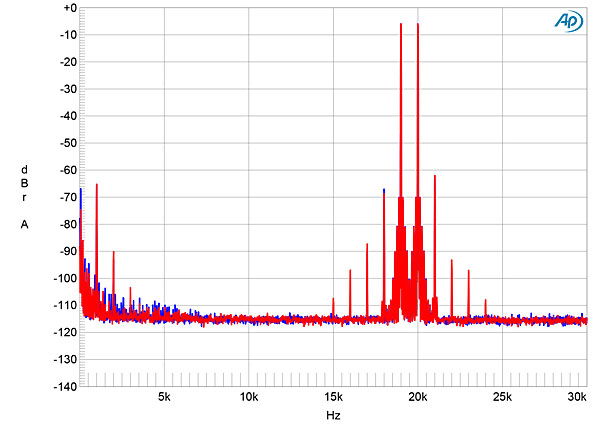
Fig.1 Jadis Orchestra Black, volume control set to maximum, frequency response at 2.83V into: simulated loudspeaker load (gray), 8 ohms (left channel blue, right red), 4 ohms (left cyan, right magenta), 2 ohms (red) (2dB/vertical div.).
Fig.2 Jadis Orchestra Black, small-signal, 10kHz squarewave into 8 ohms.
Channel separation at 1kHz was good in the L–R direction, at 80dB, but less so in the other direction, at 60dB. The wideband, unweighted signal/ noise ratio, ref. 2.83V into 8 ohms and taken with the input shorted but the volume control set to its maximum, was 67.8dB in the left channel and 70.9dB in the right channel. Both ratios increased to 85.8dB when A-weighted. Spectral analysis of the amplifier's noise floor indicated that the primary sources of noise are spuriae at the AC mains frequency of 60Hz and its harmonics (fig.3).
Fig.3 Jadis Orchestra Black, spectrum of 1kHz sinewave, DC–1kHz, at 1W into 8 ohms (linear frequency scale).
Fig.4 Jadis Orchestra Black, distortion (%) vs 1kHz continuous output power into 8 ohms.
Fig.5 Jadis Orchestra Black, distortion (%) vs 1kHz continuous output power into 4 ohms.
Like the earlier version of the Orchestra, the Black is not happy with loads below 4 ohms. This can be seen in fig.6, which plots the THD+N percentage against frequency at 2.83V, which is equivalent to 1W into 8 ohms (blue and red traces), 2W into 4 ohms (cyan, magenta), and 4W into 2 ohms (gray). Despite the relatively low power, the Jadis's THD+N is >1% at all frequencies into 2 ohms. The distortion signature in the midrange appears to be primarily the subjectively innocuous second harmonic (figs.7 & 8), though the third harmonic dominates at low frequencies (fig.9). This is most likely due to the output transformer core starting to saturate. Intermodulation distortion was relatively low, however. The difference product at 1kHz, resulting from the Orchestra Black driving an equal mix of 19kHz and 20kHz tones at a modest power into 8 ohms (fig.10), lay at –66dB (0.05%).
Fig.6 Jadis Orchestra Black, THD+N (%) vs frequency at 2.83V into: 8 ohms (left channel blue, right red), 4 ohms (left cyan, right magenta), 2 ohms (gray).
Fig.7 Jadis Orchestra Black, 1kHz waveform at 1W into 8 ohms, 0.13% THD+N (top); distortion and noise waveform with fundamental notched out (bottom not to scale).
Fig.8 Jadis Orchestra Black, spectrum of 1kHz sinewave, DC–1kHz, at 1W into 8 ohms (linear frequency scale).
Fig.9 Jadis Orchestra Black, spectrum of 50Hz sinewave, DC–1kHz, at 2W into 8 ohms (linear frequency scale).
Fig.10 Jadis Orchestra Black, HF intermodulation spectrum, DC–24kHz, 19+20kHz at 2W peak into 8 ohms (linear frequency scale).
The Jadis Orchestra Black performed on the test bench as I would expect from a push-pull amplifier using a single pair of EL34 output tubes per channel. It should not be partnered with loudspeakers whose impedance drops below 4 ohms.—John Atkinson