Focal Clear vs Audeze LCD-X: Audeze's easy-to-drive, 20-ohm, 103dB/mW LCD-X headphones are my real-world reference cans. They and Sennheiser's HD 800 S headphones—both models cost $1699—are the ones that Focal's Clear, at $1500, needs to beat.
My experiences with the venerable HD 800 Ses are limited to trying them at CanJams, but the not-always-comfortable LCD-Xes have spent more time on my head than have any headphones other than the Koss Porta Pros. I cherish the Audezes' lively, blues-with-a-feeling dynamics and the burnished-toned way they reproduce the sounds of violins, guitar amps, and sopranos.
But while the LCD-Xes have long satisfied my tastes, Focal's new Clears sound, to me, more correct in tone and spectral balance. And their metal domes sound less metallic than do the Audezes' Mylar-film, planar-magnetic drivers. How can that be?
With the Clear, Padmavibhushan Dr. Ali Akbar Khan, playing the sarod (an ancient, Hindustani stringed instrument) on his Indian Architexture (SACD, Water Lily Acoustics WLA-ES-20-SACD), sounded noticeably more pure of tone and transparent than with the LCD-Xes. Spatial perspectives were more precisely described. The Clears' greater transparency wiped away the LCD-Xes' slight veiling, revealing more of Akbar Khan's mastery of the sarod.
Conclusions: I have logged months of daily use of the Focal Clears, and compared them at length with Audeze's LCD-X and with Focal's own Elear and Utopia headphones. To my ears, the Elears seem subliminally dull on some microdynamic level that makes them less engaging than the more extroverted Clears. The Utopias are the least dull, most highly resolving headphones I know, but, like the Audezes, they deliver music with a kind of metal-tempered resilience that I find distracting. Nowadays, I use the Utopias and LCD-Xes as tools for studying recordings rather than for listening pleasure. Fortunately, listening pleasure is exactly what the Focal Clears gave me. They had that super-satisfying, just-right Goldilocks magic. They are my new real-world reference.
iFi Audio Pro iCAN headphone amplifier
Opening the shrink-wrapped box containing iFi Audio's Pro iCAN headphone amplifier ($1699) felt exactly like unpacking an expensive new Apple product. As I removed the polished outer sleeve, the silver iFi logo on the box within had me thinking, Classy logo, classy company—hope the sound is classy. Will it make a good preamp? Will it drive the HiFiMan Susvaras?
 In life, having choices makes me feel safe and empowered. But in audio, choices are mostly annoying and unsettling. They mean features, and I am no fan of features. I prefer to pay for performance. I prefer my DACs and amps to come in solid, pedestrian cases with sturdy isolating feet, but no display, buttons, or remote control. Products with long menus of features make me think their manufacturers are pandering to the marketplace, wasting customers' money, and lack authentic audio aesthetics of their own.
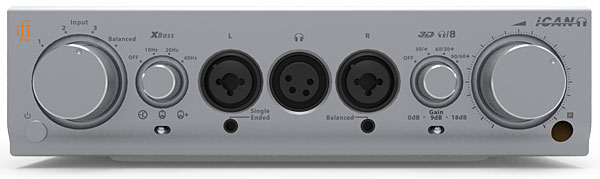
For these reasons, my extremely positive CanJam auditions of iFi's first product in its new Pro series, the iCAN headphone amplifier–preamplifier, were marred by what I perceived as a plethora of pandering features. The front panel is jam-packed with switchy doodads, including a three-position switch that lets the user choose among Solid-State (pure class-A J-FET), Tube (all-tube class-A with two 5670 tubes), and Tube+ (which reduces negative feedback).
Besides the big Input and Volume dials, there are two smaller knobs: one controls iFi's XBass "analogue signal processing (ASP)" bass-correction system, which offers up to 12dB of boost at three low-frequency turnover points: 10, 20, and 40Hz. The other small knob selects among three "3D Holographic Matrix" circuits labeled 30-60-90-degrees, for either headphones or loudspeakers. According to the owner's manual, "The 3D Holographic for Headphones is [an analogue matrix circuit] not based on a standard [DSP] cross-feed system," but "renders the whole 3D soundfield in a manner that strongly parallels listening to loudspeakers in a normal room." Personally, I prefer my ASP straight—no ice, no glass.
In life, having choices makes me feel safe and empowered. But in audio, choices are mostly annoying and unsettling. They mean features, and I am no fan of features. I prefer to pay for performance. I prefer my DACs and amps to come in solid, pedestrian cases with sturdy isolating feet, but no display, buttons, or remote control. Products with long menus of features make me think their manufacturers are pandering to the marketplace, wasting customers' money, and lack authentic audio aesthetics of their own.
For these reasons, my extremely positive CanJam auditions of iFi's first product in its new Pro series, the iCAN headphone amplifier–preamplifier, were marred by what I perceived as a plethora of pandering features. The front panel is jam-packed with switchy doodads, including a three-position switch that lets the user choose among Solid-State (pure class-A J-FET), Tube (all-tube class-A with two 5670 tubes), and Tube+ (which reduces negative feedback).
Besides the big Input and Volume dials, there are two smaller knobs: one controls iFi's XBass "analogue signal processing (ASP)" bass-correction system, which offers up to 12dB of boost at three low-frequency turnover points: 10, 20, and 40Hz. The other small knob selects among three "3D Holographic Matrix" circuits labeled 30-60-90-degrees, for either headphones or loudspeakers. According to the owner's manual, "The 3D Holographic for Headphones is [an analogue matrix circuit] not based on a standard [DSP] cross-feed system," but "renders the whole 3D soundfield in a manner that strongly parallels listening to loudspeakers in a normal room." Personally, I prefer my ASP straight—no ice, no glass.
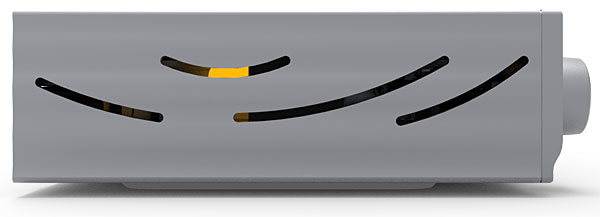
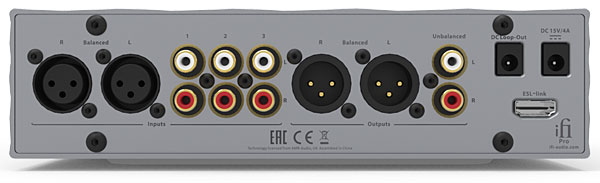 That said, the Pro iCAN provides choices I do like, including: variable gain (0, 9, or 18dB), which I regard as a necessary feature on any headphone amp, if it can be achieved without sonic compromise; three unbalanced (RCA) and one balanced (XLR) line-level inputs; and single-ended and balanced outputs. You can also choose among five headphone output jacks: one four-pin and two three-pin balanced (all XLRs); two balanced/single-ended (6.3mm TRS); one single-ended (3.5mm); and one balanced (3.5mm, TRRS standard). The case and volume control feel of professional quality: solid and smooth. And happily, the Pro iCAN is the exact size—7.6" wide by 2.5" high by 8.4" deep—to stack atop my Mytek HiFi Brooklyn DAC (they worked well together). The Pro iCAN's two high-frequency, twin-triode, NOS GE 5670 tubes glowed lurid orange through their magnifier on the top panel, surrounded by ventilation slots cut in a pattern of concentric circles.
iFi calls the Pro iCAN's audio circuit TubeState. It's fully discrete and fully balanced, with a switchable choice of tube or J-FET input: a bipolar second stage and a MOSFET-buffered bipolar, class-A power-output stage that shifts to class-AB at high output levels with low-impedance headphones. According to the manual, the Pro iCAN can deliver 14,000mW (balanced) or 4800mW (single-ended) into 16 ohms, or 23V (balanced) or 11.5V (single-ended) into 600 ohms.
That said, the Pro iCAN provides choices I do like, including: variable gain (0, 9, or 18dB), which I regard as a necessary feature on any headphone amp, if it can be achieved without sonic compromise; three unbalanced (RCA) and one balanced (XLR) line-level inputs; and single-ended and balanced outputs. You can also choose among five headphone output jacks: one four-pin and two three-pin balanced (all XLRs); two balanced/single-ended (6.3mm TRS); one single-ended (3.5mm); and one balanced (3.5mm, TRRS standard). The case and volume control feel of professional quality: solid and smooth. And happily, the Pro iCAN is the exact size—7.6" wide by 2.5" high by 8.4" deep—to stack atop my Mytek HiFi Brooklyn DAC (they worked well together). The Pro iCAN's two high-frequency, twin-triode, NOS GE 5670 tubes glowed lurid orange through their magnifier on the top panel, surrounded by ventilation slots cut in a pattern of concentric circles.
iFi calls the Pro iCAN's audio circuit TubeState. It's fully discrete and fully balanced, with a switchable choice of tube or J-FET input: a bipolar second stage and a MOSFET-buffered bipolar, class-A power-output stage that shifts to class-AB at high output levels with low-impedance headphones. According to the manual, the Pro iCAN can deliver 14,000mW (balanced) or 4800mW (single-ended) into 16 ohms, or 23V (balanced) or 11.5V (single-ended) into 600 ohms.
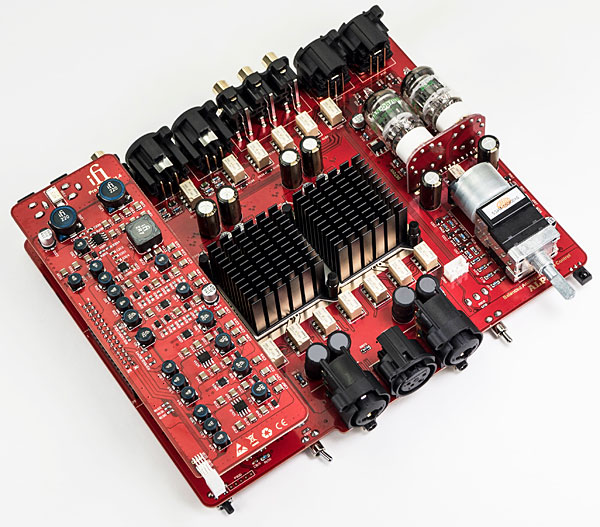 All of these features make me ask: What exactly is the iFi Pro iCAN? Is it a "studio-grade" product, as claimed on its webpage? Or a feature-fueled lifestyle product? It appears to be both. Either way, the Pro iCAN played recordings in an unusually appealing manner—which is why I'm writing about it.
During the iFi Pro iCAN's tenure in the bunker, I used it mostly to play music files via Mytek HiFi's Brooklyn and Manhattan II DACs. I used the iCAN, along with the Manhattan II, Rogue Audio RH-5, and Pass Laboratories HPA-1 headphone amps, to compare the Focal Clear, Elear, and Utopia headphones. During all this, driving any of these headphones, the Pro iCAN was never sonically outclassed, and never the weak link.
Listening to Puente Celeste's Nama (DSD128, MA Recordings M084A) with the 83dB-sensitive HiFiMan Susvaras caused me to wonder: Why should the Tube+ (reduced feedback) setting sound the most transparent, unrestrained, and naturally flowing? Tube+ was a gentler, more elastic version of the plain Tube setting, which in turn was a more vivid and elastic version of the pure JFET option, which seemed too tight and spatially restricted. Tube+ was the setting at which the music felt most free, and singers and instruments felt the most there and real. The second surprise of this connection was how the 9dB gain setting was fine for the low-sensitivity Susvaras, the 18dB setting too hard and flat. At 18dB, instruments gained in impact and body but lost an important measure of organic flow. With more sensitive headphones, I preferred the openness of the 0dB gain setting.
All of these features make me ask: What exactly is the iFi Pro iCAN? Is it a "studio-grade" product, as claimed on its webpage? Or a feature-fueled lifestyle product? It appears to be both. Either way, the Pro iCAN played recordings in an unusually appealing manner—which is why I'm writing about it.
During the iFi Pro iCAN's tenure in the bunker, I used it mostly to play music files via Mytek HiFi's Brooklyn and Manhattan II DACs. I used the iCAN, along with the Manhattan II, Rogue Audio RH-5, and Pass Laboratories HPA-1 headphone amps, to compare the Focal Clear, Elear, and Utopia headphones. During all this, driving any of these headphones, the Pro iCAN was never sonically outclassed, and never the weak link.
Listening to Puente Celeste's Nama (DSD128, MA Recordings M084A) with the 83dB-sensitive HiFiMan Susvaras caused me to wonder: Why should the Tube+ (reduced feedback) setting sound the most transparent, unrestrained, and naturally flowing? Tube+ was a gentler, more elastic version of the plain Tube setting, which in turn was a more vivid and elastic version of the pure JFET option, which seemed too tight and spatially restricted. Tube+ was the setting at which the music felt most free, and singers and instruments felt the most there and real. The second surprise of this connection was how the 9dB gain setting was fine for the low-sensitivity Susvaras, the 18dB setting too hard and flat. At 18dB, instruments gained in impact and body but lost an important measure of organic flow. With more sensitive headphones, I preferred the openness of the 0dB gain setting.
 At 9dB gain, the Susvaras reproduced Nama with a level of visceral excitement that occurs only with a great recording, world-class headphones, and an amp able to bring out the best of both. In Solid-State mode, "Chiquita" was fast, punchy, tautly defined, and spatially precise, but voices seemed harmonically restrained. In Tube mode, some of the harmonics returned—but the real glories of this spectacular MA download were still hidden and restrained. In Tube+ mode, its full harmonic splendor and illusions of space returned. Tube+ made me forget about hi-fi reviewing for a while.
When I used the Pro iCAN as a line-level preamp (0dB gain), it seemed higher-resolving, tighter, and more transparent in Solid-State mode. Still, I preferred the bigger soundstage, natural presence, and fully developed harmonics of Tube+.
The problem is the iFi Pro iCAN's price. There are more than a few distinguished headphone amplifiers available for $1699 or thereabouts—Schiit Audio's impressive Ragnarok integrated amplifier ($1699) comes to mind. Besides driving loudspeakers with 100W into 4 ohms, the Ragnarok can output 15W (!) into 32-ohm headphones—and sound muy bien, très bon while doing so. Nevertheless, I believe that the iFi Pro iCAN's most distinguishing and valuable feature was its unique and appealing reproduction of music in its Tube+ mode, with 0dB gain, and reduced feedback. A must-audition at your next CanJam.
At 9dB gain, the Susvaras reproduced Nama with a level of visceral excitement that occurs only with a great recording, world-class headphones, and an amp able to bring out the best of both. In Solid-State mode, "Chiquita" was fast, punchy, tautly defined, and spatially precise, but voices seemed harmonically restrained. In Tube mode, some of the harmonics returned—but the real glories of this spectacular MA download were still hidden and restrained. In Tube+ mode, its full harmonic splendor and illusions of space returned. Tube+ made me forget about hi-fi reviewing for a while.
When I used the Pro iCAN as a line-level preamp (0dB gain), it seemed higher-resolving, tighter, and more transparent in Solid-State mode. Still, I preferred the bigger soundstage, natural presence, and fully developed harmonics of Tube+.
The problem is the iFi Pro iCAN's price. There are more than a few distinguished headphone amplifiers available for $1699 or thereabouts—Schiit Audio's impressive Ragnarok integrated amplifier ($1699) comes to mind. Besides driving loudspeakers with 100W into 4 ohms, the Ragnarok can output 15W (!) into 32-ohm headphones—and sound muy bien, très bon while doing so. Nevertheless, I believe that the iFi Pro iCAN's most distinguishing and valuable feature was its unique and appealing reproduction of music in its Tube+ mode, with 0dB gain, and reduced feedback. A must-audition at your next CanJam.
Opening the shrink-wrapped box containing iFi Audio's Pro iCAN headphone amplifier ($1699) felt exactly like unpacking an expensive new Apple product. As I removed the polished outer sleeve, the silver iFi logo on the box within had me thinking, Classy logo, classy company—hope the sound is classy. Will it make a good preamp? Will it drive the HiFiMan Susvaras?
In life, having choices makes me feel safe and empowered. But in audio, choices are mostly annoying and unsettling. They mean features, and I am no fan of features. I prefer to pay for performance. I prefer my DACs and amps to come in solid, pedestrian cases with sturdy isolating feet, but no display, buttons, or remote control. Products with long menus of features make me think their manufacturers are pandering to the marketplace, wasting customers' money, and lack authentic audio aesthetics of their own.
For these reasons, my extremely positive CanJam auditions of iFi's first product in its new Pro series, the iCAN headphone amplifier–preamplifier, were marred by what I perceived as a plethora of pandering features. The front panel is jam-packed with switchy doodads, including a three-position switch that lets the user choose among Solid-State (pure class-A J-FET), Tube (all-tube class-A with two 5670 tubes), and Tube+ (which reduces negative feedback).
Besides the big Input and Volume dials, there are two smaller knobs: one controls iFi's XBass "analogue signal processing (ASP)" bass-correction system, which offers up to 12dB of boost at three low-frequency turnover points: 10, 20, and 40Hz. The other small knob selects among three "3D Holographic Matrix" circuits labeled 30-60-90-degrees, for either headphones or loudspeakers. According to the owner's manual, "The 3D Holographic for Headphones is [an analogue matrix circuit] not based on a standard [DSP] cross-feed system," but "renders the whole 3D soundfield in a manner that strongly parallels listening to loudspeakers in a normal room." Personally, I prefer my ASP straight—no ice, no glass.
That said, the Pro iCAN provides choices I do like, including: variable gain (0, 9, or 18dB), which I regard as a necessary feature on any headphone amp, if it can be achieved without sonic compromise; three unbalanced (RCA) and one balanced (XLR) line-level inputs; and single-ended and balanced outputs. You can also choose among five headphone output jacks: one four-pin and two three-pin balanced (all XLRs); two balanced/single-ended (6.3mm TRS); one single-ended (3.5mm); and one balanced (3.5mm, TRRS standard). The case and volume control feel of professional quality: solid and smooth. And happily, the Pro iCAN is the exact size—7.6" wide by 2.5" high by 8.4" deep—to stack atop my Mytek HiFi Brooklyn DAC (they worked well together). The Pro iCAN's two high-frequency, twin-triode, NOS GE 5670 tubes glowed lurid orange through their magnifier on the top panel, surrounded by ventilation slots cut in a pattern of concentric circles.
iFi calls the Pro iCAN's audio circuit TubeState. It's fully discrete and fully balanced, with a switchable choice of tube or J-FET input: a bipolar second stage and a MOSFET-buffered bipolar, class-A power-output stage that shifts to class-AB at high output levels with low-impedance headphones. According to the manual, the Pro iCAN can deliver 14,000mW (balanced) or 4800mW (single-ended) into 16 ohms, or 23V (balanced) or 11.5V (single-ended) into 600 ohms.
All of these features make me ask: What exactly is the iFi Pro iCAN? Is it a "studio-grade" product, as claimed on its webpage? Or a feature-fueled lifestyle product? It appears to be both. Either way, the Pro iCAN played recordings in an unusually appealing manner—which is why I'm writing about it.
At 9dB gain, the Susvaras reproduced Nama with a level of visceral excitement that occurs only with a great recording, world-class headphones, and an amp able to bring out the best of both. In Solid-State mode, "Chiquita" was fast, punchy, tautly defined, and spatially precise, but voices seemed harmonically restrained. In Tube mode, some of the harmonics returned—but the real glories of this spectacular MA download were still hidden and restrained. In Tube+ mode, its full harmonic splendor and illusions of space returned. Tube+ made me forget about hi-fi reviewing for a while.