Maestro, musique!
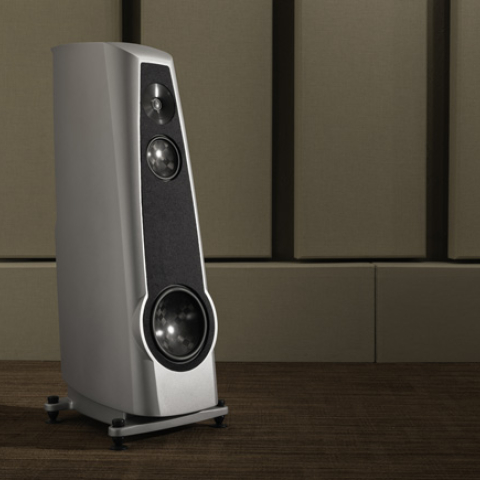
Through the Maestro Evos, the bass on Metropolis's "Planners and Thinkers" (16/44.1 FLAC, Soundtrack Classics/Tidal) slammed so deep and turned so seismic, it was almost scary. My room is built on a concrete slab with rubber subflooring, but damned if my chair didn't shake. I'd accidentally clicked the "loop track" button in Roon and was powerless against the repeats. The sound was so satisfying that I let the recording play four, five times in a row. I also got bruising bass on "Prism" by British trip-hop outfit Submotion Orchestra (16/44.1 FLAC, SMO/Qobuz). The listening experience was almost tactile. The Maestros' super-beefy low end and their unapologetic boisterousness might be a little too much for some listeners. In food terms, this speaker is the 16oz ribeye (saturated fat and all), not the lean 10oz sirloin. Me, I'm a ribeye man. Sometimes I even put the "SUB BASS LEVEL" jumper on the back of the speakers in the rightmost position for a little extra bass. Next up was "Slang" (16/44.1 FLAC, A440/Tidal), a Jaco Pastorius composition played by Brian Bromberg on both fretted and fretless basses. Though all multitracked parts play in more or less the same register, nothing sounded jumbled or crowded. It was easy to follow each bass line, even as they wrapped around each other.
 The album I've played more than any other this year is Charles Mingus's The Black Saint and the Sinner Lady (24/96 FLAC, Impulse!/Qobuz). By turns lyrical and frenetic, the album turned 60 years old this summer. It deserves some commemoration—plus a few awed relistens—for the offbeat arrangements alone. The tortured bassist and his band paint with rich brass textures and trippy, furious colors. Muted horns sound like they're singing, wailing, protesting, mourning. There's an obvious debt in the orchestration to Duke Ellington's Anatomy of a Murder, but Mingus is much brasher than the older man, taking improvisation to the brink of anarchy before pulling his musicians back into the fold of the written score. Add some flamenco-guitar passages, a lush classical-piano part, and a flurry of surprising chord changes and rhythm shifts, and there it is: an affecting musical triumph, undiminished by age.
If you need convincing that the Maestros can do more than punch hard and low, the Mingus masterpiece is exhibit A. Those textures I mentioned came through with astonishing control and liveliness.
Some fault metal-dome tweeters, including beryllium-dome tweeters, for sounding sharp and penetrating. Not in my book. When John Atkinson wrote his review of the Maestro Evos' predecessors (also equipped with beryllium-dome HF drivers), he found that the speakers were "a touch mellow in the top octave." That's true with the Evos as well. The Maestros give you what's there, excelling in detail, but the tweeter range isn't goosed in pursuit of faux high-frequency resolution.
The album I've played more than any other this year is Charles Mingus's The Black Saint and the Sinner Lady (24/96 FLAC, Impulse!/Qobuz). By turns lyrical and frenetic, the album turned 60 years old this summer. It deserves some commemoration—plus a few awed relistens—for the offbeat arrangements alone. The tortured bassist and his band paint with rich brass textures and trippy, furious colors. Muted horns sound like they're singing, wailing, protesting, mourning. There's an obvious debt in the orchestration to Duke Ellington's Anatomy of a Murder, but Mingus is much brasher than the older man, taking improvisation to the brink of anarchy before pulling his musicians back into the fold of the written score. Add some flamenco-guitar passages, a lush classical-piano part, and a flurry of surprising chord changes and rhythm shifts, and there it is: an affecting musical triumph, undiminished by age.
If you need convincing that the Maestros can do more than punch hard and low, the Mingus masterpiece is exhibit A. Those textures I mentioned came through with astonishing control and liveliness.
Some fault metal-dome tweeters, including beryllium-dome tweeters, for sounding sharp and penetrating. Not in my book. When John Atkinson wrote his review of the Maestro Evos' predecessors (also equipped with beryllium-dome HF drivers), he found that the speakers were "a touch mellow in the top octave." That's true with the Evos as well. The Maestros give you what's there, excelling in detail, but the tweeter range isn't goosed in pursuit of faux high-frequency resolution.
In his 2021 review of Magico's M2, Jim Austin wrote something that stuck with me: "Some big speakers turn pianos into battleships. I admit that this can be a pleasant experience, but it's not realistic; plus, it's unnerving to encounter a 15' soprano." He added, "some big speakers ... make all music sound big."
 Well, that's the Maestros, to an extent. They do small and intimate just fine, delectably even—but sometimes, they scale things up. No, they never conjured 15' Brünnhildes, but Paquito D'Rivera's solo clarinet at the beginning of "Afro," from the terrific Habanera (16/44.1 FLAC, Enja/Tidal), did sound larger than life in my room. Michael Hedges's acoustic guitar on the Zappa composition "Sofa No.1," off Oracle (16/44.1 FLAC, Windham Hill/Qobuz), was a touch inflated, too.
I am torn. Is there some exaggeration in how the Maestros present small instruments and solo vocals? Often, yes. Is it engaging and thrilling all the same? Also yes. Moving the speakers closer together addressed my gripe to some extent, rendering instruments smaller, but the soundstage got smaller, too, and I sensed a bit less of the majesty that I find so appealing in the Maestros.
Clearly this issue is highly recording-dependent; it depends on how the microphones were placed and how the music was mixed. On one of the most arresting songs from David Bowie's vast catalog, "Bring Me the Disco King," from Reality (16/44.1 MQA, ISO/Qobuz), a grand piano and a minimalist, cymbal-less drum kit are drawn with proper proportions—and the Thin White Duke has the voice of a vulnerable man, not a giant. These lines have taken on new meaning since his death seven years ago:
Well, that's the Maestros, to an extent. They do small and intimate just fine, delectably even—but sometimes, they scale things up. No, they never conjured 15' Brünnhildes, but Paquito D'Rivera's solo clarinet at the beginning of "Afro," from the terrific Habanera (16/44.1 FLAC, Enja/Tidal), did sound larger than life in my room. Michael Hedges's acoustic guitar on the Zappa composition "Sofa No.1," off Oracle (16/44.1 FLAC, Windham Hill/Qobuz), was a touch inflated, too.
I am torn. Is there some exaggeration in how the Maestros present small instruments and solo vocals? Often, yes. Is it engaging and thrilling all the same? Also yes. Moving the speakers closer together addressed my gripe to some extent, rendering instruments smaller, but the soundstage got smaller, too, and I sensed a bit less of the majesty that I find so appealing in the Maestros.
Clearly this issue is highly recording-dependent; it depends on how the microphones were placed and how the music was mixed. On one of the most arresting songs from David Bowie's vast catalog, "Bring Me the Disco King," from Reality (16/44.1 MQA, ISO/Qobuz), a grand piano and a minimalist, cymbal-less drum kit are drawn with proper proportions—and the Thin White Duke has the voice of a vulnerable man, not a giant. These lines have taken on new meaning since his death seven years ago:
 Don't let me know when you're opening the door.
Close me in the dark, let me disappear.
Soon there'll be nothing left of me,
Nothing left to release. Though Bowie recorded the song at age 56, 13 years before he died, his vocals sound tired, but beautiful in the way of old leather or a fallen autumn leaf. The almost eight-minute-long lamentation is shot through with ache and regret. It's no swan song, but it would have fit seamlessly on his final two albums, The Next Day and Blackstar, on which his life force had begun to wane—though not his capacity for beauty. The frailty of "Disco King" and its maker is underlined by a couple of small errors. Bowie hits a wrong note in the second line of verse two. Pianist Mike Garson, in his most memorable performance since 1973's hyper-lyrical "Lady Grinning Soul" (off Aladdin Sane), gets creative with the timing and dynamics of his phrases and finally comes in simply too late with a chord around 3:10.
One moment, the Maestros take on the character of a 200lb street brawler, the next, that of a ballerina. They did the only thing that matters in the wild world of hi-fi: connect me to the music. I produced pages of notes full of terms like authority, grace, ebullience, grandeur, brawn. But maybe this says it better than reams of descriptors: During the evaluation of almost every new piece in my system, I make a fresh Roon playlist of songs that show off the product particularly well. On average, I end up with a list of 30, 40 songs. After two months with the Maestros, I was up to 157 tracks. From chamber quartets to EDM, orchestral showpieces to Appalachian folk, delta blues to big band, these exceptional French speakers brought the joy. Astute and revealing, they're among the hautest of haut-parleurs.