Manufacturer's Comment
Editor: We greatly appreciate the time and effort that John Atkinson and Art Dudley have put into becoming intimately familiar with our latest DragonFlys. Our goal was to surpass versions 1.0 and 1.2 in every meaningful way, reaching new levels of performance and value through the successful implementation of sophisticated technology, enabling compatibility with mobile devices, and providing software upgradability.
In direct comparisons against the original DragonFly, Art preferred the Black for its "superior musical incisiveness: clearer pitch relationships and more sharply drawn rhythmic nuances." Elsewhere, Art is no less poignant: "Black kicked the old DAC's ass out the door." The Red, meanwhile, impressed Art with its greater musical nuance, improved senses of drama and drive, and ultimate ability to communicate the emotion in a performance: "it was easier, with the Red, to hear and feel the enthusiasm with which each singer attacked his lines."
Something we've long admired is Stereophile's "separation of powers"—subjective listening balanced by objective measurements—a quality unique to the magazine and of great value to its readers. There may be no single measurement that can reliably predict an audio component's ability to stimulate the listener's emotions, but measurements can provide meaningful insight into a product's fundamental character.
While John's work on the test bench reveals good overall measured performance, we were surprised by the Red's results, as our own tests have indicated no such anomalies. Of the two models, the Red, with its more sophisticated parts and circuit design, should invariably demonstrate significantly higher performance—both in the listening environment and on the test bench. As Art noted, the Red delivered "an emotional mainline of conductor and orchestra playing as one, in accordance with a single, sensitive musical vision"—beautiful words, and extremely high praise.
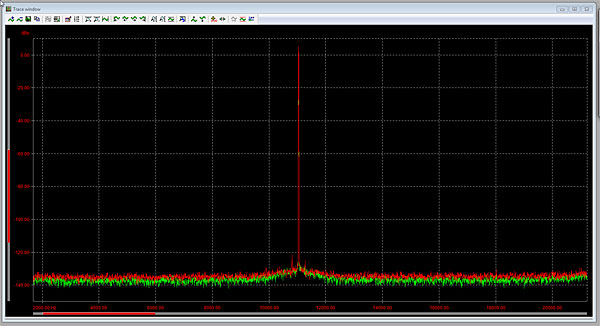
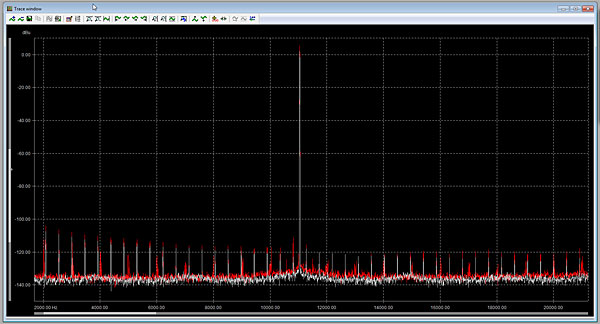
With this in mind, and in an attempt to better understand John's findings, lead designer Gordon Rankin subjected nine random samples of the Red to an intense battery of tests, using the Apple Music app to play 24-bit files from an iPad, as well as several Mac computers running OSX. As with John's tests, all DSP—equalization, level normalization, etc.—was disabled. Gordon's tests were performed using a Prism Sound dScope Series III measurement system.
As you'll see from figs.1 and 2, Gordon's tests reveal much cleaner results—commensurate with the performance that we'd expect from the Red.
 We hope that we have contributed information that will result in greater insight and understanding, and that all who listen may enjoy an experience as "emotionally devastating" as that described and felt by Art—with similar degrees of nuance, power, and pure musicality.—Steve Silberman, VP Development
Gordon Rankin, lead designer
AudioQuest
Fig.1 J-Test (24-bit): red trace shows results from an iPad Mini (v.1); green trace shows results from a MacBook Pro running Quad Xeon OS 10.11.5.
Fig.2 J-Test (16-bit): red trace shows the results from an iPad Mini (v.1); gray trace shows results from a MacBook Pro running Quad Core OS 10.11.5.
While we are confident in John's process, we are concerned about his findings, and we look forward to receiving his measurement samples so that we can learn more.
Gordon Rankin, lead designer
AudioQuest