In Ultralinear mode, a smaller (lower-voltage) version of the audio signal is taken from a tap on the output transformer primary winding and applied to the second grid. The keys to Ultralinear operation are choosing just the right signal level to apply and choosing precisely where on that coil—usually expressed as a percentage—you want the tap. Get those things right and distortion is minimized. Ultralinear is a form of feedback.
The other big advantage to Ultralinear operation is that you get more power. The 160 is specified to put out twice as much—140W—in Ultralinear mode than in triode mode, where it is specified at 70W.
To invoke a clichè, triode is for your right brain and Ultralinear is for your left. Triode sound is sweeter and rounder, while Ultralinear sound is punchier, and perhaps more extended. "Most will default to Ultralinear and use triode on certain recordings," Gordon told me.
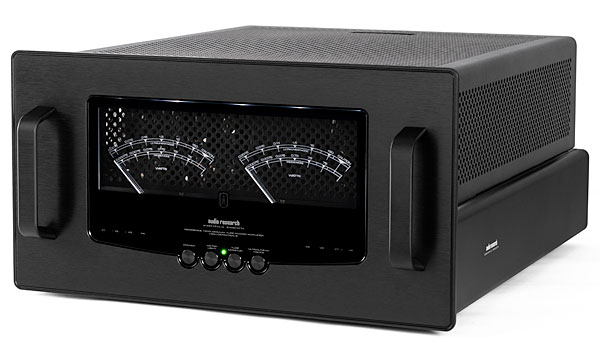
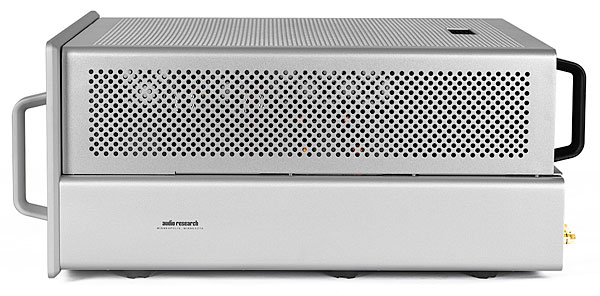
That's all the adjustments it is possible to make. The Reference 160 S is not really an amp to play with. It's an amp to listen to . . . and also to look at, because the Reference 160S is lovely in an uncommon way—unique in my experience except for its untwinned twin, the 160 M. I don't know if they were thinking about it this way—I kind of doubt it—but to me, visually, the 160 S is a slightly arch, minimalist riff on what Audio Research amps are supposed to look like. With its pale faceplate and starlit power meters—all silver and white light—there's a heavenly austerity to it that complements its sound. Fairy dust.
 That sound
I wonder what Bill Johnson would think of today's transistor amplifiers. You've probably heard this before, but Bill wasn't against transistors—his company built amplifiers out of them for years—he just didn't think they sounded as good as tubes do. He acknowledged during his lifetime that transistor amps had gotten better. Johnson also made the point, from the company's earliest days, that Audio Research doesn't make euphonic tube amps. He claimed to be aiming for honest, accurate, undistorted sound. So I wonder, if he were still around, how he would judge the Reference 160 S's performance against that of any of a number of very good solid-state amplifiers that, like the Reference 160 S, defy sonic clichès. I started my listening with that question in mind.
Weeks ago, I de-crated the 160 S, added the tubes, and hooked it up to my system. I left it in as we—the amp and I—got used to each other. Finally, I got down to business. I put on the first movement of Mahler's Symphony No.2 with Benjamin Zander and the Philharmonia Orchestra (Linn Records, 24/192 ALAC download). I turned up the volume to the lowest point where I could hear the quietest passages distinctly. This recording has such a wide dynamic range that, at this volume setting, the loudest passages were over 95dB.
At this volume, with the amplifier in triode mode, with these 86dB/W/m speakers, during the loudest peaks, the needles drifted into the "caution" zone and occasionally beyond. This amp should have been at or near clipping, according to the meters, but I heard only the same relaxed clarity. The soundstage was deep, rising toward the back as if the orchestra was on, well, risers.
It's difficult to articulate the change I heard when I switched the Reference 160 S from triode to Ultralinear. I did not hear more bass extension. There was, I suppose, a touch more air. Articulation and detail may have been a touch better set to Ultralinear—I felt I was now hearing a suggestion of individual instruments within an instrumental section. ("You're the best one in your row!") Punchier? Maybe, but not obviously so.
In triode mode there was a fine velvet, burnished beauty. In Ultralinear, voices and instruments had pure, penetrating edge and the music was more explicit—but the sound was just as lovely. What was happening sonically? There was obviously a little more top-end energy in Ultralinear. I don't consider my other sonic observations trustworthy because they're tainted by my expectations. (Was there more second-harmonic distortion in triode mode? Less third harmonic? I would say yes to both.)
As I was busy writing, just now, Roon Radio took over from Zander and Mahler (who were finished playing) and delivered me to a series of familiar tracks, and then on to some unfamiliar ones.
 I was having a blast listening to this music, familiar and unfamiliar. It happens sometimes, but not that often, and Roon Radio is often at fault: I forget about reviewing and start having fun. It's that clichè about the reviewer staying up late listening to records. So forgive me for setting aside the serious business of direct comparisons and familiar tunes.
Roon Radio took some odd turns, at one point playing what sounded like Korean Christmas music (Tell me, Roon, how do you get from Zander's Mahler to music on the Wellmade Yedang label?) Soon, I was on to some chamber music: The Borodin Trio playing Arensky, and then a piece I didn't know but now love: the Sonata No.1 for Piano and Cello by Brazilian composer "Mozart" Camargo Guarneri (what a name for a composer!), performed by Antonio Menenses and Celina Szrvinsk on the album Soirèes Internationales, which features music composed in Paris during the 1920s (CD-rez stream from Qobuz, originally Avie Records AV2162). Recommended.
Roon Radio soon returned to more familiar tunes: the Brahms Violin Sonata No.2 in A, performed by Augustin Dumay and Louis Lortie, on Onyx Classics (FLAC rip from CD, Onyx 4133). It sounded gorgeous, but before I could finish writing this paragraph—guess I was doing too much listening and not enough writing—we were on to the Granados Piano Trio performed by the LOM Piano Trio on Naxos (Naxos 8.572262), and one particular moment when Joan Orpella's violin, just inside the left speaker, sounded startlingly real, as if her bow had poked a hole in space. This was in Ultralinear mode.
They say that every amplifier has its own sound, and I'm sure that's true. But not every sound imposes itself on music in ways that matter. Through all of this, I noticed no particular coloration; in fact, the sound was more open than I'm used to, which I take to be the absence of coloration. The soundstage was three-dimensional, sometimes startlingly so. On some recordings, images seemed etched; on others they seemed loose, bloody, and abundant. Whether from a violin's bow or a piano's hammer, transients seemed natural. On well-recorded piano, the balance between woody impact and string tone seemed ideal—this all still in Ultralinear mode. To paraphrase JGH describing the D-150 years ago, if the Reference 160 had a sound of its own, I couldn't hear it.
Except: I was consistently aware of beautiful tone. Perhaps a bit more in triode mode than in Ultralinear, but always present, always there. This is the Itzhak Perlman of amplifiers. And like any good tonalist, the 160 S could also make scratchy, strident sounds when the music required it.
It was time for some jazz. With albums in Roon arranged by "most played," I noticed Patricia Barber's Nightclub on the first page and put it on. On "Bye Bye Blackbird," I heard big, rich, close-miked midrange piano notes, mainly from the left side of the soundstage, sounding natural if larger than life. On the next track, "Invitation," about 23 seconds in, Barber's voice hits the t in the second syllable of "after" with real force: She practically spits it, soon followed by a sustained, accentuated "sssssssss." Through the ARC, there was appropriate harshness in that spat t, and the extended "s" was hissing-intense, but without unnatural sibilance—only the natural kind, harsh but not alien. It sounded bad in a good way, or good in a bad way, or something.
On several albums, the sound closed the gap between electronic sound and physical, mechanical, real-sounding sound. Sound that's been recorded and reproduced always has a certain amount of electronic character. Often it's baked into the recording. The best purist recordings come close to getting rid of it, but the reproduction system can add it back. This system, with this amp, was adding back less of it. The electricity stayed inside, where it belongs.
Michael Fremer reviewed the Audio Research Reference 6 line preamplifier in the December 2016 issue of Stereophile. The ARC preamp, he wrote, "was an exceptionally skilled and unerringly convincing teller of sound stories that revealed, with every record I played, musically significant information not found in the usual checklist of sonic attributes." Intriguing.
I've got one here, in a box in the spare bedroom. Sometimes I love this job.
Conclusion: With the Audio Research Reference 6
I was having a blast listening to this music, familiar and unfamiliar. It happens sometimes, but not that often, and Roon Radio is often at fault: I forget about reviewing and start having fun. It's that clichè about the reviewer staying up late listening to records. So forgive me for setting aside the serious business of direct comparisons and familiar tunes.
Roon Radio took some odd turns, at one point playing what sounded like Korean Christmas music (Tell me, Roon, how do you get from Zander's Mahler to music on the Wellmade Yedang label?) Soon, I was on to some chamber music: The Borodin Trio playing Arensky, and then a piece I didn't know but now love: the Sonata No.1 for Piano and Cello by Brazilian composer "Mozart" Camargo Guarneri (what a name for a composer!), performed by Antonio Menenses and Celina Szrvinsk on the album Soirèes Internationales, which features music composed in Paris during the 1920s (CD-rez stream from Qobuz, originally Avie Records AV2162). Recommended.
Roon Radio soon returned to more familiar tunes: the Brahms Violin Sonata No.2 in A, performed by Augustin Dumay and Louis Lortie, on Onyx Classics (FLAC rip from CD, Onyx 4133). It sounded gorgeous, but before I could finish writing this paragraph—guess I was doing too much listening and not enough writing—we were on to the Granados Piano Trio performed by the LOM Piano Trio on Naxos (Naxos 8.572262), and one particular moment when Joan Orpella's violin, just inside the left speaker, sounded startlingly real, as if her bow had poked a hole in space. This was in Ultralinear mode.
They say that every amplifier has its own sound, and I'm sure that's true. But not every sound imposes itself on music in ways that matter. Through all of this, I noticed no particular coloration; in fact, the sound was more open than I'm used to, which I take to be the absence of coloration. The soundstage was three-dimensional, sometimes startlingly so. On some recordings, images seemed etched; on others they seemed loose, bloody, and abundant. Whether from a violin's bow or a piano's hammer, transients seemed natural. On well-recorded piano, the balance between woody impact and string tone seemed ideal—this all still in Ultralinear mode. To paraphrase JGH describing the D-150 years ago, if the Reference 160 had a sound of its own, I couldn't hear it.
Except: I was consistently aware of beautiful tone. Perhaps a bit more in triode mode than in Ultralinear, but always present, always there. This is the Itzhak Perlman of amplifiers. And like any good tonalist, the 160 S could also make scratchy, strident sounds when the music required it.
It was time for some jazz. With albums in Roon arranged by "most played," I noticed Patricia Barber's Nightclub on the first page and put it on. On "Bye Bye Blackbird," I heard big, rich, close-miked midrange piano notes, mainly from the left side of the soundstage, sounding natural if larger than life. On the next track, "Invitation," about 23 seconds in, Barber's voice hits the t in the second syllable of "after" with real force: She practically spits it, soon followed by a sustained, accentuated "sssssssss." Through the ARC, there was appropriate harshness in that spat t, and the extended "s" was hissing-intense, but without unnatural sibilance—only the natural kind, harsh but not alien. It sounded bad in a good way, or good in a bad way, or something.
On several albums, the sound closed the gap between electronic sound and physical, mechanical, real-sounding sound. Sound that's been recorded and reproduced always has a certain amount of electronic character. Often it's baked into the recording. The best purist recordings come close to getting rid of it, but the reproduction system can add it back. This system, with this amp, was adding back less of it. The electricity stayed inside, where it belongs.
Michael Fremer reviewed the Audio Research Reference 6 line preamplifier in the December 2016 issue of Stereophile. The ARC preamp, he wrote, "was an exceptionally skilled and unerringly convincing teller of sound stories that revealed, with every record I played, musically significant information not found in the usual checklist of sonic attributes." Intriguing.
I've got one here, in a box in the spare bedroom. Sometimes I love this job.
Conclusion: With the Audio Research Reference 6
After the change of preamp, I lost my sonic bearings. There was too much change. I couldn't keep track. The late hour surely had something to do with it, as, I'm sure, did the fact that the preamp itself was new and fresh from the box (although the tubes are pre-aged). At a minimum, it needed a good warmup. I let the music play overnight and tried again late the next day. By then, things had settled in a bit.
I've been thinking a lot lately about the twin, possibly conflicting, goals of audio: on the one hand, to deliver fidelity, and on the other, to provide pleasure. (Any allusion to love and marriage is unintentional—really!) Is honesty aligned with beauty or opposed to it? William Zane Johnson was committed (or so he claimed) to delivering as much accurate musical information as possible, to not pretty things up with tubey euphonic coloration, but his ultimate goal was musicality.
This Audio Research combo—the Reference 6 preamplifier and the Reference 160 S amplifier—combined gorgeous tone with physicality: horsehair on gut, hammer on strings, soft wood buzzing in brass, the harshness of spat vocals or an intentionally scratchy violin. I didn't know that so much of the music in my collection possessed so much tonal beauty.
Maybe it doesn't. Maybe the beauty is added, not revealed. I'm not sure I care.
That soundI wonder what Bill Johnson would think of today's transistor amplifiers. You've probably heard this before, but Bill wasn't against transistors—his company built amplifiers out of them for years—he just didn't think they sounded as good as tubes do. He acknowledged during his lifetime that transistor amps had gotten better. Johnson also made the point, from the company's earliest days, that Audio Research doesn't make euphonic tube amps. He claimed to be aiming for honest, accurate, undistorted sound. So I wonder, if he were still around, how he would judge the Reference 160 S's performance against that of any of a number of very good solid-state amplifiers that, like the Reference 160 S, defy sonic clichès. I started my listening with that question in mind.
I was having a blast listening to this music, familiar and unfamiliar. It happens sometimes, but not that often, and Roon Radio is often at fault: I forget about reviewing and start having fun. It's that clichè about the reviewer staying up late listening to records. So forgive me for setting aside the serious business of direct comparisons and familiar tunes.
After the change of preamp, I lost my sonic bearings. There was too much change. I couldn't keep track. The late hour surely had something to do with it, as, I'm sure, did the fact that the preamp itself was new and fresh from the box (although the tubes are pre-aged). At a minimum, it needed a good warmup. I let the music play overnight and tried again late the next day. By then, things had settled in a bit.