Sidebar 3: Measurements
As with the Audio Research Reference 160 M amplifier that was reviewed in the October 2018 issue of Stereophile, measuring the Reference 160 S was a complicated business. The amplifier has balanced and single-ended inputs, output stages that can be run in either triode or Ultralinear mode, and three output-transformer taps. In effect, it is 12 different amplifiers. I performed full sets of tests using the balanced inputs in both triode and Ultralinear modes from the 4 ohm, 8 ohm, and 16 ohm output taps, then repeated some of the tests using the single-ended inputs. After I installed the tubes, I used the Tube Check button on the front panel to make sure all was well with the eight KT150 beam tetrode output tubes; the four LEDs for each channel illuminated green, indicating no problems.
I tested the REF 160 S with my Audio Precision SYS2722 system (see the January 2008 "As We See It"). As with the REF 160 M, the amplifier's voltage gain at 1kHz into 8 ohms depended on the input, mode, and output tap. Using the balanced inputs and Ultralinear mode, I measured 26.4dB from the 16 ohm tap, 24.2dB from the 8 ohm tap, and 21.5dB from the 4 ohm tap. In triode mode, these gains were all 0.5dB lower and, as with the monoblock amplifier, the unbalanced inputs offered 6dB more gain than the balanced inputs. The amplifier's balanced inputs preserved absolute polarity (ie, were noninverting) with both output modes and from all output taps. However, the unbalanced inputs inverted polarity. The balanced input impedance was usefully high at >220k ohms at 20Hz and 1kHz, dropping to 192k ohms at 20kHz. The unbalanced input impedance was 49k ohms at low and middle frequencies, dropping to a still-high 26k ohms at the top of the audioband.
The REF 160 S's output impedance depended on mode and output tap. In triode mode from the 8 ohm tap, the impedance ranged from 0.7 ohm at 20Hz to 0.8 ohm at 1kHz and 1.1 ohms at 20kHz. The impedance was higher from the 16 ohm tap, ranging from 1.1 to 2 ohms, and lower from the 4 ohm tap, ranging from 0.42 to 1.1 ohms. The output impedances were all slightly higher in Ultralinear mode, but even so, for a tube amplifier, the REF 160 S has a commendably low output impedance in all of its modes. Consequently, the modulation of the amplifier's frequency response, due to the Ohm's law interaction between this source impedance and the impedance of our standard simulated loudspeaker, was relatively small, at ±0.7dB (figs.1 & 2, gray traces).
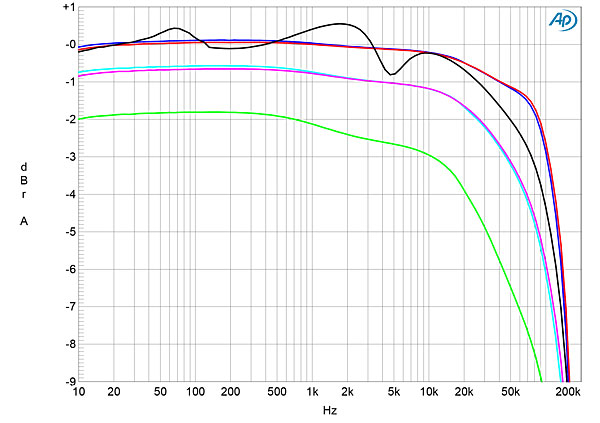
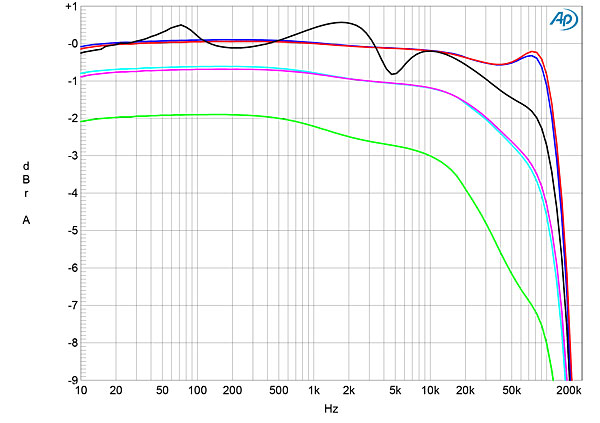
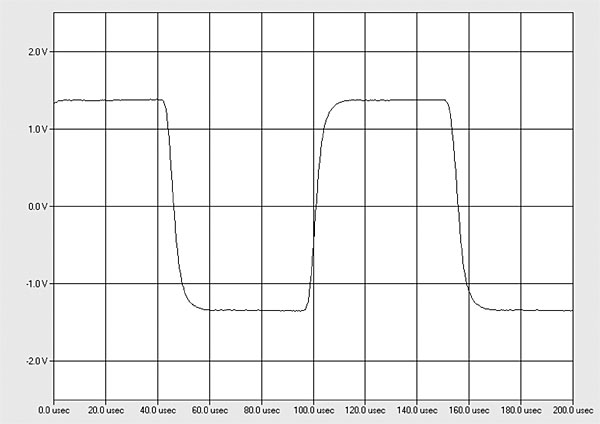

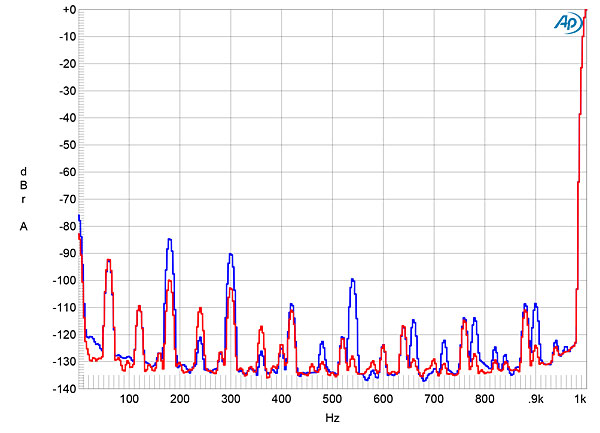
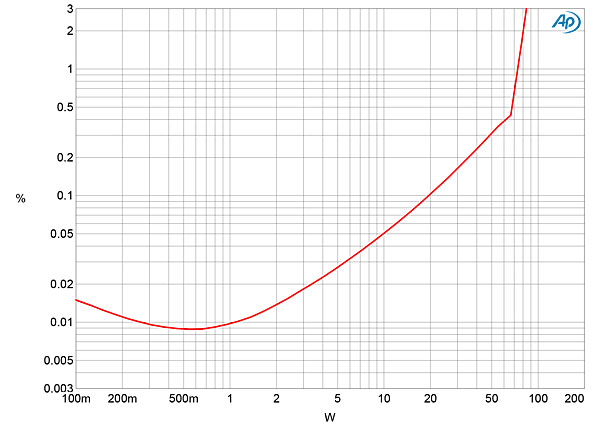
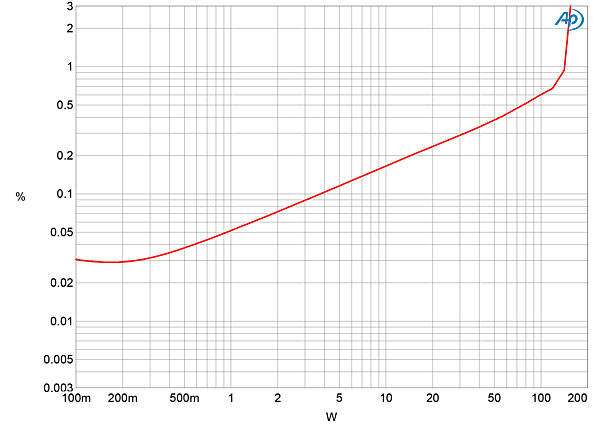
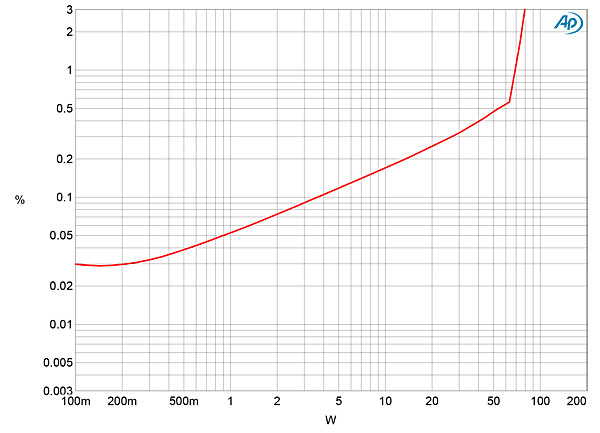
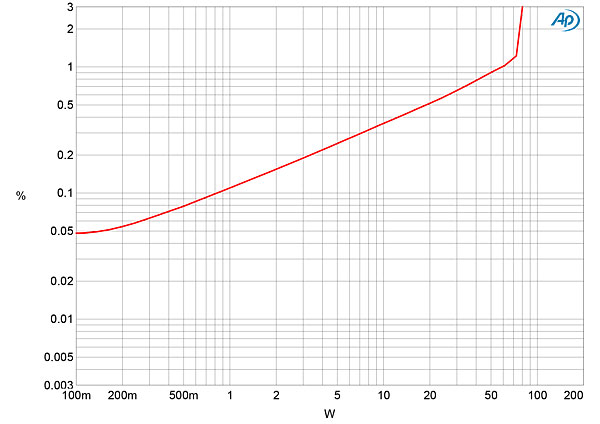
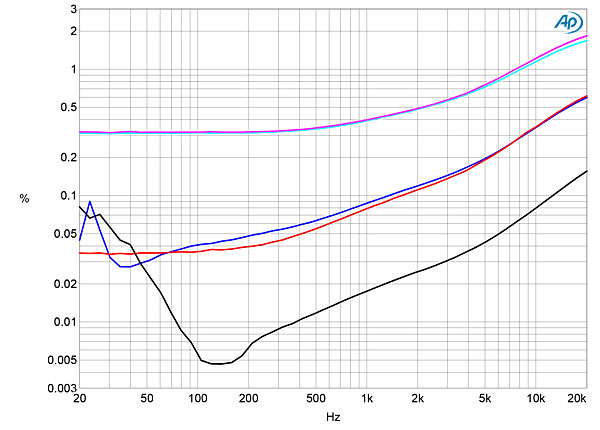
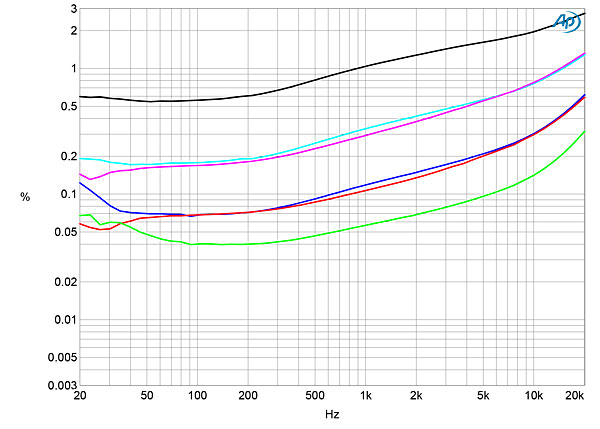
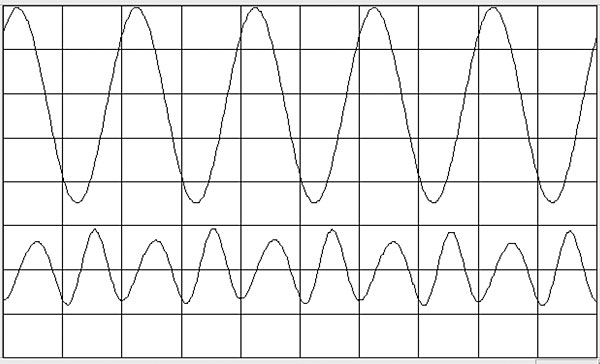

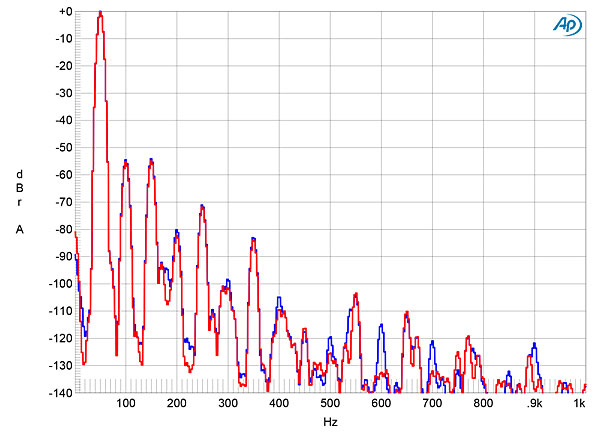
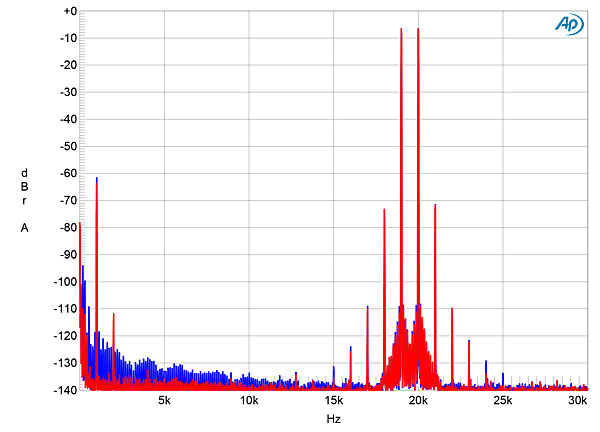
Fig.1 Audio Research REF 160S, Triode mode, 8 ohm tap, frequency response at 2.83V into: simulated loudspeaker load (gray), 8 ohms (left channel blue, right red), 4 ohms (left cyan, right magenta), 2 ohms (green) (1dB/vertical div.).
Fig.2 Audio Research REF 160S, Ultralinear mode, 8 ohm tap, frequency response at 2.83V into: simulated loudspeaker load (gray), 8 ohms (left channel blue, right red), 4 ohms (left cyan, right magenta), 2 ohms (green) (1dB/vertical div.).
Fig.1 was taken in triode mode from the 8 ohm tap; the behavior from this tap in Ultralinear mode (fig.2) was almost identical, though a small ultrasonic peak can be seen into 8 ohms (blue and red traces). In both modes, the response into 8 ohms (figs.1 & 2, blue and red traces) was flat in the midrange, with a slight tilt-down in the treble that became more pronounced as the load impedance fell. In the worst case, with the 8 ohm tap driving 2 ohms (figs.1 & 2, green traces) or the 16 ohm tap driving 4 ohms (not shown), the output was down by 2dB at 20kHz. This is associated with slightly lengthened risetimes with the amplifier's reproduction of a 10kHz squarewave under these conditions (fig.3). A small overshoot can be seen when the load impedance is higher than the nominal tap impedance (fig.4). This correlates with the small ultrasonic peak in the frequency response in fig.2, but the squarewave is free from ringing.
Fig.3 Audio Research REF 160S, Ultralinear mode, 16 ohm tap, small-signal 10kHz squarewave into 8 ohms.
Fig.4 Audio Research REF 160S, Ultralinear mode, 4 ohm tap, small-signal 10kHz squarewave into 8 ohms.
Channel separation was excellent, at >90dB in both directions below 2kHz, falling to an okay 66dB at the top of the audioband. Measured at the 8 ohm taps and taken with the unbalanced inputs shorted to ground, the amplifier's unweighted, wideband signal/noise ratio was 82dB, ref. 1W into 8 ohms, this ratio improving to 89.2dB when the measurement was A-weighted. The S/N ratios were about 2.5dB higher from the 4 ohm taps and 2dB lower from the 16 ohm taps, this behavior correlating with the respectively lower and greater gains from these taps. Spuriae at the 60Hz power-supply frequency and its harmonics were present in the REF 160 S's noise floor at low levels but were a little higher in the left channel (fig.5, blue trace) than the right (red).
Fig.5 Audio Research REF 160S, Triode mode, 8 ohm tap, spectrum of 1kHz sinewave, DC–1kHz, at 1W into 8 ohms (left channel blue, right red, linear frequency scale).
The REF 160 S is specified as delivering up to 70W into 8 ohms (18.45dBW) in triode mode and 140W into 8 ohms (21.5dBW) in Ultralinear mode. Using our definition of clipping, which is when the output's percentage of THD+noise reaches 1%, the amplifier with both channels driven in triode mode with a 1kHz signal clipped at 70W when the load was matched to the output transformer tap (fig.6). The clipping power in Ultralinear mode was at least 140W, again when the load and output tap were matched (fig.7). Less power was available when the load was not matched to the nominal transformer tap. In triode mode from the 8 ohm tap, the REF 160 S clipped at 70W into 8 ohms (fig.8) but at 61W into 4 ohms (14.8dBW, fig.9). With the worst mismatching, the REF 160 S clipped at 31W (11.9dBW) from the 16 ohm tap driving 4 ohms and 26W (8.1dBW) from the 4 ohm tap driving 2 ohms, in both triode and Ultralinear modes.
Fig.6 Audio Research REF 160S, Triode mode, 16 ohm tap, distortion (%) vs 1kHz continuous output power into 16 ohms.
Fig.7 Audio Research REF 160S, Ultralinear mode, 8 ohm tap, distortion (%) vs 1kHz continuous output power into 8 ohms.
Fig.8 Audio Research REF 160S, Triode mode, 8 ohm tap, distortion (%) vs 1kHz continuous output power into 8 ohms.
Fig.9 Audio Research REF 160S, Triode mode, 8 ohm tap, distortion (%) vs 1kHz continuous output power into 4 ohms.
As with the REF 160 M, the upward slope of the traces in figs. 6–9 suggests that the REF 160 S uses only a modest amount of loop negative feedback. I examined how the percentage of THD+noise changed with frequency at 6.33V, which is equivalent to 2.5W into 16 ohms, 5W into 8 ohms, 10W into 4 ohms, and 20W into 2 ohms. The THD+N was very low in the midrange into 16 ohms from the 16 ohm tap in Ultralinear mode (fig.10, gray trace), but rose both at higher frequencies and into lower impedances. The THD+N was very high in level across the audioband from the 16 ohm tap into 4 ohms (cyan and magenta traces); the amplifier is being driven into clipping above 8kHz at 10W into 4 ohms. The distortion from the 8 ohm tap into 8 ohms in Ultralinear mode was slightly higher than it was from the 16 ohm tap, as it was in triode mode. However, while the 4 ohm tap offered low distortion in both modes when the load impedance was greater than 4 ohms (fig.11, green, blue, and red traces), the THD+N was high into 4 ohms (cyan and magenta traces). Into 2 ohms, from the 4 ohm tap, at 20W output, THD is above our 1% definition of clipping at 1kHz and above (gray trace).
Fig.10 Audio Research REF 160S, Ultralinear mode, 16 ohm tap, THD+N (%) vs frequency at 6.3V into: 16 ohms (left channel gray), 8 ohms (left blue, right red), 4 ohms (left cyan, right magenta).
Fig.11 Audio Research REF 160S, Triode mode, 4 ohm tap, THD+N (%) vs frequency at 6.3V into: 16 ohms (left channel green), 8 ohms (left blue, right red), 4 ohms (left cyan, right magenta) 2 ohms (left gray).
Fortunately, the REF 160 S's distortion was predominantly the subjectively innocuous second harmonic (fig.12), and higher harmonics other than the third are all low in level (fig.13). This spectrum was taken into 8 ohms from the 8 ohm tap. Dropping the load to 4 ohms (fig.14) increased the levels of both the second and third harmonics, with the third now equal in level to the second. When the amplifier drove an equal mix of 19 and 20kHz tones at 10W into 8 ohms from the 8 ohm tap in Triode mode (fig.15), the second-order difference product at 1kHz lay just below –60dB (0.1%) and the higher-order intermodulation products were lower in level. As with the Audio Research Reference 160 M monoblock, the REF 160 S's measured performance is affected by the design team's decision not to use a lot of loop negative feedback. The amplifier will offer relatively high levels of low-order harmonic distortion when the load impedance is less than the nominal output transformer tap, so owners should make sure that the impedance of their loudspeakers is not significantly lower than the value of the output tap that gives sufficient loudness.—John Atkinson
Fig.12 Audio Research REF 160S, Triode mode, 8 ohm tap, 1kHz waveform at 5W into 8 ohms, 0.127% THD+N (top); distortion and noise waveform with fundamental notched out (bottom, not to scale).
Fig.13 Audio Research REF 160S, Ultralinear mode, 8 ohm tap, spectrum of 50Hz sinewave, DC–1kHz, at 10W into 8 ohms (left channel blue, right red, linear frequency scale).
Fig.14 Audio Research REF 160S, Triode mode, 8 ohm tap, spectrum of 50Hz sinewave, DC–1kHz, at 20W into 4 ohms (left channel blue, right red, linear frequency scale).
Fig.15 Audio Research REF 160S, Triode mode, 8 ohm tap, HF intermodulation spectrum, DC–30kHz, 19+20kHz at 10W peak into 8 ohms (linear frequency scale).