 Compared to the HoloAudio Serene
For this next part, I connected the HE1 to my solid state reference power amplifier, the Parasound Halo A 21+. This and all subsequent comparisons were made single-ended because the Lab 12 Pre 1 has only single-ended inputs and outputs and I wanted to use the same Cardas Clear Beyond cables for all comparisons. Driving the Falcon Gold Badge speakers, the powerful Parasound offers a more balanced, evenly rendered contrast structure, never too soft or hard. Music does not get loose or blurred at the frequency extremes. With the Parasound, the Vacuum HE1 preamp perked up dynamically and marched to a tighter, more crisply rendered tune. Musical forms were more sculpted. The pace quickened. Together, the GD preamplifier and Parasound amplifier generated an extraordinary amount of push and momentum, which emphasized rhythmic grooves and amped up engagement factor. A marching band with fireworks. I really enjoyed this combo.
For me, the real measure of Audio-GD's Vacuum HE1 XLR was how it compared to PrimaLuna's EVO 400 line-level tube preamplifier ($5295), which I reviewed in June 2019. I regard the EVO 400 as one of the finest tube preamps of the current era, and I was curious to see which of these two preamps I would enjoy most.
 After everything warmed up, the EVO 400 pre sounded very densely textured, with deep deep spaces, supersaturated tones, and gutsy, high-torque dynamics. I especially enjoyed listening to Slovak double bass virtuoso Roman Patkoló playing his own composition, "Lied ohne Worte," Op.109, from his album The Six Seasons (16/44.1 FLAC Nasswetter Music Group/Tidal). Using the stock PrimaLuna tubes, I heard a plush, earthy sound that I know well and am predisposed to liking. Staunch solid staters would likely find the EVO 400's presentation too round and un-crispy, but to me it represents the opposite of "hi-fi sound." While listening to Patkoló, I swayed to its rhythms and bathed in bass harmonics.
 The Vacuum HE1's finest review moment came while I was playing my favorite new artist, Dutch-Japanese pianist Tomoko Mukaiyama, performing contemporary compositions by Vanessa Lann, Galina Ustvolskaya, Sofia Gubaidulina, and Meredith Monk (16/44.1 FLAC, Tomoko/Tidal). My favorite composer of that group is Sofia Gubaidulina, the Russian mystic and intellectual whose Piano Sonata VI uses space and interval and percussive impact to weave a precisely crafted listening experience that feels like a trance march into a labyrinth with no promise of an exit. Mukaiyama uses her piano as a chromatic generator and percussion instrument herding supplicants into a state of transcendent awareness; I imagine this was Gubaidulina's intended effect. The Audio-GD's Vacuum HE1 preamp did a spectacular job-better than my other preamps-of forming the sounds and expressing the harmonics of Gubaidulina's Piano Sonata VI. Getting lost in a labyrinth never felt so mysterious and necessary.
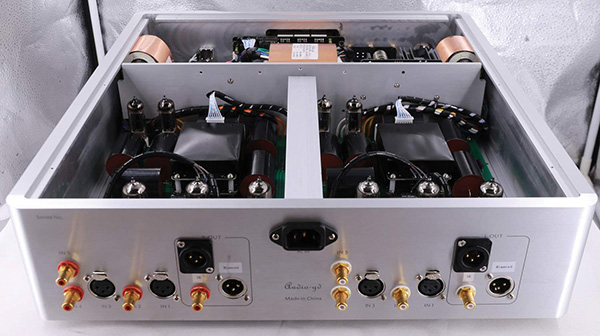
Over the years, I've noticed that the greater the number of tubes a tube amplifier employs, the more "tubey" it sounds. That rule applies double when some of the tubes are rectifiers or voltage regulators. Rain forests of tubes expose more humid atmosphere, reverberation, and cascading harmonics than sun-bright two-tube desert amps. The 10-tube, tube-rectified Audio-GD, the 8-tube, tube-rectified Prima Luna, and the 2-tube, silicon-rectified Lab 12 attest to the truth of that statement. Coincidentally, the illusion of transparency or bright, open airiness may be inversely related to the number of tubes an amp employs. While all three preamps exhibited equal ability to show the way into the recording, the two-tube Lab 12 felt the freshest, most fully awake, and big-sky open. The PrimaLuna EVO 400 exhibited the most shimmering clear-pond transparency. And the Audio-GD Vacuum HE1 XLR came across as the most well-formed and descriptive, like a fine glass camera lens with extreme depth of field. In terms of invisibility, all three of these tube preamps compared favorably to HoloAudio's Serene preamp, which I still regard as the solid state transparency master.
If I were forced to describe the fundamental sound character of the Audio-GD Vacuum HE1, I'd say it sounded so much like my Denafrips Terminator Plus DAC that I am certain it was adding very little to what was coming out of the T-Plus. I once auditioned a preamp that measured famously well. In brief auditions, it sounded superclean and superquiet. Unfortunately, I realized I couldn't tell if I was listening to my record player or my DAC. Sources I knew well sounded more like the preamp than themselves. That is not transparency. In contrast, Audio-GD's Vacuum HE1 XLR line-level preamp allowed diverse audio sources to sound maximally diverse-and that, folks, is transparency. In my system, with my chosen recordings, the Vacuum HE1 played pure, pleasurable, and remarkably invisible, in the manner of much more expensive preamps. To my ears, the Vacuum HE1 XLR is a forward-thinking, reference-level component at a not-astronomical price. Maybe it's even a game-changer like those two-stroke dirt bikes.