CD Player/Transport Reviews

Sort By:  Post Date TitlePublish Date

Meridian 263 D/A processor & 200 CD transport
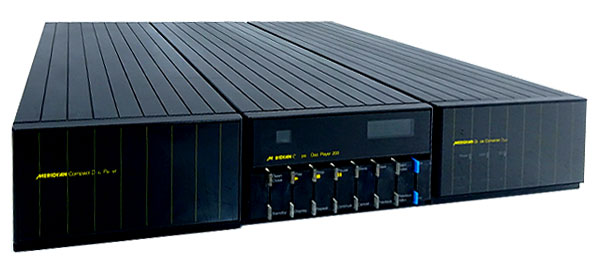
Whoever invented the adage "Good things come in small packages" wasn't into high-end audio. Most high-end products are huge and heavy, with massive power supplies, thick front panels, and battleship build quality. This dreadnought approach is justified if it directly affects the unit's sonic performance (as in the Mark Levinson No.31 transport, for example). In some products, however, the massive build can reflect a shotgun, overkill approach by the designer, or a mere fashion statement.
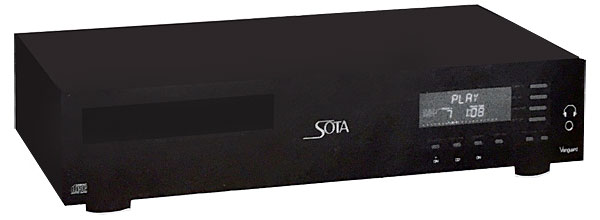
SOTA Vanguard II CD player

The Greek myth of Odysseus has always been a favorite of mine. For an audiophile looking for a CD transcription system under $2500, it seems to be an especially appropriate metaphor. Almost all the units I've heard since CD's inception fall into one of two camps: the Sirens or the Rocks.

For those of you not up on your Greek mythology, the Sirens were the archetypal seductresses whose sweet songs lured sailors to drive their ships upon the rocks. Siren CD players are those that soften and sweeten the sound. Their primary purpose is to seduce, to give a false sense of comfort to their victims; their fidelity to the truth is secondary to their desire to elicit a positive emotional reaction.

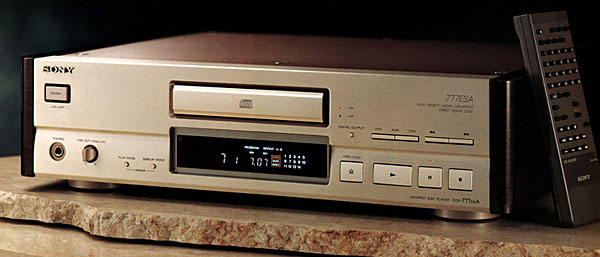
Sony CDP-X779ES CD player

Sony's first CD player, the much-maligned CDP-1 (reviewed in Vol.5 No.10), did all the things we'd been promised from CD except deliver perfect sound. It met CD's incredible claims for frequency range and linearity, harmonic and intermodulation distortion, and signal/noise ratio, yet—despite my own initial enthusiasm for it—it proved ultimately to be a disappointing-sounding player (footnote 1). Its sound was rather hard and grainy, and quite spectacularly uninvolving to listen to. But considering that it was the first of its kind, it was a good start despite its many sonic shortcomings (footnote 2).

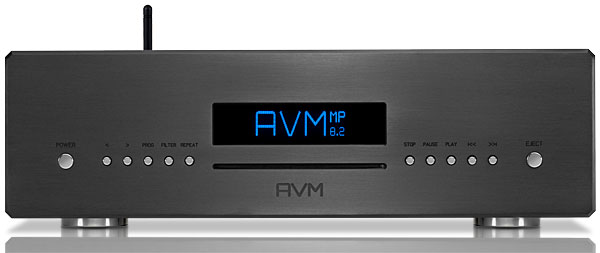
AVM Ovation MP 8.2 CD player-D/A processor

For all its faults—complex grammar, inconsistent rules of pronunciation, burdensomely endless vocabulary—English has proven itself a commendably plastic language. This is good for audio enthusiasts, in the US and elsewhere, whose choices in playback gear continue to evolve not only in substance and function but in name: Unlike many of the people who speak it, English can keep pace with the changes.

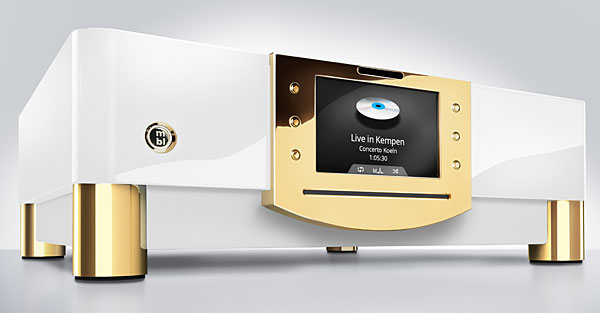
MBL Noble Line N31 CD player-DAC

MBL's Corona C15 monoblock has been one of my amplification references since I reviewed it in 2014, and as I've been reviewing DACs the past year or so, it was high time I spent time with one of the German company's digital products.

"Black shiny products are tough to photograph at shows, so trust me when I say the new N31 is dripping with gorgeousness not reflected in this photo," wrote Jon Iverson in his report from the 2017 Consumer Electronics Show. And when I unpacked my review sample of the Noble Line N31 ($15,400), I was indeed taken with its looks.

Naim CD5 XS CD player

By no means could I undertake a survey of candidates for Your Last Perfectionist-Quality CD player—so far, my ongoing series of reviews has focused on models from Audio Note, Bryston, EAR, Luxman, and Metronome—without including Naim Audio. After all, it was Naim that brought to market the first really good-sounding CD player of my experience: the two-box CDS, introduced in 1991 at a then-staggering price of $6999. In doing so, they convinced me that a digital future might not be so bad after all.

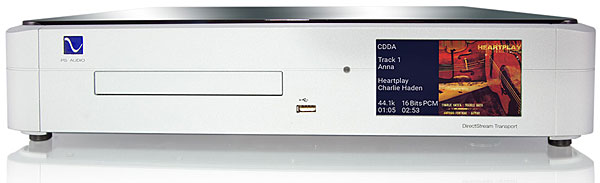
PS Audio DirectStream Memory Player universal transport

The first time I heard a CD player in my own system was in 1983, the first year of the format's introduction in the West. CD players were generally hard to come by, but I had a friend who worked for Sony, and he came over with his new toy: Sony's next-to-top-of-the-line CD player. (I think it was a CDP-501.) We connected it to my system—at the time, Quad ESLs driven by a Luxman tube amplifier, with a Linn turntable—and listened to some Sony demo CDs.

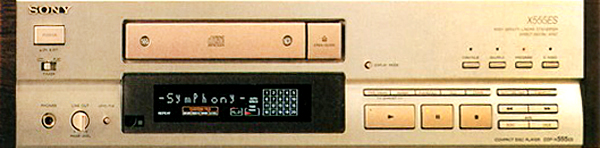
Sony CDP-X555ES CD player

I'll give the Giant Japanese Conglomerates one thing: they build their CD players like Humvees. The Sony CDP-X555ES ($900) exudes pride in ownership; from the simulated-wood side panels to the copper-shielded chassis, the Sony is a very impressive-looking player. Typically, however, Sony chose to marry a very sophisticated digital section with what appears to be a standard mid-fi analog section featuring Texas Instruments 5532 dual op-amps, carbon composition resistors, and inexpensive electrolytic coupling caps. The 555ES has both fixed and variable outputs, and a Toslink optical output. There is no coaxial digital output.

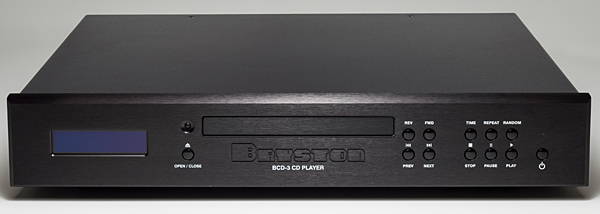
Bryston BCD-3 CD player

The English saying "putting the cat among the pigeons" has an obvious meaning in a general sense, but when applied to commerce it conveys something more specific: bringing to market a product that will make mincemeat of the competition, presumed complacent by comparison.

The phrase winked at me from the margins of an e-mail I received last year from Gary Dayton, Bryston Audio's VP of sales and marketing, whom I know from my visits to the Montreal Audio Fest. Referring to my ongoing series of reviews of ca-$10,000 CD players—the best of which one might consider for the title The Last CD Player You'll Ever Buy—Dayton suggested I have a listen to his company's new BCD-3, which retails for the comparatively low price of $3495. I accepted almost at once, and set about adjusting an English saying for a Canadian product: With the BCD-3, has Bryston succeeded in putting the wolverine among the loons?

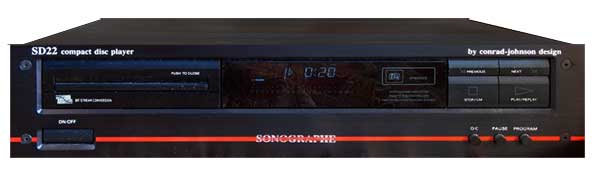
Sonographe SD-22 CD player

While many of the "modded Philips" firms simply replace the plastic "Philips" or "Magnavox" logo with their own after completing all their internal circuit mojo, for the Sonographe SD-22 ($895), Conrad-Johnson goes quite a bit further by wrapping the stock plastic flimsy-luxe box with their own heavy metal skin, making for a much stronger and nonresonant chassis. Unlike many of the modkateers, C-J doesn't replace the fairly flimsy stock RCA jack assembly of the Philips machine; in my experience, this is one of the first things to go bad on such a unit, as the contact integrity is usually poor and gets worse. Replacing the RCA assembly with high-quality gold RCAs would've raised the price of the SD-22 another $50–100, but I think the long-term reliability might be worth it. The SD-22 has no digital-out jacks, only analog outputs.
Advertisement
Advertisement
Advertisement