Tonearm Reviews

Sort By: Post DateTitle Publish Date

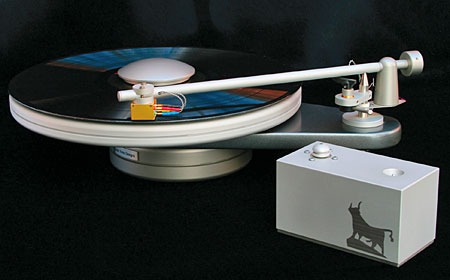
Simon Yorke Designs Series 9 turntable & tonearm

Simon Yorke is an artist, a machinist, an electronics wiz, and a political idealist. He's also an analog enthusiast who melds aesthetic and technical considerations into eye-catching, densely packed, compact record-playing devices that are ruggedly built and functionally elegant. His turntables' smooth, matte-gray, metallic finishes and efficient lines make them among the most visually pleasing ever made.


Linn Ekos SE tonearm, Keel LP12 subchassis, & Trampolin turntable base

Visit www.stereophile.com and look at the Vote">http://cgi.stereophile.com/cgi-bin/showvote.cgi?522">Vote Results for June 17, 2007: You'll see that when we asked our readers to name the one audio product that's spent the greatest amount of time in their systems, the most common answer by far was the Linn">http://www.stereophile.com/turntables/1103linn">Linn Sondek LP12 turntable (footnote 1). Little wonder that Scotland's most famous record player endures as an object of attention for various and sundry commercial tweaks.


Kuzma Stabi XL turntable & Air Line tonearm

Almost immediately on entering the analog marketplace in 1982, Franc Kuzma, a mechanical engineer based in Slovenia, then part of the former Yugoslavia, established a reputation for manufacturing finely engineered, high-performance products that sold at reasonable prices. Kuzma's early industrial designs, however, while serviceable, looked less than distinguished.


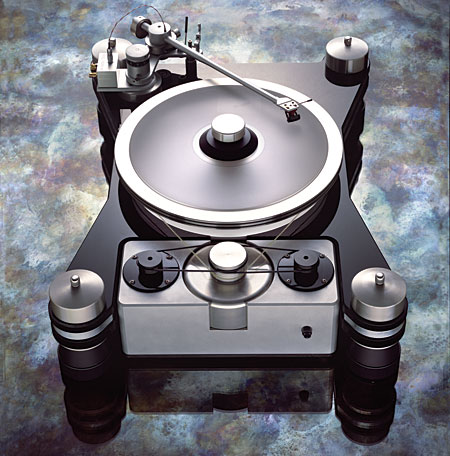
VPI HR-X turntable & JMW12.6 tonearm

VPI Industries' TNT turntable and JMW Memorial tonearm have evolved through several iterations over the last two decades. Some changes have been large, such as the deletion of the three-pulley subchassis and the introduction of the SDS motor controller. Others have been invisible—a change in bearing or spindle material, for example, or the way the bearing attaches to the plinth. And, as longtime Stereophile readers know, I've been upgrading and evolving along with VPI, most recently reporting on the TNT">http://www.stereophile.com/turntables/498">TNT V-HR turntable (Stereophile, December 2001).


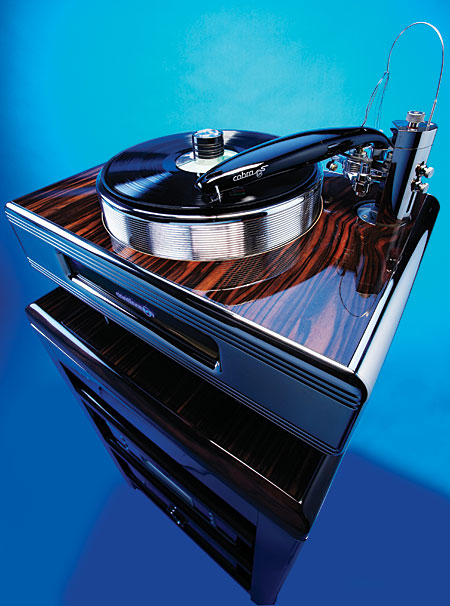
Continuum Audio Labs Caliburn turntable & Cobra tonearm

Part New Jersey diner, part Wurlitzer jukebox, with a snakelike tonearm that at certain angles looks vaguely lewd, this boxy, man-sized creation from Australia seems to have been built around its distinctive looks rather than for any functional purpose. Combine that with its sky-high price—itself almost obscene—and the result is apparently the sort of product that envious, cynical, self-loathing audiophiles love to hate, and reviewers love to write about.


Graham Engineering Phantom B-44 tonearm

The Graham">http://www.stereophile.com/tonearms/400">Graham Engineering 1.5 tonearm, originally introduced in 1990, was a thoughtfully executed design that logically addressed all of the basics of good tonearm performance—geometry, resonance control, rigidity, dynamic stability—with effective, sometimes ingenious ideas, while providing exceptional ease and flexibility of setup. Over time, designer Bob Graham came up with ways to significantly improve the 1.5's performance, including the replacement of its brass side weights with heavier ones of tungsten, an improved bearing with a more massive cap, various changes in internal wiring, a far more rigid and better-grounded mounting platform, and a new, sophisticated ceramic armwand. (The original wand had hardly been an afterthought: its heat-bonded, constrained-layer-damped design consisted of an inner tube of stainless steel and an outer tube of aluminum.) The arm's name changed from the 1.5 to the 1.5t (tungsten), then the 1.5t/c (ceramic), and on to the 2.0http://www.stereophile.com/tonearms/401">2.0;, 2.1, and 2.2http://www.stereophile.com/tonearms/401/index7.html">2.2;.


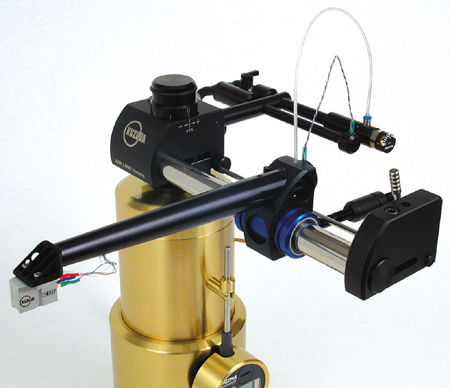
Kuzma Air Line tonearm

The lacquers from which LPs are pressed are cut in a straight line, and that's how the LP groove should be traced. Even when set up perfectly, a pivoted arm describes an arc across the disc surface, maintaining tangency to the groove at only two points on that arc. Yet despite numerous attempts at building and selling linear-tracking tonearms, few remain on the market, and most are fraught with technical problems. Linear-tracking arms can be anything but linear, committing more sins of geometry as they meander across the record surface than do their pivoted brethren.


Clearaudio Champion 2 turntable & Unify tonearm with Benz Micro L2 phono cartridge

Turntables are intrinsically cool. Maybe it's that I am of the pre-CD generation, for which the acquisition of one's first really good turntable marked an audiophile's coming of age. Just as turntable technology has progressed to such awe-inspiring pieces as the SME">http://www.stereophile.com//analogsourcereviews/796/">SME 30/2 and Rockport">http://www.stereophile.com//analogsourcereviews/258/">Rockport Technologies Sirius III, less stratospherically priced 'tables now offer levels of performance that, if not revelatory, show why so many audiophiles (including yours truly) continue to love their LPs with something just short of fanaticism.


Graham Robin tonearm

The best tonearm I ever heard was a second-generation Mission Mechanic, ca 1986. It was mounted on a Roksan Xerxes turntable, and I spent several happy hours listening to records on that combination (with a low-compliance EMT cartridge) in two very different systems: one with solid-state amplification from DNM and Roksan's own dynamic Darius loudspeakers, and the other—my home system of the time—using tube amplification from Conrad-Johnson and a borrowed pair of Stax electrostatic speakers.


Advertisement
Advertisement
Advertisement