Tonearm Reviews

Sort By: Post DateTitle Publish Date

VPI TNT V-HR turntable & JMW 12.5 tonearm
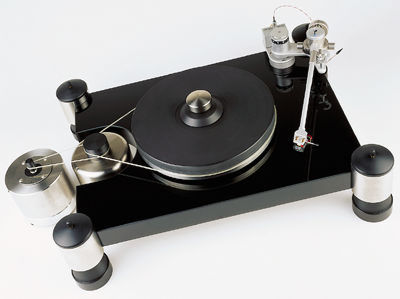
I'm a tinkerer. From homemade audio isolation and room-treatment products to a local area network (LAN) connecting my Macintosh laptops, I'm always building or modifying something. One of my latest projects is a combination of parts swaps and custom-machined bits to better adapt the ergonomics of my exotic Italian Bimota motorcycle to my distinctly un-Italian 6'3" frame. But regardless of what I'm into, I can't resist the urge to tinker.
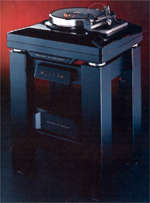
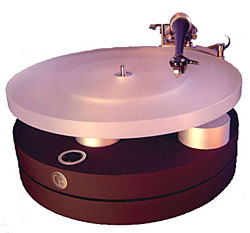
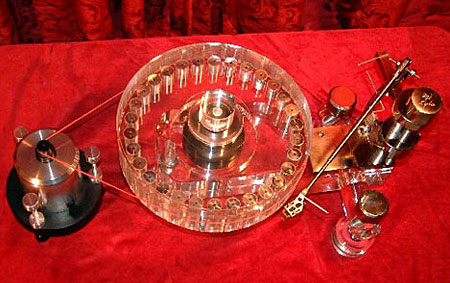
Rockport Technologies System III Sirius turntable and tonearm

Andy Payor hurls a briefcase full of engineering and scientific mumbo-jumbo at in an attempt to justify the $73,750 price of the latest and greatest edition of his Rockport Technologies turntable, but really—isn't this all-air-driven design a case of analog overkill? After all, defining a turntable's job seems rather easy: rotate the record at an exact and constant speed, and, for a linear tracker, put the stylus in play across the record surface so that it maintains precise tangency to a radius described across the groove surface. By definition, a pivoted arm can't do that, so the goal there is to minimize the deviation. That's basically it. Right?


Wilson Benesch Full Circle turntable, ACT 0.5 tonearm, & Ply MC cartridge

"Hello, I'd like to apply for a Federal Grant? For what? Oh, to design and build a new, high-tech, very expensive turntable. What's that? It plays records. Yes, that kind of turntable. Of course they still make records. Why? How much time do you have? Oh, I forgot—you're a federal employee, you have all day! Well, I didn't mean to insult you. It was a joke....No, I'm serious about the turntable. You do? What kind of music? When are they from? RCA Record Club? Classical Music? 1950s and '60s? Yes. I'll give you $5 each. I know it's generous, but... How much money do I want for the grant? Coupla hundred thousand dollars. No, our turntables will never be used to play Marilyn Manson records—Marilyn doesn't do vinyl. It's in the mail? Thank you. I'll come get the LPs tonight."

Graham Model 2.0 tonearm

When Bob Graham introduced his 1.5">http://www.stereophile.com//analogsourcereviews/400/">1.5 tonearm at the end of the 1980s, many thought he was dreaming: Vinyl was going the way of the console radio—who would invest two-grand-plus in a tonearm? But there was a method to Graham's madness—he'd designed his arm to be a drop-in replacement for more than 20 years' worth of SME arms, all of which shared the same mounting platform. Perhaps, in his wildest dreams, Graham had already envisioned the current "analog revival"—but even without it, he figured there'd be a robust replacement market, and he was poised to exploit it with what he thought was a superior product.


Immedia RPM-2 tonearm

If the sole criterion for choosing a winner in today's hotly contested premium arms race was original thinking, the Immedia RPM-2 might well come out on top. While some of its design details resemble those found on other products, in many significant areas the arm is unique—not for uniqueness's sake, but in order to efficiently implement some clearly considered goals. If the unipivot RPM-2 bears a resemblance to any other contemporary arm, it is Naim's highly regarded ARO—which I've never heard. The similarity, though, would appear to be superficial.


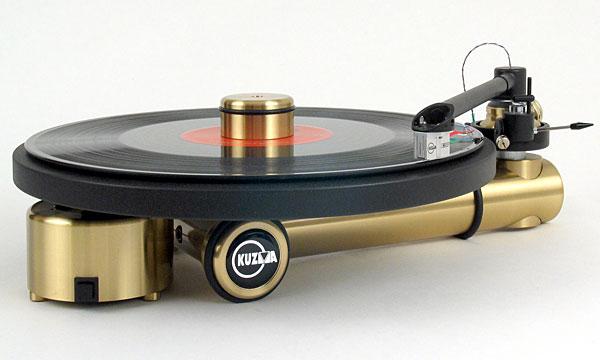
Kuzma Stabi turntable & Stogi tonearm

I first learned of the Kuzma Stogi at the 1993 Winter CES in Las Vegas. In VPI's room at the Sahara, a portly, black tonearm was sitting proudly atop the new VPI TNT Series 3 turntable. Pointing straight at me from the center of its massive, exceptionally stout frame was a tapered armtube the diameter of a swollen thumb. The fact that this unknown (to me) tonearm was chosen to sit atop a turntable as respected as the TNT told me I was looking at a serious new product. VPI's Harry Weisfeld was standing nearby, beaming as usual, to answer the barrage of questions that sprang from my lips as I leaned over for a closer inspection. Who? What? Where? When? Why? How much?

Naim Aro tonearm

When I was visiting Santa Fe last Easter (footnote 1), one of the subjects I raised with JA was Naim's ARO tonearm. This unique unipivot design has languished in Class K of Stereophile's "Recommended Components" listing for far too long. JA explained that the regular reviewers have quite enough to do, thank you, just keeping up with speakers, electronics, and especially digital. The esteemed Martin Colloms is happily using an ARO on his Linn Sondek, and wrote a review for the English magazine Hi-Fi News & Record Review in May 1991, but since there is a very small but nevertheless vociferous overlap in US readership between the two magazines, it is Stereophile policy not to have two reviews by the same reviewer of a given piece of gear.


Graham Model 1.5 tonearm

Frankly, I'm fed up with the prophets of doom, those false seers who forecast vinyl's imminent demise. Some claim to have seen the writing on the wall as far back as ten years ago, sensing that the advent of the CD would perforce relegate the stylus-in-groove method of transduction to the trashpile of history. First of all, most of the music I enjoy happens to be on LP. And I'm sure I speak for many audiophiles who have also spent a lifetime building up a vinyl collection when I say we're not about to throw away our cherished treasuries of music. These LPs I expect to enjoy until the end of my time. Thus, I welcome any phono-system technological advance that will recover more information from the groove.


Advertisement
Advertisement
Advertisement