

J.Sikora Standard Max Supreme turntable, KV9 Max Zirconium tonearm
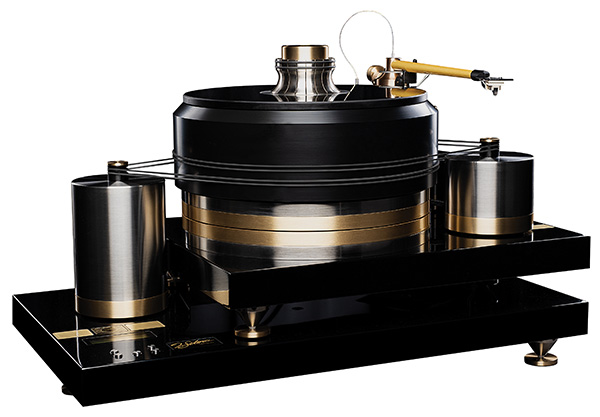
In his review of the J.Sikora Initial turntable, Stereophile's resident artist/sage Herb Reichert wrote, "Extended bathing, lighting candles, making tea, and preparing food are ritual work forms that prepare my senses to accept both pleasure and illumination."
When it comes to playing records, I too have a ritual. It involves carefully cleaning the vinyl, first on a Pro-Ject VC-33, followed by immersion in a HumminGuru Ultrasonic vinyl cleaner. Before and after, I inspect the record's grooves with a pricey VisibleDust Quasar R magnifier. Only thenblack coffee hot, glasses cleaned, stylus brushed free of contaminants, notepad at handam I ready to receive the messages ingrained in a shiny black vinyl disc.
Kuzma 4Point tonearm
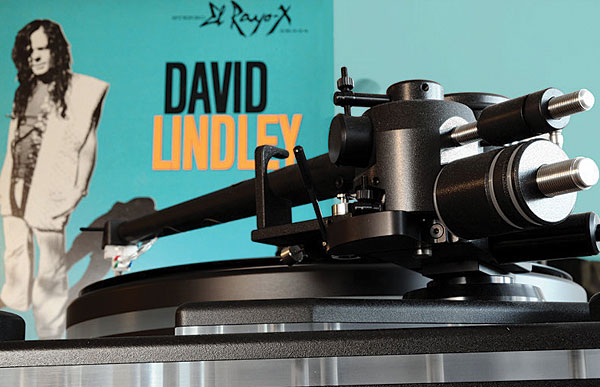
No one has ever accused Franc Kuzma of designing glamorous audio jewelry. His turntables and tonearms are industrial-strength examples of engineering know-how and machining excellence. But to those who appreciate such things, his products are truly beautiful, even if they're not adorned with chrome, wood, and sleekly polished surfaces. And if looking at the 4Point tonearm ($6500) in pebbly Darth Vader black doesn't get your analog juices flowing, perhaps its innovative design will. But first, this message:
Kuzma Air Line tonearm
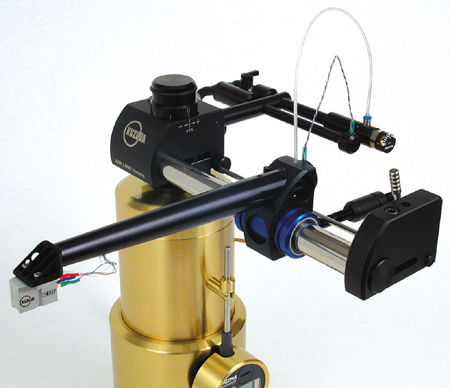
The lacquers from which LPs are pressed are cut in a straight line, and that's how the LP groove should be traced. Even when set up perfectly, a pivoted arm describes an arc across the disc surface, maintaining tangency to the groove at only two points on that arc. Yet despite numerous attempts at building and selling linear-tracking tonearms, few remain on the market, and most are fraught with technical problems. Linear-tracking arms can be anything but linear, committing more sins of geometry as they meander across the record surface than do their pivoted brethren.
Kuzma Stabi turntable & Stogi tonearm
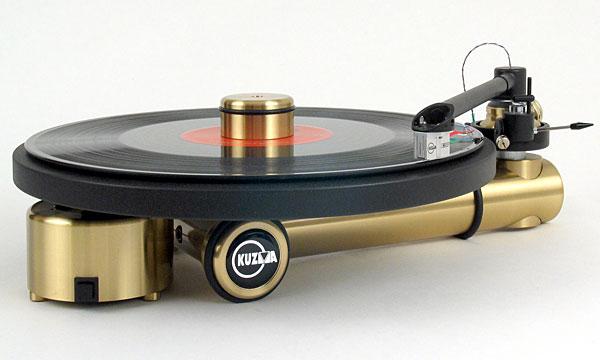
I first learned of the Kuzma Stogi at the 1993 Winter CES in Las Vegas. In VPI's room at the Sahara, a portly, black tonearm was sitting proudly atop the new VPI TNT Series 3 turntable. Pointing straight at me from the center of its massive, exceptionally stout frame was a tapered armtube the diameter of a swollen thumb. The fact that this unknown (to me) tonearm was chosen to sit atop a turntable as respected as the TNT told me I was looking at a serious new product. VPI's Harry Weisfeld was standing nearby, beaming as usual, to answer the barrage of questions that sprang from my lips as I leaned over for a closer inspection. Who? What? Where? When? Why? How much?
Kuzma Stabi XL turntable & Air Line tonearm

Almost immediately on entering the analog marketplace in 1982, Franc Kuzma, a mechanical engineer based in Slovenia, then part of the former Yugoslavia, established a reputation for manufacturing finely engineered, high-performance products that sold at reasonable prices. Kuzma's early industrial designs, however, while serviceable, looked less than distinguished.
Linn Ekos SE tonearm, Keel LP12 subchassis, & Trampolin turntable base

Visit www.stereophile.com and look at the Vote">http://cgi.stereophile.com/cgi-bin/showvote.cgi?522">Vote Results for June 17, 2007: You'll see that when we asked our readers to name the one audio product that's spent the greatest amount of time in their systems, the most common answer by far was the Linn">http://www.stereophile.com/turntables/1103linn">Linn Sondek LP12 turntable (footnote 1). Little wonder that Scotland's most famous record player endures as an object of attention for various and sundry commercial tweaks.
Linn Ekos tonearm
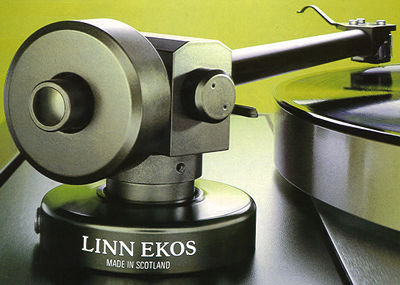
"Tonearm?" muttered John Crabbe, my erstwhile editor at Hi-Fi News & Record Review, as he bent over my shoulder some 12 years ago to see what I was writing about. "A tonearm belongs on an acoustic gramophone—you should use the term 'pickup arm,' which doesn't suggest that the arm has a sound of its own."
Linn Klimax LP12 Record-Playing System
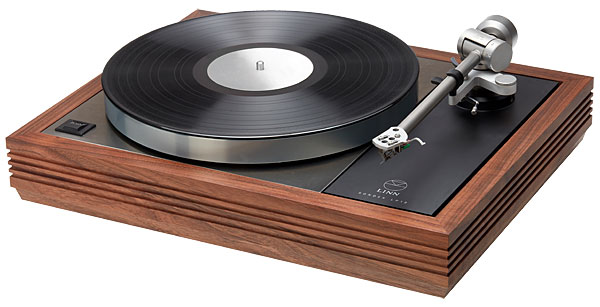
Playing records is a delight-filled chore. The simple, quiet act of lowering a tonearm places one's mind at the ready for something marvelous to happen. Surely, this gentle ritual initiates a higher mode of psychic connectedness than poking absentmindedly at a side-facing equilateral triangle on a piece of cheap plastic.
Listening #118

Until recently, my favorite shirt was one I'd found on a clearance table at Macy's: a red paisley thing with long sleeves and a button-down collar, not unlike the ones seen in photographs of Peter Holsapple or the young Syd Barrett. When I first found it, this shirt was dusty, and appeared to have been marked down at least a half-dozen times before bottoming out at a price that wouldn't buy a six-pack of Mountain Dew at the local stop-and-rob. Maybe it was on the verge of being discarded, but I suspect that the people at Macy's had simply forgotten it was there.
Listening #122
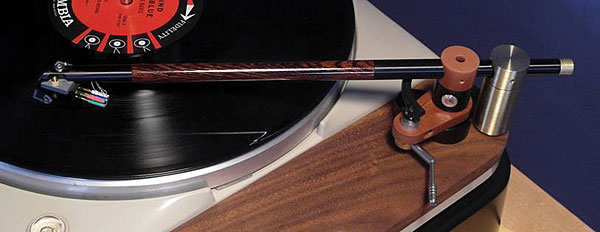
Sad though they may be, Flat Earthers endure in getting two things right: In any music-playback system, the source is of primary importance; and in a music system in which LPs are the preferred medium, the pickup arm is of less importance than the motor unitbut of greater importance than just about everything else.