

California Audio Labs CL-15 CD player
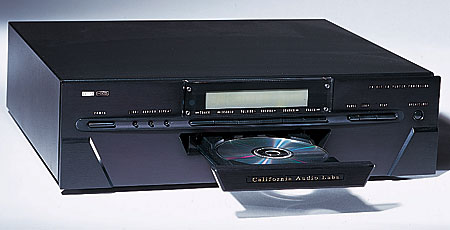
It was inevitable that I'd encounter the California Audio Labs CL-15 in my search for a CD player priced less than stratospherically. CAL was one of the first companies to hit the market with a high-end CD player, and they've been building great-sounding digital gear ever since. What's more, the CL-15's predecessor was the Icon">http://www.stereophile.com/cdplayers/696cal">Icon PowerBoss Mk.II HDCD, a longtime personal favorite. I was particularly curious to see how the CAL would stack up against today's competition. I've been impressed with CAL products over the years—the original Sigma, the Delta, the DX-1 and 2, and, of course, the Icon. On the other hand, the competition—players like the Rega">http://www.stereophile.com/cdplayers/634">Rega Planet, Arcam's Alpha 8 and Alpha">http://www.stereophile.com/cdplayers/199arcam">Alpha 9, and Ultech's UCD 100—has improved dramatically since I last heard the Icon.
California Audio Labs Icon Mk.II Power Boss CD player
I have always been a dyed-in-the-wool vinyl fan, committed to the superiority of analog over current 44kHz/16-bit CD technology. Nevertheless, I have been surprised at how greatly the sound of CD has improved over the past 10 years. By 1994, digital had gotten much closer to analog than I had ever expected, which was a good thing, as 1994 also saw the disappearance of the LP as a medium for obtaining new releases of mainstream recordings. But over the last two years, I've noticed some interesting phenomena: More turntables, tonearms, and cartridges started to become available, at least in the high-end arena. Audiophiles and, to a lesser extent, segments of the general music-loving public, began clamoring for new vinyl releases. Specialty labels, such as Classic Records and Acoustic Sounds, started to reissue premium vinyl releases of classical, jazz, and pop classics at reasonable prices. And major labels again began to offer vinyl versions of major pop releases.
California Audio Labs Tempest CD player
"A thing divine—for nothing natural I ever saw so noble."
California Audio Labs Tempest II CD player
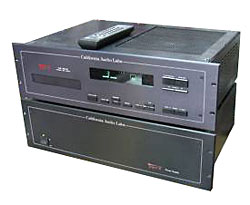
Snickering was heard from the major consumer electronics purveyors when California Audio Labs came out with the original">http://www.stereophile.com/cdplayers/654">original Tempest, their first CD player using tube output stages. But not from the audiophile community. It was, all things considered, an inevitable product; I'm certainly not the only one who wondered—before the emergence of California Audio Labs—who would be the first to build such a unit. The obvious candidates were Audio Research or Conrad-Johnson. But those companies apparently read the audio tea-leaves and, perhaps perceiving the early high-end hostility toward the new format, apparently decided to bide their time. (With regards to tube players, they're still biding it, though C-J has had a prototype player up and running for some time.)
California Audio Labs Tercet Mk.III CD player
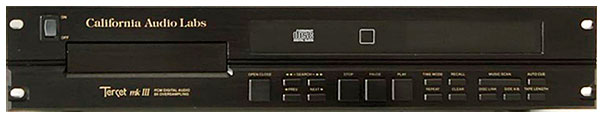
At $1295, the Tercet Mk.III represents a step up from CAL's $750 Icon, which I enthusiastically recommended back in April 1990 (Vol.13 No 4, footnote 1). Externally, with the exception of a wider and slightly thicker front panel, it appears to be a carbon copy of that unit. Like the other products in California Audio Lab's stable, the Tercet Mk.III is designed from the ground up in-house.
Cambridge Audio CD1 CD player
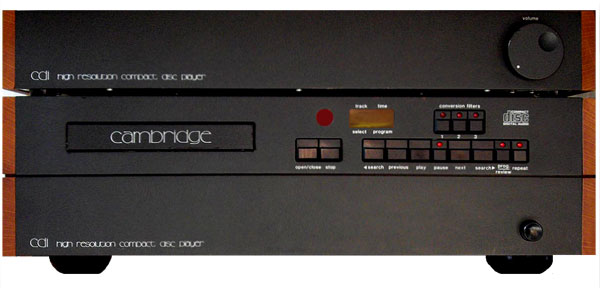
Four years after its launch, the CD medium would appear to have come of age, at least in production terms. Annual player manufacture is now big business, and there is hardly a major audio brand without a CD machine to its nameeven such analog stalwarts as Audio-Technica and Shure have succumbed.
Cary 303/200 CD player
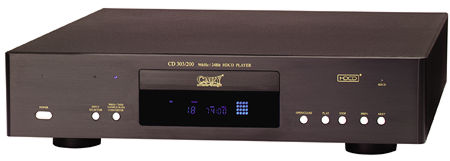
The CD-303/200 is a stout, handsome unit with a thick front panel of black-anodized aluminum (silver is also available) and a beefy, epoxy-coated aluminum chassis. Even the remote control—a heavy aluminum unit with multi-function, backlit buttons—screams "Quality!" Curiously, however, the remote is clad in chrome plate, rather than brushed aluminum or anodized black to match the player. The coup de grace is the CD-303/200's transport mechanism, a Philips CDM12, which is good enough as is; Cary addition of a thick, machined drawer warmed this metallurgist's heart.
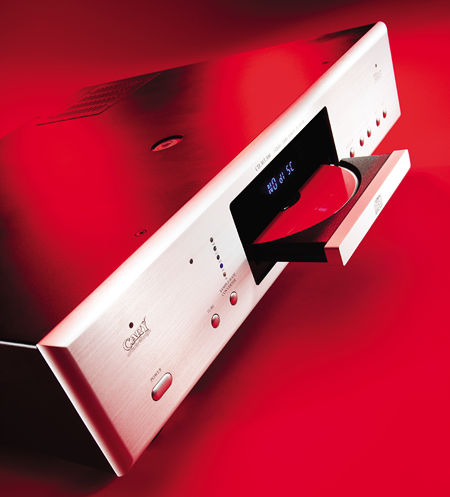
Cary Audio Design CD303/300 CD player
Is it a trend or just a fad? That's what some of us want to know when we stumble over a new way of doing things, the implication being that a trend is somehow better than a fad.
CH Precision D1.5 SACD/CD player/transport
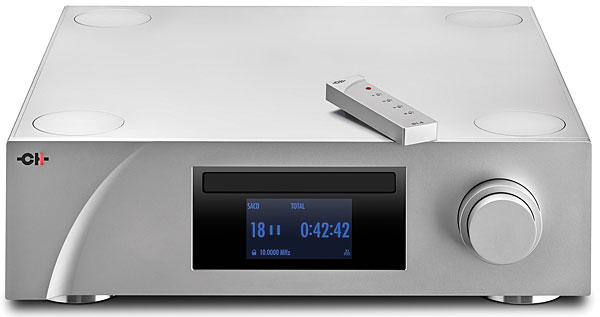
There's a school of thought that maintains that among all hi-fi components, the D/A converter is easiest to perfect or come close to perfecting. Just make sure that every sample is converted accurately, that there's little rolloff in the audioband, that aliased images are suppressed almost completely, and that background noise is extremely low, and you have a top-quality D/A processor. Use of a high-quality DAC chip is assumed.
Chord Choral Blu CD transport & Choral DAC64 digital audio converter
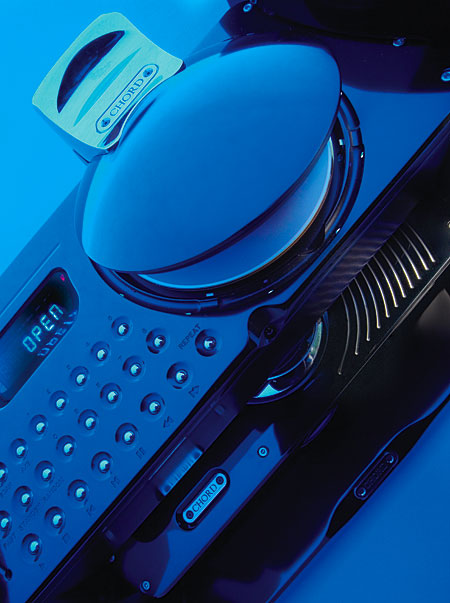
I was stumbling through the Denver Convention Center at CEDIA 2006 when I spotted John Franks, of Chord Electronics, and Jay Rein, of Chord's US importer, Bluebird Music, stranded in the basement purgatory for "niche" products. I couldn't resist asking, "What sin relegated you guys to this little hell?"