

Gryphon Ethos CD player-D/A processor

What kind of creature is this? Gryphon Audio Designs' new Ethos ($39,000)pronounced EE-toss by its Danish manufacturersis marketed as a CD player and digital-to-analog converter. It's decidedly au courant in that it includes two 32-bit/768kHz ES9038PRO Sabre DAC chipsone for each channelwith each holding eight individual DAC chips; offers optional upsampling to either 24/384 PCM or DSD128; and decodes up to 32/384 PCM and quadruple DSD (DSD512) via its USB input, or up to 24/192 (and no DSD) via AES/EBU or S/PDIF.
Hegel Music Systems Mohican CD player
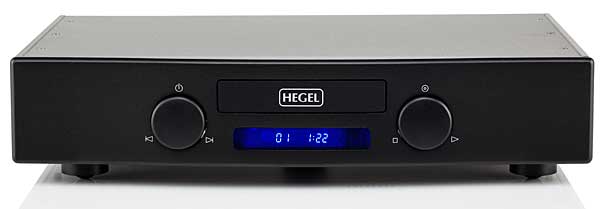
Someone on Audio Asylum wrote, "When it comes to hi-res audio, Herb is a babe in the woods." This is true, though probably not in the way this person imagined. High-resolution master David Chesky has been my friend forever, and I used to write for his website HDtracks.com. Todd Garfinkle, founder of and producer for MA Recordings, and Kavichandran Alexander, of Water Lily Acoustics, are not only valued friends, but I own most of their stunning recordings. In short, I'm no stranger to SACD or 24-bit/192kHz playback. But compared to most audiophiles, I've been a bit slow in appreciating the intricacies and virtues of hi-rez computer audio.
Hegel Music Systems Viking CD player
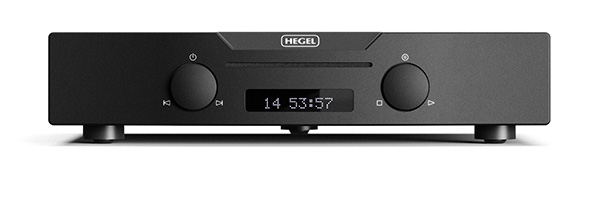
The pleasures of reviewing a new CD player reside in its light weight, compact dimensions, and, most of all, its ABC-simple installation: no cartridge to mount, no stylus to break, no step-up trans formers or cartridge-load values to explore. No server, no Ethernet switches, no digital processor or outboard clock, no NOS, OS, filter choices, or upsampling (usually), no DSD or DXD, no specialized cables, and-especially-no garish, billboard-sized LCD menu to trigger anxiety. Just plug the player in, connect it to a preamp, and choose a CD to play first.
Yes, folks, digital audio was once that simple.
I'm pleased to be reviewing a new CD player, the Viking from Hegel Music Systems, in part because Hegel's founder and chief engineer Bent Holter appears to feel the same way I do.
Jay's Audio CDT3-MK3 CD transport
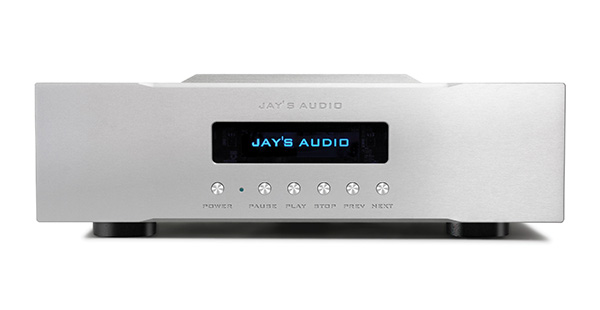
They say a jack of all trades is the master of none. While this expression is typically used to describe people, it also works for machines that play 5" optical discs.
The Compact Disc was launched in 1982, but the four decades since have seen an alphabet soup of similar-looking shiny discs including major formats like DVD, SACD, DVD-A, and Blu-ray Audio. As each new format arrived, hardware manufacturers scrambled to keep up, developing machines that could play just about any disc you could throw at them (or, rather, insert in them). The result was a bunch of "jack of all trades" disc spinners...
But what if we gave up the notion of universal compatibility and concentrated on building a player dedicated to squeezing the best possible results from the very first, and by far the most common, shiny 5" disc, the good old-fashioned "Red Book" Compact Disc? Would we get better performance?
JVC XL-Z1050TN CD player
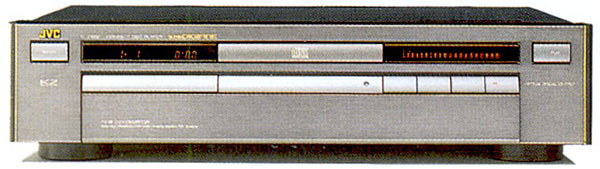
The $800 JVC XL-Z1050TN 1050 is the Bitstream successor to JVC's popular 18-bit XL-Z1010, which got an enthusiastic thumbs-up from Robert Harley in April 1990 (Vol.13 No.4). Its styling is, in my opinion, much improved over the older player's, with the distinctive brushed-bronze finish of the rest of JVC's XL-Z line. The rear panel sports fixed and variable outputs (footnote 1), as well as Toslink optical and coaxial digital outputs. As with the 1010, the JVC features their proprietary K2 Interface, a circuit that reduces jitter by resampling the pulses with a short-duration gate just ahead of the single-bit JVC JCE-4501 DAC chip.
Kalista DreamPlay One CD player
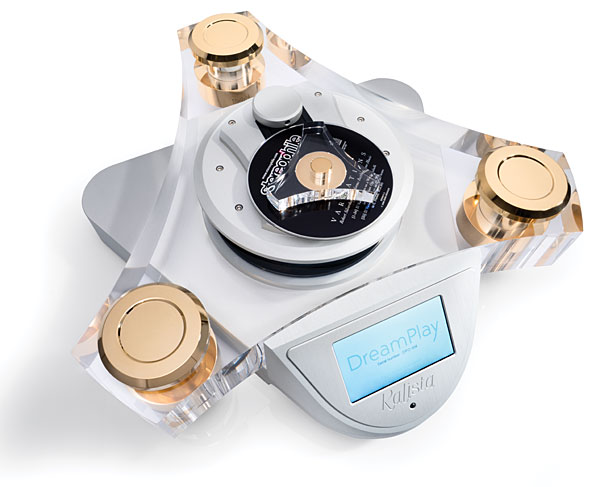
Some of my reviewer colleagues would have you believe that negative reviews are the most difficult of all to write, and that positive reviews fairly write themselves. What nonsense!
As I write this, my copy deadline is three days away, yet I've succeeded at crafting little more than my heading (easy enough: it's just the product's name, followed by my name) and my Associated Equipment sidebar (also easy), leaving a great expanse of nothing in between. That's mostly because the Kalista DreamPlay One, a two-box CD player whose $43,000 price might once have kept me from even considering it as a real-world product, has stunned me into a sort of paralysis: I feel that anything I write will be inadequate to the task.
Kinergetics KCD-40 CD player
A strange disguise; still, write it down,
it might be read. Nothing's better left unsaid.—Keith Reid
it might be read. Nothing's better left unsaid.—Keith Reid
Krell Cipher SACD/CD player

Around the turn of the century, a review of the latest hair-raisingly expensive turntable would often begin with a soothing chant that, yes, the RotorGazmoTron XT-35000 is a tad pricey, but it will be the last piece of analog gear you ever buyso go ahead, take the plunge. A dozen years later, pressing plants are stamping out LPs 'round the clock, and new high-end turntables are rolling off production lines at a respectable clip. So who knows whether today's Cassandras might be equally premature in bewailing the death of the Compact Disc? Which is to say that I can't in good conscience urge you to pay $12,000 for a CD player on the grounds that the medium's about to die, so splurge now while there's still something to splurge on. But if you have the scratch, and the itch for such a product, step right up and let me tell you about the Krell Cipher.
Krell DT-10 CD transport
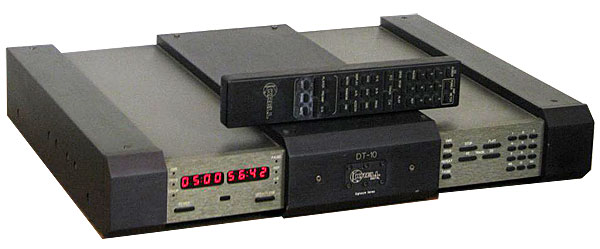
So many things in this world are designed for convenience, not for excellence. That's all right if you have a choice, but it becomes a problem when products designed for convenience become universal standards and are thus foisted on everyoneincluding enthusiasts, who must then live with a product aimed at the lowest common denominator.
The digital interface between CD transports and digital processors is a perfect example of this dilemma. The Sony/Philips Digital Interface Format (S/PDIF) standard was designed so that connecting two digital products required only one cable. This single cable carries left and right audio channels as well as the timing clock essential to making the system work.
Krell KAV-300cd CD player
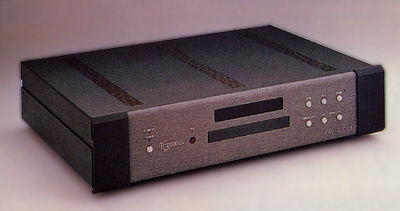
You'd be hard-pressed to find a company more protective of its reputation than Krell. At a recent meeting of the Academy for the Advancement for High End Audio and Video, a motion was made to replace the phrase "High End" with the more purely descriptive "High Performance." Krell's CEO, Dan D'Agostino, objected—while he knew the description fit his products, he wasn't sure about those from some of the other members.