

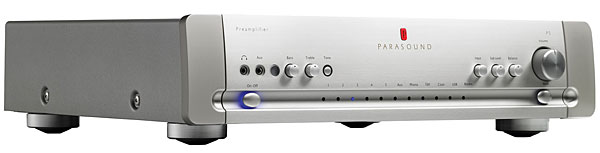
Parasound Halo P 5 2.1-channel D/A preamplifier
Asked how to make a guitar, the celebrated luthier Wayne Henderson offered a straight-up answer: "Just get a pile of really nice wood and a whittling knife. Then you just carve away everything that isn't a guitar." (footnote 1)
The making of a preamplifier seems more or less the opposite. You start with a simple volume control and a couple of jacks, then add whatever you think constitutes a preamplifier. Choices might include electronic source switching, line-level gain, phono-level gain and equalization, tone controls, tone-defeat switches, a balance control, a headphone jack, an iPod input, and maybe even a digital-to-analog converter with a USB receiver. The sky is pretty much the limit.
Parasound P/FET-900 preamplifier

Introduced at the 1988 Summer CES, this preamplifier from San Francisco-based Parasound costs $395 and is manufactured in Taiwan. It does away with mechanical switching for source select and tape functions, replacing it with CMOS integrated-circuit switches similar to those used in the British Linn LK1 and Quad 34 and 44 models. Construction is to a good standard and the circuit is carried on two main pcbs and three small ones. Following a signal from the phono inputs, the MM-only RIAA amplifier is based on discrete FETs, its output joining the line-level signals at the switching ICs, these controlled by DC voltages controlled by front-panel pushbuttons.
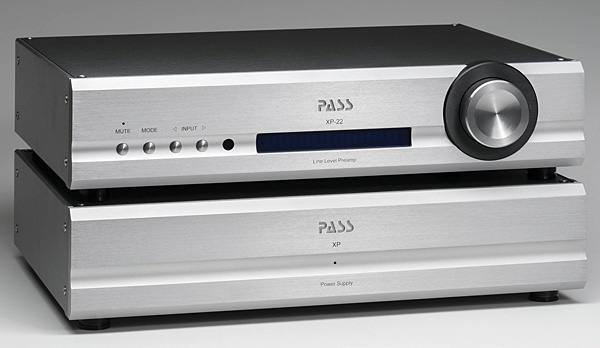
Pass Laboratories XP-22 line preamplifier
For those who listen with their ears and not their brain, perfectionist hi-fi offers many surprises.
A friend called me up a few weeks ago and asked if the DAC we both own had received an automatic firmware update he hadn't heard about; something had changed, it wasn't good, and he couldn't figure out what it was. His system's sound was suddenly pale and unfocused.
There had been no firmware update.
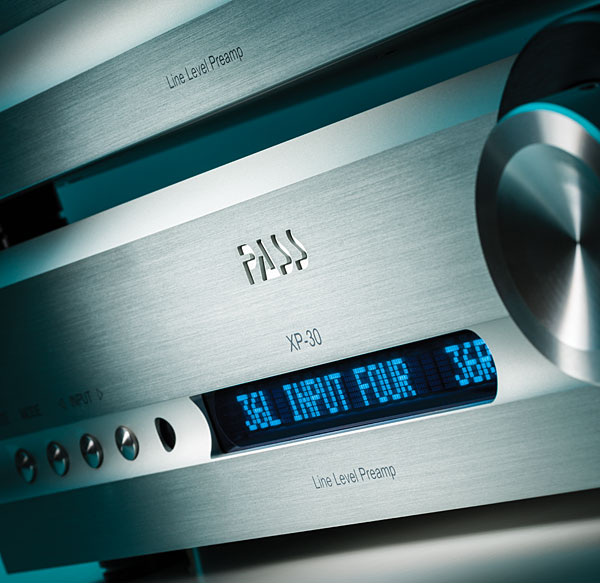
Pass Laboratories XP-30 line preamplifier
It was the strangest thing. In the fall of 2008 I was comparing Ayre Acoustics' then-new KX-R line preamplifier with no preamplifier at allI was feeding the power amplifier directly with the output of the Logitech Transporter D/A processor. (Levels were matched for the comparisons, of course, made possible by the fact that the Transporter has a digital-domain volume control.) Being a rational being, I knew that the active circuitry of a preamplifier, as well as the extra socketry and cables, would be less transparent to the audio signal than a single piece of wire. I wanted to determine by how much the Ayre preamp fell short of that standard.
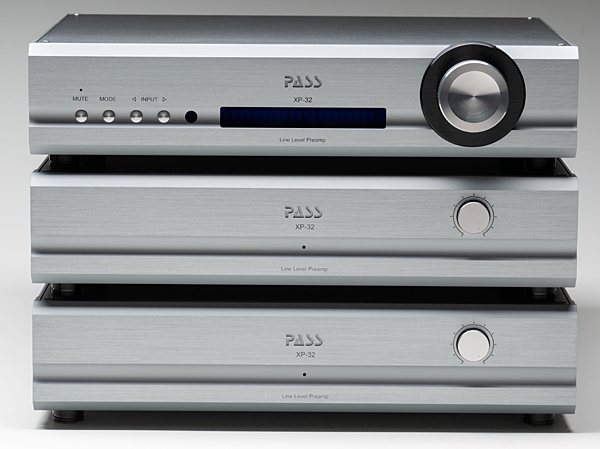
Pass Laboratories XP-32 line preamplifier
When I studied physics at university too many years ago to admit, I learned about Occam's razor. Many, many more years ago than that, Franciscan friar William of Occam stated that a hypothesis should provide the simplest possible explanation for a phenomenon.
Perfectionist Audio Components CPR IIIB/TIPS preamplifier
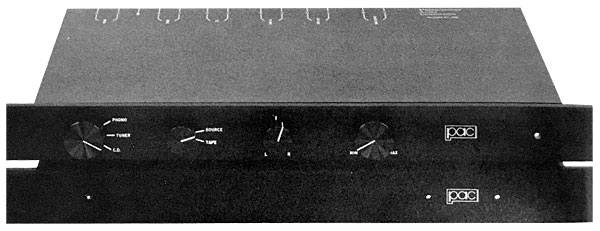
One never knows, do one? Within the past year, I've had six preamplifiers in my system for critical evaluation, reviewing four of them and using another two as references. I was getting pretty tired of listening for sonic differences among preamps, and I told JA that I'd prefer my next reviewing assignment to be something different, like a speaker or a power amp. He agreed, but said he'd first like me to review just one more preamp, the Perfectionist Audio CPR/TIPS, which had been waiting patiently in the review queue in Santa Fe. Well, one more wouldn't hurt. Sounded kind of interesting, anyway: a preamp with a battery-operated power supply!
Placette Active Linestage preamplifier
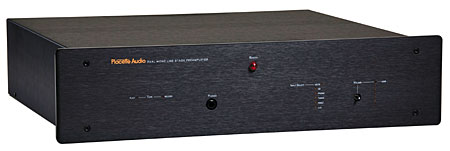
A friend once described my audio ethos as "records, tubes, big amplifiers, and really big speakers"—I always picked warmth and musicality over antiseptic neutrality, even if the former came with a few extra colors in the tonal palette. Had I listed my criteria for an audio component, transparency wouldn't have been near the top, and might not have been listed at all.
Placette Audio Remote Volume Control passive preamplifier
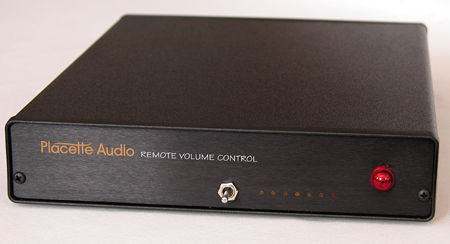
The Placette Audio Remote Volume Control is simplicity itself: a paperback-sized black box with one set of unbalanced inputs and outputs, a toggle switch (and a remote) to change the level, and a row of LEDs that light up to indicate the relative volume level. The signal path, too, is simple, with only a stepped attenuator between input and output. But this is not just any attenuator—it's a 125-step model built entirely with super-premium Vishay S-102 foil resistors.
Primare PRE35 Prisma streaming preamplifier
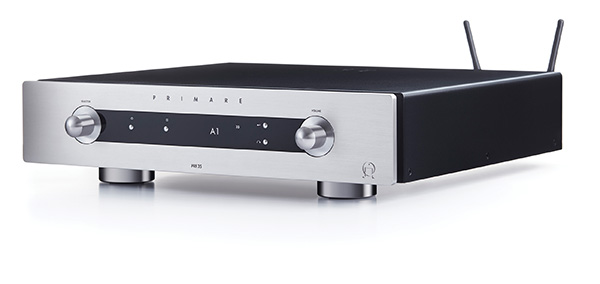
Hygge might not be the first word that comes to mind when contemplating the Primare PRE35 Prisma preamplifier, but in Limhamn, Sweden, that is how Primare likes to describe their products. It means "cozy," and it's a very important concept in the Nordic countries, almost a way of life. Another term that appears in Primare's product descriptions is lagom, which loosely translates as "not too little, not too muchjust right."
Proceed PAV audio/video preamplifier
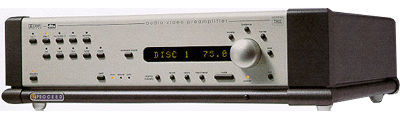
Until just recently, only companies known primarily for their surround-sound processors were producing the most advanced—and most expensive—Home Theater products. No longer. It was inevitable that traditional high-end audio manufacturers would begin producing equipment for this fast-growing market.