

Music in the Round #95: Wolf & NAD
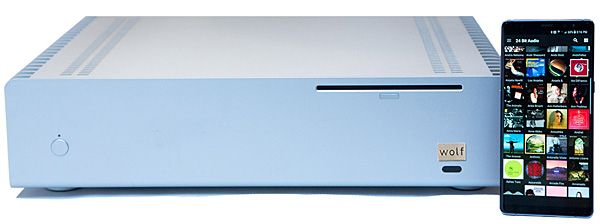
Although I no longer attend the audio pageant that was once the annual Consumer Electronics Show, I now seem to be traveling more, in hopes of recapturing the excitement CES had once provided. Last May I attended High End, in Munich, and found that while it was entirely as advertised, there was, alas, not enough emphasis on the playback of high-resolution files, and hardly any attention paid to multichannel music.
Myryad MDP 500 preamplifier-processor
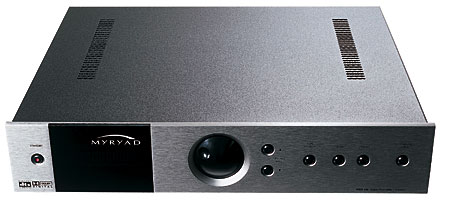
In my February">http://www.stereophile.com/hirezplayers/201">February 2000 review of Meridian's multi-talented, multichannel, multi-kilobuck Digital Theatre system, I fumed about the lack of a medium for discrete multichannel music. Even more loudly, I railed against the irresponsible mastering of many Dolby Digital and DTS discs, which place the listener in the middle of an ensemble and swirl the voices around his or her head with little concern for musical or artistic coherence.
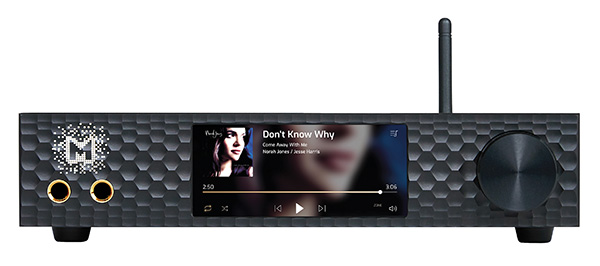
Mytek Digital Brooklyn Bridge II Roon Core preamplifier
The concept of streaming digital music files over distances great (as with internet-streaming services like Spotify, Qobuz, Tidal, etc.) and small (from a home-PC hard drive, NAS, or networked music server) became mainstream only recently. But it was already brewing during the late 20th century, with people illegally downloading low-bitrate MP3 files made from CD rips and coming close to killing the recorded-music industry.
That wasn't streaming exactly, or not in the current sense, because the files needed to be downloaded, stored locally, then either played out of a computer or loaded onto a portable player, but from that point forward it was a steady march to the streaming-dominated present.
Never mind Napsterthe first subscription audio "streaming" service was one you probably wouldn't think of: Audible, the audio book service now owned by Amazon, which started up in 1995. I did beta testing and editing work for early-days Audible, and around that time, I started loading up home-ripped MP3 files on a pocket-sized Rio MP3 player (which by then had replaced Audible's proprietary player), using it in place of a portable CD player. This led to experiments with a PC music library/player running Linux, controlled by a Handspring PalmOS device connected to the stereo system via a Sound Blaster 16 card.
NAD 118 digital preamplifier
Tone controls? I ripped them out of my Dyna PAS-3! And that was the last time I had tone controls. As a card-carrying audiophile, I wanted just what the engineer had inscribed on the recording, with as little change as possible (read: high fidelity).
NAD M66 streaming preamplifier
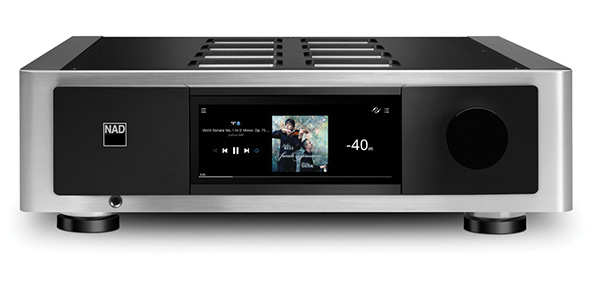
In my early years in audio, I witnessed the rise and fall of the AM-FM receiver, first in vacuum tube mono and later in solid state stereo. Some of them grew to be behemoths, supporting multiple inputs, equalizers, dual speaker zones, and powerful amplifiers. When radio sources receded in popularity and with the rise of CDs, cable TV, and DVD, radio receivers were replaced by A/V receivers in the mainstream market.
Today, the ascension of streaming as the conduit for both audio and video content has nudged these, too, from the center stage. One can stream content from the bewildering variety of products with internet access including cell phones, smart TVs, almost any computer, and of course, dedicated streaming devices from the cheap-and-cheerful to seriously audiophile. If your music is on the web or on a NAS, many of these will let you browse for it, find it, and play it.
NAD Monitor Series 1300 preamplifier
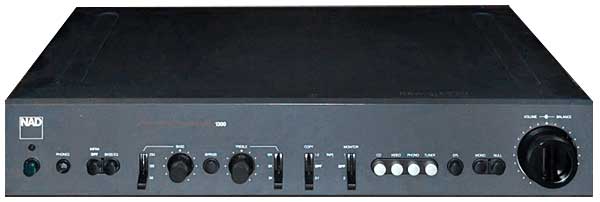
By far the most complicated of the three preamps i review in this issue in terms of facilities offered, NAD's "Monitor Series" 1300 ($398) provides two buffered tape loops, an external processor loop (which can also be used as a third tape-recorder loop), a headphone output, a "null" switch, switchable bass equalization to extend the low-frequency range of small loudspeakers, and treble and bass controls, each with a choice of three turnover frequencies: 3kHz, 6kHz, 12kHz, and 50Hz, 125Hz, 250Hz, respectively.
Naim NAC 552 preamplifier
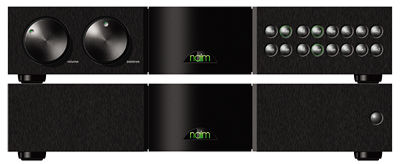
There's nothing groundbreaking about the technology included in Naim's new $22,400, two-box, remote-controllable, top-of-the-line NAC 552 preamplifier. Still, the inclusion of two sets of RCA input jacks is a departure from Naim's tradition of DIN jacks, and the NAC 552's programmability is unusual for a high-end two-channel audio product. And you can order RCA output jacks at no extra cost, which is how my review sample was configured.
Naim NAC 62 preamplifier & NAP 140 power amplifier
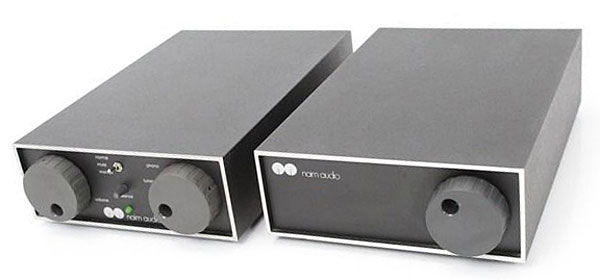
Back in 1970, one Julian Vereker decided to record some musician friends in his house in Salisbury, England. Using standard, off-the-shelf electronics and tape machines, he was startled at how dissimilar the recording was to the sound of live instruments. As a result, he started designing his own recording electronics, including a recording console, of which he sold several to local broadcast facilities.
Naim NSC 222 streaming preamplifier & NPX 300 power supply
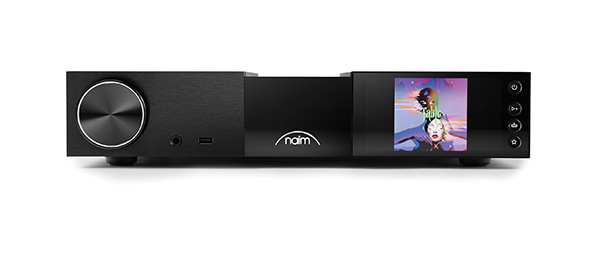
Naim has comprehensively reimagined its Classic Series, which has been around for some 20 years with improvements along the way. Included in the new range of products is the 200 series, comprised of two products: the NAP 250 power amplifier, which I reviewed in the November 2023 issue of Stereophile, and the NSC 222 streaming preamplifier ($8999), which is reviewed here. A third component in the New Classic series, the NPX 300 power supply (also $8999), which is intended to be paired with the NSC 222 and other Naim components, is also considered in this review.
Parasound Halo JC 2 line preamplifier
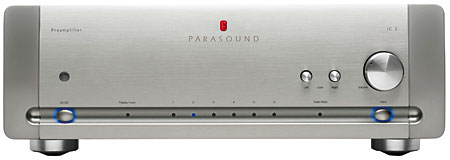
My very first review of a preamplifier, for British magazine Hi-Fi News & Record Review in May 1984, was of the Audio Research SP-10. In my opening to that review, I wrote that, "more than any other component," a preamplifier "should approximate to the late Peter">http://www.stereophile.com/news/121503walker">Peter Walker's 'Straight Wire with Gain.'" By this I meant that a preamplifier should not be in the business of effecting dramatic changes, and in any case, dramatic changes are not the kind that prove to be of lasting value. However, I also wrote back then that what I became increasingly aware of while using the SP-10 "was the fact that 'neutrality' is a positive virtue rather than just an absence of aberration."