

PS Audio 4.6 preamplifier
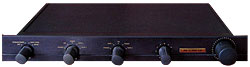 Choosing a moderately priced preamp has traditionally presented the audiophile with a host of serious problems. Most attempt to be all things to all listeners, expending resources on bells and whistles which would have been better expended on basic performance. Few have anything resembling a decent moving-coil stage. But there have always been a few designers (and companies) willing to expend much of their effort at the "low end of the high end." PS Audio has been such a company. Their new 4.6 preamp, an update and cosmetic clone of the earlier, well-received 4.5, is not at the top of their preamp rangethat honor belongs to the 5.5but it is clearly designed to be more than a price-point product.
PS Audio PMG Signature line preamplifier
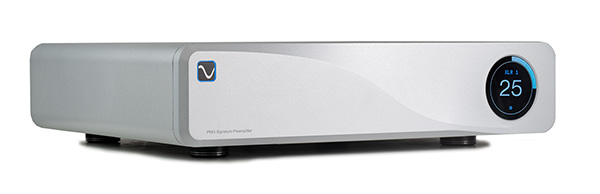
I view preamplifiers the way my dog views vacuum cleaners: warily and a bit mystified by their existence. The less-is-more, straight-wire-with-gain approach has always seemed the correct one to me. The preamps I own often sit forlornly in my gear closet until I am in temporary need of their services.
Quad 33 preamplifier & Quad 303 power amplifier
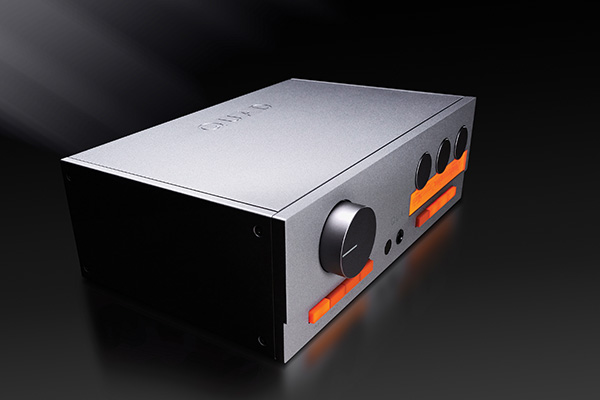
Launched in 1967, Quad's highly original, elegantly styled 33 preamplifier and 303 power amplifier were Quad's first allsolid state designs and among the first solid state separates. The 303 may have been one of the first "vertical" amplifiers. Together with the 405 stereo amplifier, which came out in 1975, and the FM2 and FM3 tuners, these products proved to be enduring, widely feted successes from their launch until they were discontinued, the 33 in 1982, the 303 in 1985. Meanwhile, they enjoyed massive production runs, were marketed worldwide, and were much admired for their modern industrial design. It's said that Quad sold 120,000 33 preamps and 100,000 303 amplifiers. Across two versions, the 405 sold even more.
Quad introduced new versions of the 33 and 303 (each component $1599) in 2024, apparently moved to do so by the continuing hot market for originals.
Quad 34 preamplifier
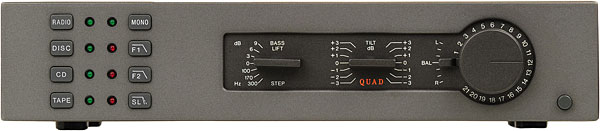
The Model 34 preamplifier is the component from English manufacturer Quad that will disenchant perfectionists, partly because of its obvious pandering to connoisseurs of old and sometimes lousy-sounding records, and partly because of its sound.
This solid-state design is supplied with a built-in moving-magnet cartridge preamplifier, and a moving-coil preamp is included with it for (easy) installation by the user if desired. (Remove two screws, pull out the old module, plug in the new one and replace the screws. The job takes about 3 minutes.) The MC preamp supplied is for 20 microvolt-output cartridgescontrary to the instruction booklet's statement that the supplied one is the 100µV version. Modules having a rated input level of 100 or 400µV are available as extra-cost options.
Rotel Michi P5 preamplifier
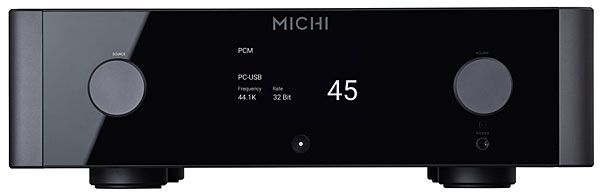
Before starting this review of Rotel's Michi P5, the 60-year-old, Japan-based audio company's recent preamplifier design, I thought it appropriate to consider "What is an audio preamplifier? What should it do?" There are plenty of opinions to be found at stereophile.com:
"What a preamp ought to do, apart from changing volume and switching sources, is as little as possible," wrote Stereophile Editor Jim Austin in his 2017 review of the PS Audio BHK Signature preamplifier.
Rotel RC-850 preamplifier

A few issues back, in my review of the Mark Levinson No.26 and No.20 (May 1988, Vol.11 No.5), I mused on the fact that the preamplifier, being the heart of a system, had a more significant effect on sound quality in the long term than, say, the loudspeakers. It was worth spending more on a preamplifier, therefore, than on loudspeakers. Needless to say, this viewpoint was regarded by many readers as dangerously heretical. I decided, therefore, to investigate the sonic possibilities of budget-priced preamps in this issue, even the most expensive being less than one-tenth the price of the Mark Levinson.
Simaudio Moon Evolution 740P line preamplifier

Transparency is a trait we all value in a hi-fi rig, and it's a concept I've long thought I understood. A system that tosses up the illusion of a clear, spacious soundstage, on which you can hearalmost seeall of the singers and/or instruments, from side to side and, especially, from front to way, way back: that's the ticket. Still, although such transparency is a sign that you've entered the realm of fine sound, it's not an absolute requirement. Tonal accuracy, dynamic range, a certain thereness that conveys the emotional heft or delicacy of musicthose things come first. Without them, the most precisely delineated soundstage is like an architect's sketch of an oil painting.
Simaudio Moon Evolution 850P line preamplifier
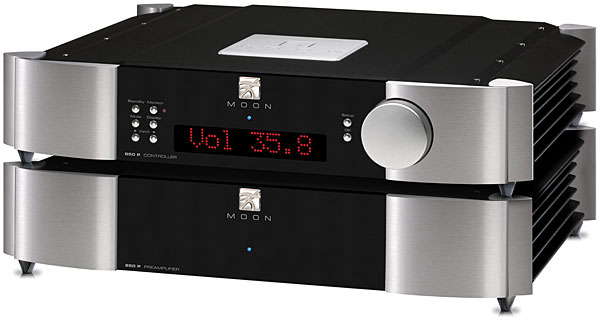
When I reviewed Simaudio's Moon Evolution 880M monoblock amplifier for the June 2013 issue, I communicated via phone and e-mail with the company's VP of marketing, Lionel Goodfield. When the topic of hearing the 880Ms at their best came up, I could almost imagine him shrugging as he said, "Just use it with the most transparent, revealing preamp you can find." Not surprisingly, he then went on to say that Simaudio's own Moon Evolution 850P would serve nicely in that role. My cynical side might normally have discounted any such suggestion from a marketing man, but I'd been hearing the same sort of thing from other sources. And, as it happened, there was an 850P at Stereophile World Headquarters . . .
Simaudio Moon Evolution P-7 line preamplifier
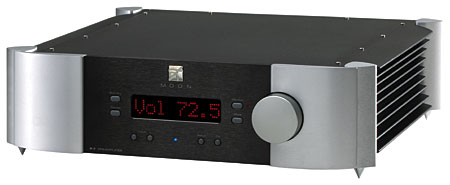
Over the years, I have become increasingly impressed by the quality of the audio engineering emanating from Simaudio, which next year celebrates its 30th anniversary. In a world where the US facilities of some well-known audio brands have been reduced to a design office coupled to a warehouse for storing product manufactured overseas, this Montreal-based manufacturer, in order to keep full control over quality and hence reliability, does as much manufacturing as possible in-house, including metalwork, some printed circuit-board stuffing, and assembly. (See my photo essay starting herehttp://forum.stereophile.com/photopost/showphoto.php/photo/856">here;.)
Simaudio Moon Evolution P-8 preamplifier
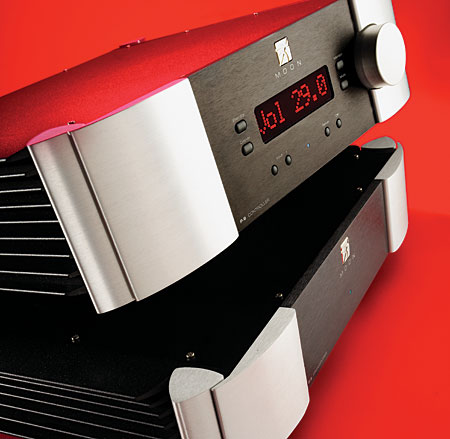
The P-8 ($11,000) is the second of Simaudio's Moon Evolution series that has passed through my system, following on the heels of the Moon Evolution W-8 power amplifier, which I reviewed">http://www.stereophile.com/solidpoweramps/306sim">reviewed in March 2006. Fortunately, the P-8's arrival preceded the W-8's departure, so I was able to use them together as well as with other components.