

Q Acoustics Concept 50 loudspeaker

Given how crowded the loudspeaker manufacturing space has always been, I am always surprised when a new brand not only springs into being but does so with new speakers that sound and measure well. Take the UK's Q Acoustics, for example. The company didn't exist before 2006 and didn't have a presence in the US until 2018.
Q Acoustics Concept 500 loudspeaker

Q Acoustics was founded in the UK in 2006, but has appeared on the radar of US buyers only in the last few years. Until recently, Q has aimed its efforts at the budget sector, earning enthusiastic reviews and commercial success.
But during that time the company also been quietly working on a product considerably more upscale, though still affordable in a marketplace now glutted with products at if-you-have-to-ask prices. The result is the Concept 500 ($5999.99/pair), first seen in the UK in 2017 and recently made available here. But you won't find it at your local audio shop (if you still have one); in the US it's currently sold only online, through Q Acoustics' US website, with a 30-day, money-back guarantee that includes shipping costsboth ways.
Quad ESL loudspeaker
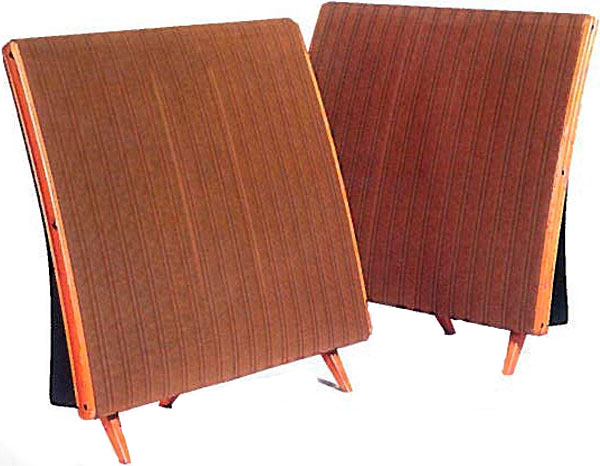
High fidelity took a giant step forward in 1956 with Peter Walker's introduction of the Quad ESL. Walker's research efforts had been motivated by his firm belief in the superiority of the electrostatic dipole over the box loudspeaker, but actually to take the economic plunge and market such a speaker was surely an act of bravery. After all, those were the pre-stereo, pre-audiophile days of the mid '50s, and the public's tastes and expectations were relatively unsophisticated. The average front end was abominable by today's standards, so that making definitive assessments of loudspeaker quality was a difficult task at best.
Quad ESL-2912 loudspeaker
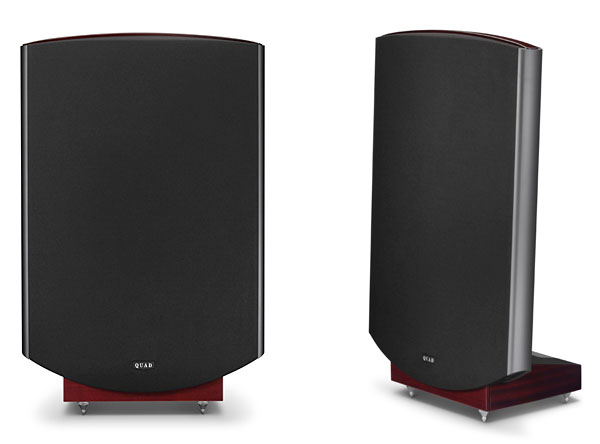
If Stereophile gave an award for Loudspeaker We've Most Frequently Reviewed, the hands-down winner would have to be the Quad ESL. The list of past and present Stereophile contributors who've written about the ESL's various incarnations includes John Atkinson, Martin Colloms, Anthony H. Cordesman, Art Dudley, Larry Greenhill, J. Gordon Holt, Ken Kessler, Dick Olsher, Herb Reichert, William Sommerwerck, Steven Stone, and Sam Tellig. The ESL-63 was John Atkinson's personal "Editor's Choice" in 1992, and the ESL-989, a successor to the ESL-63, was Stereophile's 2003 Loudspeaker of the Year and Product of the Year.
Quad ESL-63 loudspeaker
Warning to Purists: Despite certain qualities about the ESL-63 speakers which you will probably like, Quad equipment is not designed primarily for audiophiles, but for serious-music (call that "classical") listeners who play records more for musical enjoyment than for the sound. Quad's loudspeakers do not reproduce very deep bass and will not play at aurally traumatizing volume levels, and Quad's preamplifier is compromised through the addition of tone controls and filters, all for the purpose of making old, mediocre, and/or worn recordings sound as listenable as possible.
Quad ESL-989 electrostatic loudspeaker
I first heard Eugene Gigout's pipe-organ masterpiece, the Grand Chorus in Dialogue, in the Smetana Concert Hall of Prague's Municipal House (Obecnim Dome) on a Saturday evening before the 2002 flood. I recall seeing the delicate, youthful Michele Hradecka sway from side to side to reach the pedals. In response, a massive wall of deep organ chords shook the hall, the magical acoustic blending the delicate, extended highs with the thunderous bass. But this memory mixed the music with the beauty of Prague's soaring church spires, brilliant red terracotta roofs, and lavish palaces.
Quad Reference ESL-2805 loudspeaker
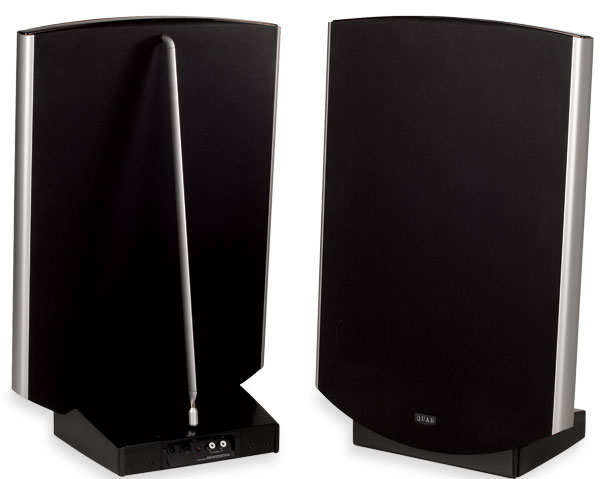
I gasped. An almost perfect 300Hz squarewave had appeared on the oscilloscope screensomething I had never before seen from a loudspeaker.
It was the spring of 1982. John Crabbe, then editor of the British magazine Hi-Fi News & Record Review, and I had driven up to Quad's factory in Huntingdon, England. The ESL-63 electrostatic loudspeaker had been launched the previous summer, and we were to interview its designer, Peter J. Walker, for an article that would appear in the July 1982 issue of HFN/RR. Peter set up a pair of ESL-63s on wooden kitchen chairs, fed one of them a 300Hz squarewave, casually placed a mike before it, and showed us the result on the 'scope. "Of course, why should a speaker being able to reproduce a squarewave matter at all, hmmm?" he rhetorically asked us.
Raidho TD3.8 loudspeaker
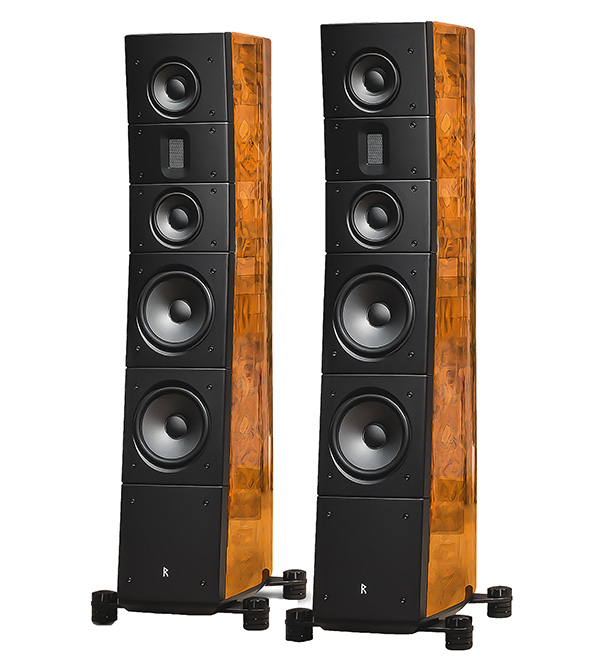
In my high-school days, I visited a friend whose well-to-do dad proudly demonstrated his new Quad ESL system for us. First up was a recording of a man with heavy footsteps traversing the space from left to right. Next came a speeding police car, siren engaged, complete with Doppler tail. I found it impressive, and a little lame at the same time. My friend and I, in love with our own artsiness, preferred Fear of Music by Talking Heads and Drums and Wires by XTC, or (in a pinch) U2's Boy.
It wouldn't have occurred to me that I'd ultimately derive frequent joy from listening to sound effects (though in my case they're usually integral to the music, not apart from it). When I hear Yosi Horikawa's bouncing marbles on Wandering, I prick up my ears and smile. A panting dog on Holly Cole's Temptation, an overhead hovercar on the Blade Runner 2049 soundtrack ... bring it on. A babbling river on Andrew Bird's Echolocations; seed pods on Tom Waits's Blood Money; liquid splashes and crinkling paper on Felix Laband's Dark Days Exit ... yes, please. I don't care if it's a little gimmicky. It's also sensual in the original meaning of the word, an aural pleasure.
The Raidho TD3.8 speakers that, after three months, just departed my home, do the trick of conjuring points in space with great acuity.
Rauna Balder loudspeaker
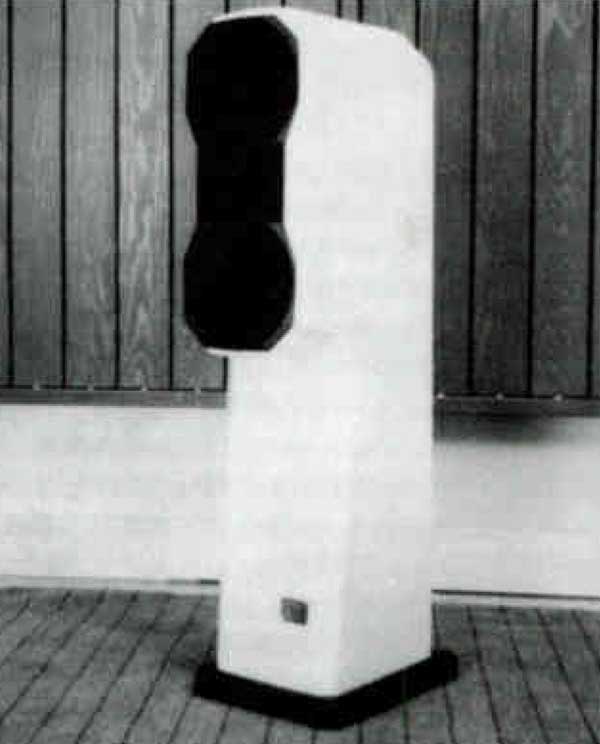
The Swedish Rauna company, which has been in existence for about five yearstheir little Mk.II Tyr two-way impressed J. Gordon Holt a couple of years back in Vol.9 No.2appears to be dedicated to the use of concrete as an enclosure material. One of the problems with conventional wooden cabinets is that the walls flex and vibrate, adding a spurious and often time-delayed output at some frequencies. It has even been reported that in extreme cases, the contribution of the cabinet to the overall sound at some frequencies approaches that from the drive-units. In theory, concrete should give a rigid construction with any panel resonant frequencies moved up above the critical midrange.
RBH 641-SE loudspeaker
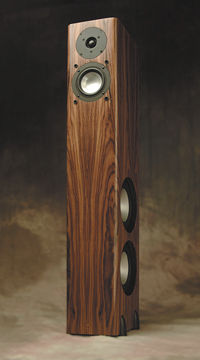
When it was suggested that I call in on speaker manufacturer RBH Sound during a planned trip">http://www.stereophile.com//asweseeit/470/">trip to Utah in the fall of 2001, my response was "Who is RBH?" To my embarrassment, the speaker company had not popped up on my radar screen since it was formed in Los Angeles in 1976. However, I had certainly heard some of the speakers they had manufactured for other companies, most notably the McIntosh models of the early 1980s, with their line arrays of dome tweeters.