

Ø Audio Verdande loudspeaker
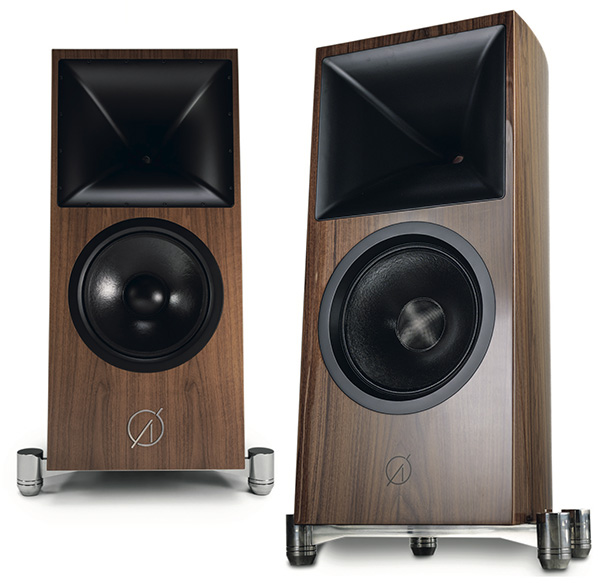
Full-range speakers are usually at least three-way rather than two-way, for good reasons. Although a three-way crossover network is harder to do right, and there can be phase-coherence issues if the drivers aren't well-matched and well-integrated, a two-way speaker with a woofer big enough to generate room-filling lows is even more difficult.
Acapella High Violoncello II loudspeaker
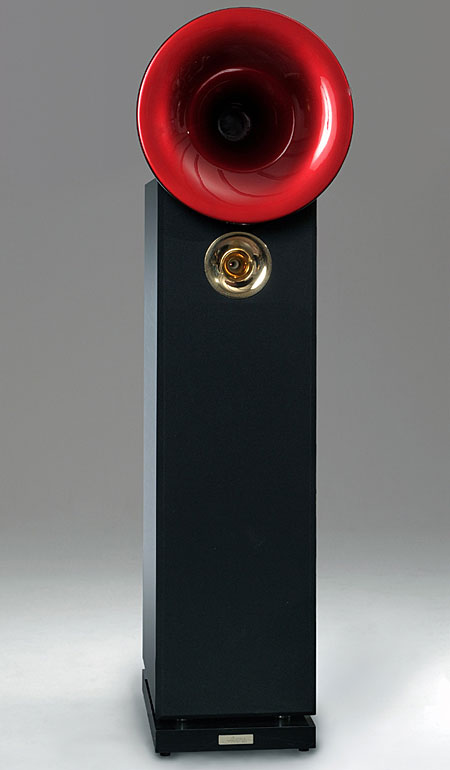
Stereophile's founder, the late J. Gordon Holt, always had a thing for horn loudspeakers, feeling that these archaic beasts offered a "jump factor" that could never be rivaled by conventional, direct-radiating designs. A horn drastically increases the efficiency with which electrical power is converted into acoustic power, which means that for a given sound-pressure level, a smaller amplifier can be used compared with a direct-radiator, and that all distortions, both electrical and mechanical, can theoretically be much lower. Yet outside of a small circle of enthusiasts, horns never got much of a following in high-end audio, and as high amplifier power became plentiful and relatively cheap, horns largely disappeared from domestic audio use (except in Japan).
Acarian Alón IV loudspeaker
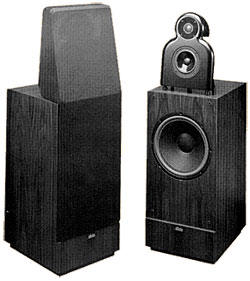
My first encounter with the Acarian Alón IV was at the 1992 Las Vegas WCES. I was doing the show report dealing with speakers, and there was already enough advance buzz about the Alón IV that I put it on my "Speakers I Must Listen To" list. And listen I did, at some length, and came away impressed with their open quality and well-defined soundstage. In discussing reviewing assignments with John Atkinson, I told him that the Alón IV was one of the speakers I wouldn't mind spending some time with. (The list also includes the WAMM, the MartinLogan Statement, and the Apogee Grand, but I'm not holding my breath.)
Acarian Systems Alón Circe loudspeaker

Who knows not Circe,
The daughter of the Sun, whose charmed cup
Whoever tasted, lost his upright shape,
And downward fell into a groveling swine?
—John Milton, Comus
The daughter of the Sun, whose charmed cup
Whoever tasted, lost his upright shape,
And downward fell into a groveling swine?
—John Milton, Comus
Acoustat 2+2 loudspeaker
 While I refuse to admit publicly how long I have been sitting on these loudspeakers before doing the report on them, I must say that it is probably a good thing I wasn't in all that of a hurry to get around to it. They did not sound very good in the room where I had initially installed them, and had I written the report on that basis, it would have been lukewarm, to say the least.
I have now had the opportunity to live with the Acoustat 2+2s in my usual listening room, which is more like a typical listening environment (19' by 24' by 9' and moderately padded), and I am more than a little impressed. This is an extremely good speaker, particularly at its price of $2100/pair.
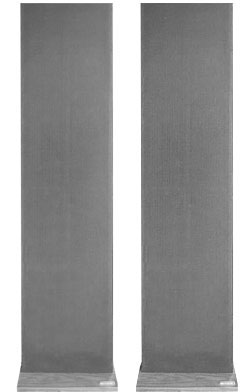
The 2+2 resembles the Model Four in that it contains four of Acoustat's full-range electrostatic panels per side, but differs from it in that two of the panels (per side) are stacked on top of the first pair to produce a radiating surface twice as high and half as wide as that of the Four. The result, particularly in the case of the black-grilled version we tested, bears a startling resemblance to the mysterious obelisk in 2001, A Space Odyssey. The 2+2 system towers almost to the ceiling (and at just under 8' may be too high for some ceilings), and although it is more graceful in appearance than a pair of Fours, it tends to dominate a listening room at least as much.
While I refuse to admit publicly how long I have been sitting on these loudspeakers before doing the report on them, I must say that it is probably a good thing I wasn't in all that of a hurry to get around to it. They did not sound very good in the room where I had initially installed them, and had I written the report on that basis, it would have been lukewarm, to say the least.
I have now had the opportunity to live with the Acoustat 2+2s in my usual listening room, which is more like a typical listening environment (19' by 24' by 9' and moderately padded), and I am more than a little impressed. This is an extremely good speaker, particularly at its price of $2100/pair.
The 2+2 resembles the Model Four in that it contains four of Acoustat's full-range electrostatic panels per side, but differs from it in that two of the panels (per side) are stacked on top of the first pair to produce a radiating surface twice as high and half as wide as that of the Four. The result, particularly in the case of the black-grilled version we tested, bears a startling resemblance to the mysterious obelisk in 2001, A Space Odyssey. The 2+2 system towers almost to the ceiling (and at just under 8' may be too high for some ceilings), and although it is more graceful in appearance than a pair of Fours, it tends to dominate a listening room at least as much.
Acoustat Spectra 11 loudspeaker
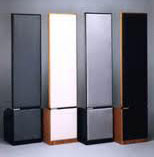 I wish I could be enthusiastic about the Acoustat Spectra 11an electrostatic/dynamic hybrid selling for $999/pair. At first glance, the Acoustat Spectra 11 looks like a good deal. They could almost be called knock-offs of the Martin-Logan Sequelsthey're about the same size. As with the Sequels, there are moving-coil bass cabinets below, electrostatic panels on top. The Spectra 11 cannot be bi-wired and does not come with spikes. Tiptoes are recommended, and I used them. I let the speakers run in for about 24 hours before doing any serious listening.
Acoustat Spectra 1100 loudspeaker
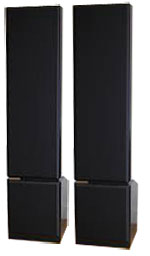 Acoustat Model Twos have been my reference loudspeakers for almost five years. I remember, on first hearing them in a high-end store in Illinois, how they let the music through in a way new and important to me. I knew I must own them! They seemed, despite their imposing appearance, to step aside when the music came on. The effect was akin to having a door opened onto the performance. One became privy to intimate details captured in recordings which are rarely heard outside the concert hall. Not veils, but flannel sheets were lifted from the sound! If one fussed around enough with placement, the Twos truly disappeared into the soundfieldmusic came from in front of, to the sides of, between, and behind them as if they weren't there. Focusing them like a fine camera lens on the listening chair created a "sweet spot" which, when I sat therein, raised within me a sense of awe usually associated with things magical. You knew when you entered this space, for it was different from that surrounding it. The musical presentation assumed an almost holographic palpability.
Acoustat Spectra 3 loudspeaker
Founded in the mid-1970s, Acoustat was the first manufacturer of full-range electrostatics literally forced to address what had long been a major weakness of such speakers: high-voltage breakdown, or "arcing." The original design was built and used in JP (Jeep) Harned's home, where the living-room french windows opened out onto a stream in the back yard. That, plus Florida's legendary humidity, conspired to produce summer days when moisture would trickle down every vertical surface in the house, including the speaker elements.
Acoustic Research AR-1 loudspeaker
Experienced reviewers know that shows are the wrong environments for critical audiophile listening. Convention centers—especially the one at Las Vegas—are huge, cavernous airplane hangers, not the intimate listening rooms reviewers thrive in. Extraneous sounds from subwoofer blasts and the constantly milling crowds leak in to sully the music. Booths set up by manufacturers on the show floor have very thin, flexible walls, and no bass treatment.
Acoustic Research MGC-1 loudspeaker
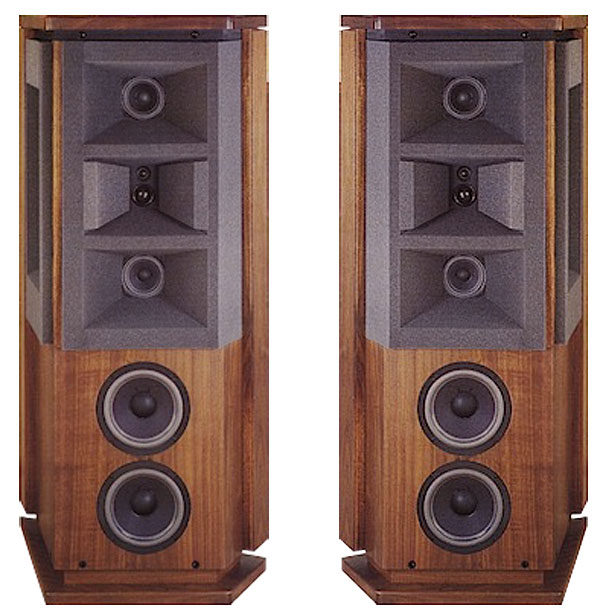
There's virtue in being in the right place at the right time. The right place in this story was the headquarters of Acoustic Research in Boston, MA, and the right time was just a couple of weeks or so before the subject of this piece was to be shown (but not heard) at a press conference in New York. Even within that short two weeks, the rot started to set in. What I saw (and heard) in Boston on that occasion was a loudspeaker that stakes a reasonable claim on being revolutionary. A rare event that. The project name was The Magic Box and I was hoping that is what it might have been called when it went on sale. The Magic Box does, after all, conjure up an image of something a little special, and it's also easy to remember.