 Drive units and crossovers
Wilson Audio has enjoyed much experience with European drivers chosen primarily for transparency and musicality. All those in the current WATT/Puppy are by ScanSpeak, which specializes in patented ultrahigh-performance designs. These drivers are renowned for low coloration deriving from inventive diaphragm mode-suppressing geometry and suspension configurations.
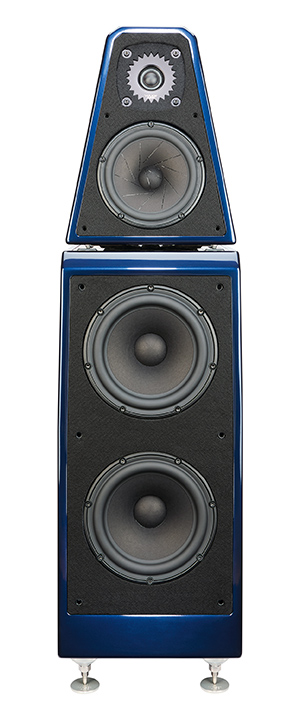
Looking first at the Puppy's low-frequency enclosure, this houses two 8" (203mm) "essentially pistonic" bass drivers fitted with homogenous cellulose-composite resin-bonded pulp cones. These are built on sturdy diecast alloy frames, with seven-bolt fixing. With a very low 21Hz fundamental resonance, the swept piston area for the pair is equivalent to a 12" (300mm) bass unit. Each driver is rated at 250W peak program. Designed with deep excursion and low loss, ie, high-Qm (mechanical quality factor) suspensions, a potentially "agile" bass quality was an important design objective. The woofers are vented by a large 3" diameter × 6" deep port on the rear panel, this milled from solid aluminum and tuned to a low 32Hz.
The highly refined 1" (25.4mm), critically doped silk-dome tweeter is a custom design. It offers particularly low distortion with good sensitivity and a wide, resonance-free bandwidth. It is also capable of exceptional transparency, especially with Wilson's enhancements, which include an oversized and specially shaped energy-absorbing carbon fiber rear chamber. This terminates much of the out-of-phase back wave exiting via the vented magnet pole, smoothly extending the effective frequency range and dubbed CSC, or "Convergent Synergy Carbon." A patented low-distortion "SD" symmetrical magnet design powers this Wilson-configured driver.
Serious money has also been spent on Wilson's ScanSpeak midrange driver, which has a wide, resonance-free frequency range. This is thanks to several key features including that patented radially "sliced" cone, where a designed segmented structure is restored by lossy bonding adhesive along the spiral seams, massively reducing the usual cone breakup coloration and almost vanquishing concentric-mode resonances. And in common with previous WATTs, the midrange enclosure has a small, slotted vent, this helping to equalize local air pressure variations emanating from the bass system. It is resistively damped by an acoustic foam insert.
Enthusiasts may well value the musicality of classic 1950s and 1960s high-end speaker systems, many of which used JBL and Altec drivers fitted with Alnico magnets. The cobalt used in the then-ubiquitous aluminum-nickel-cobalt alloy was largely sourced from currently war-torn countries and has become both expensive and hard to get. Fortuitously, ferrite "ceramic" magnets were just emerging in the late 1960s to fill the gap, and most of the industry was encouraged to join the ferrite bandwagon. But a few discerning listeners were noticing a subtle but unwelcome change in sound quality. This was related to a shift in residual driver distortion products, from a dominant second harmonic to the more dissonant third harmonic. (Interestingly, the public eventually became accustomed to this "meaner," more punchy sound.) So, when some years later, purchasers were offered a reduction in this marginally audible third harmonic thanks to new magnet alloys, many considered that the resulting sound did not seem to be quite as "dynamic"—for example when reproducing punchy transients such as drum rim shots. They had become accustomed to the extra "bite."
ScanSpeak has long pioneered a range of low-distortion, low-coloration drivers. Neodymium-alloy magnets do offer a welcome improvement in respect of lowered distortion, while the Alnico sound remains a favorite with some designers regardless of expense. Wilson's midrange driver boasts four huge Alnico magnets, these arranged in the company's characteristic QuadraMag low-distortion assembly. The WATT's midrange driver has such a wide, blemish-free bandwidth you could just about run it full range as a compact single driver system, it is that good.
All the crossovers, bass, midrange, and treble, are located in the bass enclosure, thus isolating the potentially microphonic film capacitors from the higher acceleration, higher frequency vibrations encountered in the head unit. Additionally, the crossovers are potted and encapsulated, a powerful vibration-controlling feature which helps to lower the operating noisefloor; this is a long-established Wilson technology. The mid and treble ranges are biwired to the WATT head unit.
Wilson manufactures its own crossover components, reaping the benefits from their acquisition of the renowned Rel-Cap company and plant. They have applied their expertise to tune up the manufacturing processes while also introducing new designs. Improvements include both higher-performance insulating films and electrode foils, some in multi-section combinations, achieving still-lower inductance losses and higher working ratings. Top-of-the-range AudioCapX-WA series are used in critical mid- and high-frequency locations for the WATT/Puppy, which include both copper-foil windings and copper leadout wires, to improve transparency and definition in the high-frequency range. The crossover filters also include oversize air-core inductors that feature high accuracy and sound quality.
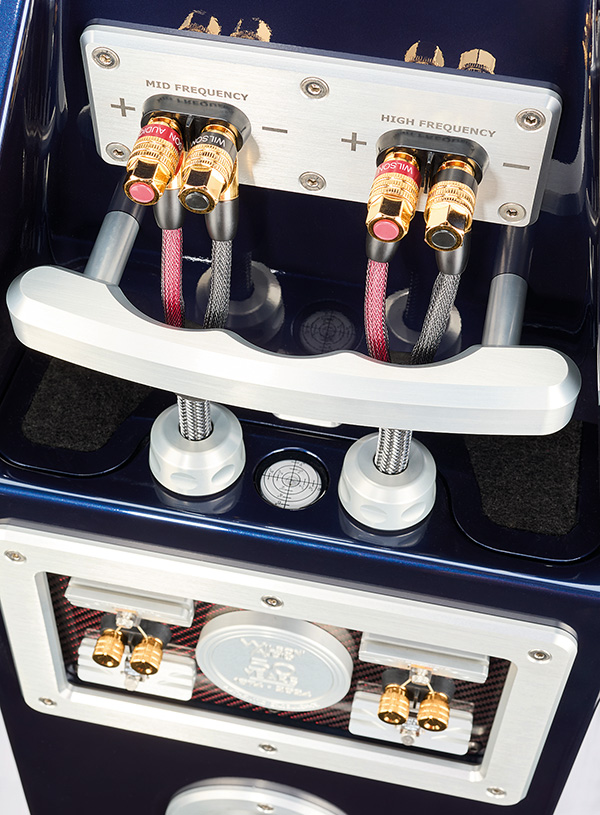
Audio power input is via generously dimensioned, heavily gold-plated three-way terminals, these designed by Wilson and sourced from the same local supplier that makes most of Wilson's metal parts. They accept spades, bare wire, and 4mm plugs. Really tight electrical connection is vitally important at this level, as these loudspeakers possess a complex and demanding load characteristic. A reliable and enduring low-resistance connection is essential for stable sound quality. These single-wired terminations are mounted on a sturdy alloy plate bolted to the back panel of the Puppy and are readily accessible for tightening with a socket-head wrench (supplied in the package and recommended for use).
Unusually, overload protection is included, here for the more susceptible mid and treble drivers, using a technique pioneered by David Wilson. Sourced from Vishay, mil-spec fusible heatsinked, audiophile-rated metal-foil resistors are used to calibrate the specific operating level of each driver, where they also protect from thermal and damage limit overload. This functionality is conveniently achieved with no additional electrical contacts and thus no loss of sound quality. Thanks to Daryl, the requisite resistors are conveniently located on the back panel of the Puppy, readily facilitating service, including by the owner.
All you have to do is loosen a couple of small socket-head bolts and the respective terminals and to swap out the fused item. As a result, costly and inconvenient replacement of damaged drivers, which may be experienced with other brands, will be extremely rare. Also note that the more powerful bass units now employed in the Puppy are also much less likely to suffer damage than before.
As before, this latest WATT/Puppy remains a 4 ohm rated amplifier load and will draw significant power from matching amplifiers. (Wilson notes a worst-case load in the upper bass of 2.87 ohms at 86Hz, if over a short frequency range.) Most modern higher-output current solid state amplifiers will be untroubled by this, but with tubed amplifiers the 4 ohm output transformer tap is advised (to maintain best control of the speaker's impedance). However, experimenting with both 4 and 8 ohm amplifier connections is always worth trying, listening for both bass quality and available loudness. And mitigating the demanding impedance, the specifications also claim a well-above-average voltage sensitivity of 89dB/2.83V/1m, with a suggested minimum amplifier rating of 25Wpc. (As we shall find, there is an additional sensitivity bonus.) In typical rooms of 2800ft
3, amplifiers up to 200Wpc into 8 ohms will provide substantial and realistically loud soundfields of some 110dBA from a stereo pair.
Installation
For this review, I had the WATT/Puppy initially set up as they came out "of the box." I planned to make notes on the factory standard alignment sound before experiencing the possible benefits of some local tuning and subsequently a calibrated install by a trained dealer. These adjustments are quite subtle, perhaps a 1° or 3° angling of the enclosure and/or the head unit azimuth. While these tuning tweaks are readily audible, they have a quite small effect on the frequency response, perhaps a dB here, half a dB there, barely showing in the usual test measurements. However, once performed, this
in situ calibration may offer the listener a more natural timbre, better focused transients, a more tuneful and extended bass, and not least a standard of imaging which is deeper, wider, and better focused. Unquestionably such versatility does help to set these designs apart, though I recall that some of the larger Focal loudspeaker systems also provided important azimuth, angling, and fine-tuning options for driver levels. Such seemingly small changes in output and orientation when applied to mid- and/ or high-frequency sections will be effective over several octaves and thus carry significant weight.
In the capable hands of a Wilson-trained installer, exclusive sound-quality bonuses include room assessment and loudspeaker placement optimization. There is also scope for further subtle alignment—micro-tuning—of the loudspeakers during the interactive optimization process, this covering listener position and seated head height, but also advantageously including the more subtle timbre of the connected components of a partnering audio system. Using a precision calibration practice pioneered and developed by David Wilson, there is significant added value for the overall performance which can be achieved—in my experience this gain can appear as much as 20%.
For severe room-system-speaker mismatches, where an even bass and a natural timbre is proving difficult to attain, a Wilson design such as the WATT/Puppy may be further tuned to take account of the room acoustic, specific placement of speakers and listener(s), the drive electronics, and even the loudspeaker cable type and length. Further variables encompassed include adjustment for the listener's seated ear height, the overall room acoustic, and in extreme cases even the power amplifier output impedance, here accommodating matching differences such as may be found between tube and transistor technologies. The
in situ calibration may, if very rarely, include fine-tuning of the mid- and high-frequency protection resistor values for best overall timbre.