Sidebar 3: Measurements
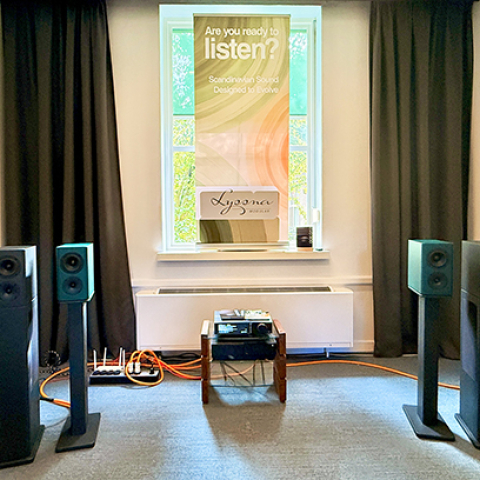
As I had done for the Wilson Sasha DAW, which Sasha Matson reviewed in January 2020, I measured one of the Sasha V speakers, serial number 0127, in Sasha's listening room. We lifted the speaker onto a small dolly so that we could rotate it for the off-axis response measurements. The inevitable reflection of the speaker's sound from the floor reduces the accuracy of the measurements in the midrange. All the measurements were performed without the grilles.
Wilson specifies the Sasha V's sensitivity as 88dB/W/1m. My estimate, in different units, was 91dB(B)/2.83V/m. As the Sasha V's nominal impedance is specified as 4 ohms, 2.83V will be equivalent to 2W rather than the specified 1W. Adjusting my estimate for this difference subtracts 3dB, confirming Wilson's estimate.
The Sasha V's measured performance is very similar to that of the Sasha DAW, though with even better-behaved enclosures, a slightly more even upper midrange, and a touch more top-octave energy.—John Atkinson
Footnote 1: EPDR is the resistive load that gives rise to the same peak dissipation in an amplifier's output devices as the loudspeaker. See "Audio Power Amplifiers for Loudspeaker Loads," JAES, Vol.42 No.9, September 1994, and stereophile.com/reference/707heavy/index.html. Footnote 2: My measured response is very similar to that measured by Paul Miller for Stereophile's sister magazine Hi-Fi News.
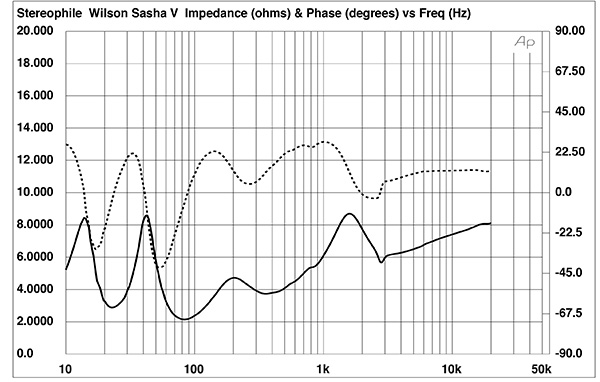
Fig.1 Wilson Sasha V, electrical impedance (solid) and phase (dashed) (2 ohms/vertical div.).
While the Sasha V's impedance magnitude remains above 4 ohms through the midrange and treble (fig.1, solid trace), it drops to 2.135 ohms at 83Hz. (The specified minimum impedance is 2.36 ohms at 82Hz.) The electrical phase angle (fig.1, dashed trace) is occasionally high, meaning that the EPDR (footnote 1), or effective impedance, lies below 2 ohms through most of the bass and below 1.5 ohms between 107Hz and 121Hz. The Sasha V is a demanding load for the partnering amplifier.
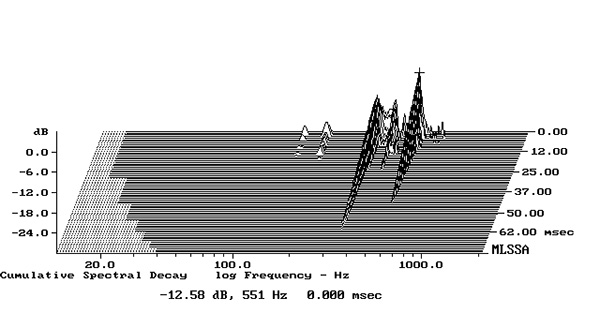
Fig.2 Wilson Sasha V, cumulative spectral-decay plot calculated from output of accelerometer fastened to the center of the upper-frequency enclosure sidewall (MLS driving voltage to speaker, 7.55V; measurement bandwidth, 2kHz).
When I investigated the woofer enclosure's vibrational behavior with a plastic-tape accelerometer, I didn't find any significant resonances. When I rapped its walls with my knuckles, it was impressively inert. The midrange/tweeter enclosure emitted a slight "plink" with the knuckle-rap test, and I found a low-level mode at 551Hz on the sidewalls and an even lower-level one at 300Hz (fig.2). The high Q (Quality Factor) and low levels mean that there shouldn't be any audible problems resulting from this behavior. These modes are also lower in amplitude and affected a smaller area than I had found with the Sasha DAW.
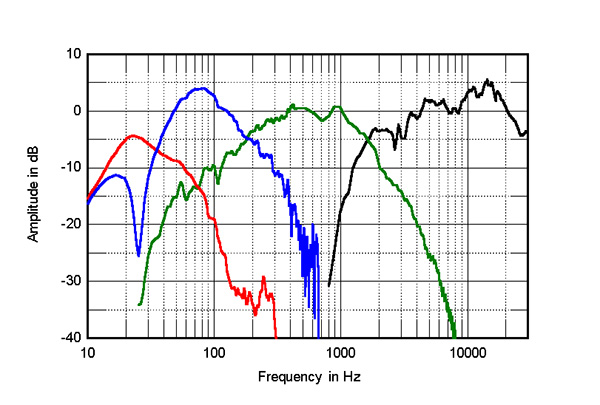
Fig.3 Wilson Sasha V, acoustic crossover on listening axis at 50", corrected for microphone response, with nearfield midrange (green), woofer (blue) and port (red) responses respectively plotted below 500Hz, 700Hz, and 300Hz.
The impedance-magnitude plot has a saddle centered on a low 25Hz, which suggests that this is the tuning frequency of the large port on the woofer cabinet's rear panel. The two woofers behave identically; the blue trace in fig.3 shows the sum of their nearfield responses, which has its minimum-motion notch at the expected 25Hz. The nearfield response of the port (red trace) peaks between 18Hz and 30Hz, and its upper-frequency rolloff is very clean. The woofers cross over to the midrange unit (green trace) just below 200Hz with a well-controlled rolloff above that frequency. As with the Sasha DAW, the midrange unit's low-frequency rolloff starts at 400Hz and is very gentle.
The Sasha V's upper enclosure is mounted on the woofer bin with spikes and steps at the rear to allow the midrange and tweeter to be aimed at the listener's ears. The tweeter is 43" from the floor, and I measured the height of Sasha's ears as he slouched in his listening chair as 40". For the farfield response measurements, I calculated where the microphone should be placed on the line between the tweeter and Sasha's ears at my standard 50" distance. The midrange unit's output on this axis has a slight peak just below 1kHz before crossing over to the tweeter (black trace) between 1kHz and 2kHz, and it rolls out relatively smoothly. The tweeter's output has a lack of energy at the bottom of its passband and slightly too much top-octave output.
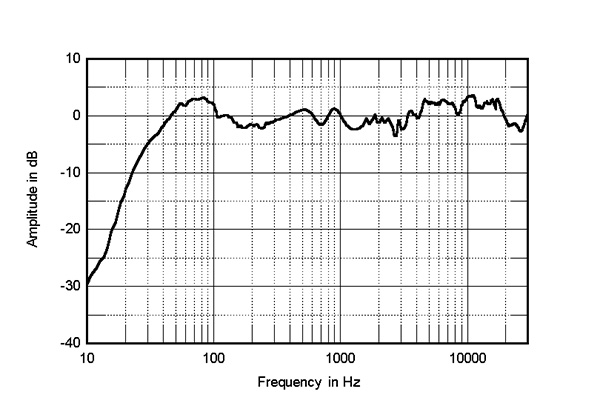
Fig.4 Wilson Sasha V, anechoic response on listening axis at 50", averaged across 30° horizontal window and corrected for microphone response, with the complex sum of the nearfield midrange, woofer, and port responses plotted below 300Hz.
The black trace above 300Hz in fig.4 shows the Wilson's farfield response, averaged across a 30° horizontal window centered on the listening axis. The overall balance is even, though there is a slight lack of presence-region energy compared with the two octaves above that region (footnote 2). The black trace below 300Hz in fig.4 shows the sum of the nearfield woofer and port outputs, taking into account acoustic phase and the different distance of each radiator from a nominal farfield microphone position. The rise in response in the upper bass, which results from the nearfield measurement technique, is lower in amplitude than I usually find. Like the Sasha DAW, the Sasha V's low-frequency alignment appears to be optimized for definition; with the low tuning frequency of the port, boundary reinforcement will give extension to 20Hz in a typical room.
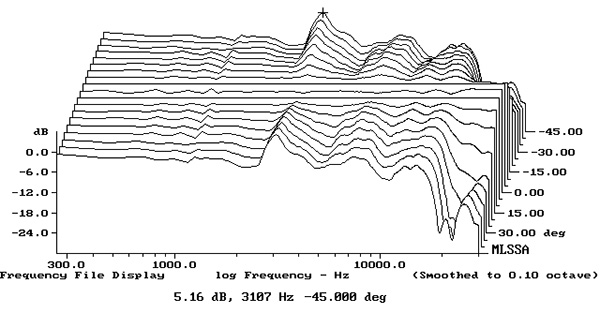
Fig.5 Wilson Sasha V, lateral response family at 50", normalized to response on listening axis, from back to front: differences in response 45–5° off axis, reference response, differences in response 5–45° off axis.
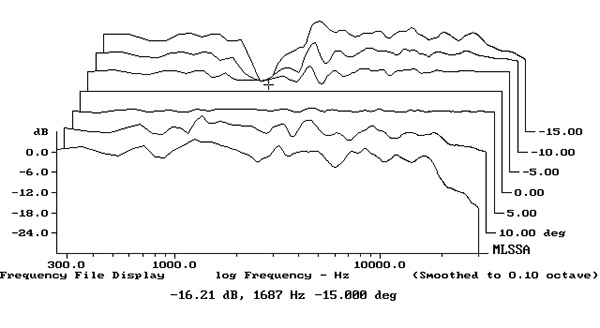
Fig.6 Wilson Sasha V, vertical response family at 50", normalized to response on listening axis, from back to front: differences in response 15–5° above axis, reference response, differences in response 5–15° below axis.
The Wilson Sasha V's horizontal dispersion, normalized to the listening-axis response, is shown in fig.5. (Even though the speaker was firing along the room's diagonal, the geometric limitations of SM's room meant that I could only measure the differences in response up to 45° to each side of the primary axis instead of my usual 90°.) The lack of presence-region energy on-axis reappears to the speaker's sides. The contour lines in this graph are otherwise even, implying stable stereo imaging. In the vertical plane (fig.6), a suckout develops in the upper crossover region 10° above the listening axis, but the balance is preserved 5° below that axis.
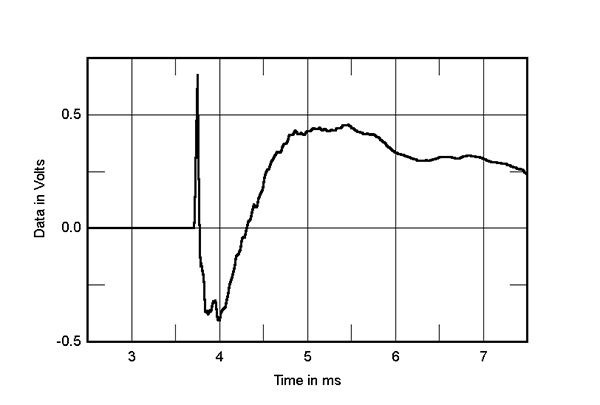
Fig.7 Wilson Sasha V, step response on listening axis at 50" (5ms time window, 30kHz bandwidth).
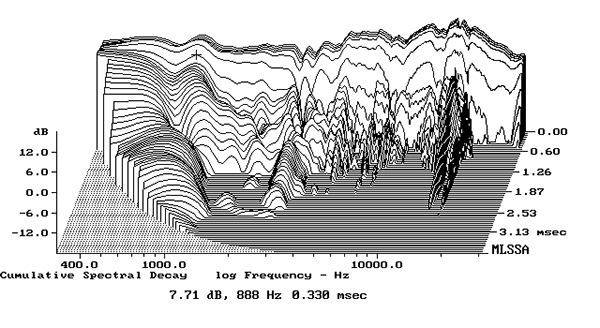
Fig.8 Wilson Sasha V, cumulative spectral-decay plot on listening axis at 50" (0.15ms risetime).
The Sasha V's step response (fig.7) is identical to that of the Sasha DAW. The tweeter's positive-going step arrives first at the microphone but has started to decay just before the midrange unit's negative-going step has reached its peak. The positive-going decay of the midrange step blends smoothly with the start of the woofer's step, which indicates an optimal crossover topology. The Wilson's cumulative spectral-decay plot (fig.8) is relatively clean overall, though some low-level delayed energy is present in the treble. There is also some delayed energy associated with the small on-axis peak just below 1kHz.
Footnote 1: EPDR is the resistive load that gives rise to the same peak dissipation in an amplifier's output devices as the loudspeaker. See "Audio Power Amplifiers for Loudspeaker Loads," JAES, Vol.42 No.9, September 1994, and stereophile.com/reference/707heavy/index.html. Footnote 2: My measured response is very similar to that measured by Paul Miller for Stereophile's sister magazine Hi-Fi News.