Sidebar 3: Measurements
With the large, heavy loudspeakers that Michael Fremer tends to review, I drive to his place with my test equipment. We maneuver one speaker onto a dolly and wheel it into his driveway for the measurements. However, with the 685lb Wilson Chronosonic XVX, this wasn't possible: I had to perform the measurements with the loudspeakers set up in Michael's room. The presence of early reflections from the room's boundaries meant that it wasn't possible to perform my usual gated, farfield frequency response measurements. Other than impedance and sensitivity, the only meaningful measurement I could make was the spatially averaged frequency response.
Wilson specifies the Chronosonic XVX's sensitivity as a high 92dB/W/m. My estimate was numerically the same using Stereophile's usual units: dB per 2.83V—not per watt—measured at 1m; the units are numerically equivalent only for an 8 ohm load. Wilson's specifications describe the loudspeaker's impedance as a nominal 4 ohms with a minimum value of 1.6 ohms at 326Hz, so the sensitivity measured in watts would be expected to be lower than specified.
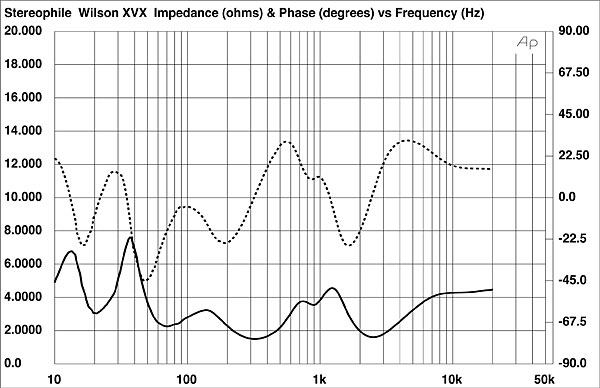
Fig.1 shows the Wilson's impedance magnitude (solid trace) and electrical phase angle (dotted trace) measured with Dayton Audio's DATS V2 system. The magnitude remains between 2 and 4 ohms for almost the entire audioband, with a minimum value of 1.5 ohms between 310Hz and 340Hz—roughly consistent with Wilson's specifications. Using an Excel spreadsheet to calculate the EPDR (footnote 1), the resistive load that gives rise to the same peak dissipation in an amplifier's output devices as the loud speaker, revealed that the XVX is a very demanding load, with EPDR less than 1.1 ohms between 52Hz and 66Hz and between 197Hz and 287Hz, with minimum values of 0.91 ohms at 450Hz and 0.94 ohms at 3250Hz. The Chronosonic XVX should be used with amplifiers like MF's darTZeel monoblocks that don't have problems driving loads of 2 ohms and lower.
Footnote 1: EPDR stands for Equivalent Peak Dissipation Resistance. See "Audio Power Amplifiers for Loudspeaker Loads," JAES, Vol.42 No.9, September 1994, and stereophile.com/reference/707heavy/index.html.
Fig.1 Wilson Chronosonic XVX, electrical impedance (solid) and phase (dashed) (2 ohms/vertical div.).
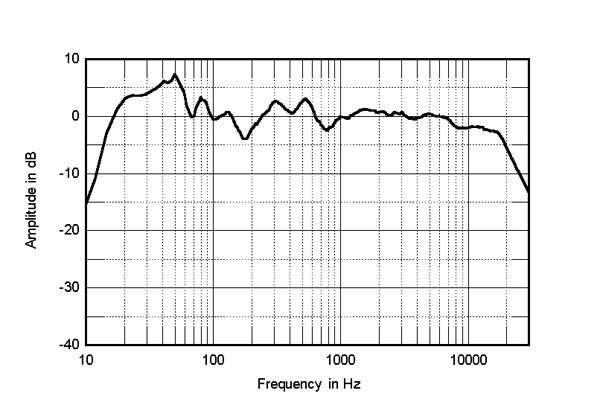
Fig.2 shows the Wilson Chronosonic XVXs' spatially averaged in-room response. Using FuzzMeasure 3.0 (now owned by Røde Microphones), a Metric Halo MIO2882 audio interface operating at 96kHz, and an Earthworks QTC-40 microphone, I averaged 20 1/6-octave–smoothed spectra, individually taken for the left and right speakers, in a rectangular grid 36" wide by 18" high and centered on the positions of the listener's ears. This tends to average out the peaks and dips below 400Hz that are due to the room's resonant modes.
Fig.2 Wilson Chronosonic XVX, spatially averaged, 1/6-octave response in MF's listening room (10dB/vertical div.).
The saddle centered on 21Hz in the impedance magnitude trace coincides with the tuning frequency of the Wilson speaker's port, which in turn suggests that the XVX is indeed a true full-range loudspeaker. Even though MF had to place the Wilsons close to the corners of his room, which exaggerates the speakers' midbass output, fig.2 indicates that the XVXes' in-room output extends below 20Hz. The dip between 130Hz and 230Hz will be due to room effects that have not been eliminated by the spatial averaging. The Wilson's higher-frequency output is generally smooth, with a slight downward slope that will be due to the increased absorption of the room's furnishings at high frequencies and the narrowing of the tweeter's dispersion in the top audio octave. Incidentally, looking at the outputs of the left and right speakers at the position of MF's head indicated that the outputs of the two samples in the frequency region where room effects were negligible were very well-matched, to within 0.5dB.
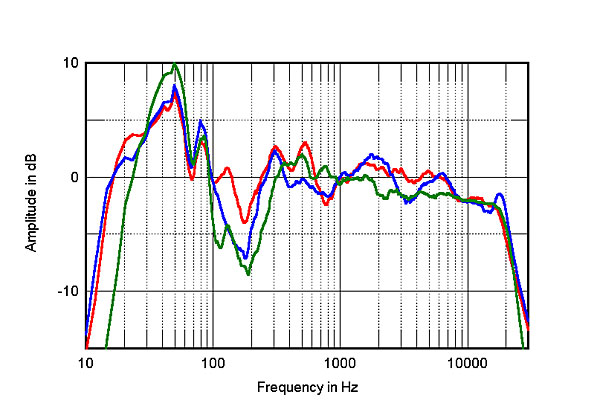
Fig.3 compares the Chronosonic XVX's spatially averaged response (red trace) with that of MF's long-term reference Wilson Alexx (blue trace) and the Sonus Faber Aida that he reviewed in October 2018. (Note the expanded vertical scale in this graph compared with fig.2, to make the differences easier to see.)
Fig.3 Wilson Chronosonic XVX, spatially averaged, 1/6-octave response in MF's listening room (red), of the Wilson Alexx (blue), and of the Sonus Faber Aida (green). Note expanded scale compared with fig.2.
With the similar corner placement, all three loudspeakers produce high levels of midbass, though the Sonus Faber does so to a greater extent than the two Wilson models. The XVX has less of a dip in the lower midrange than the other two speakers, which I suspect is due to the wide vertical spacing of its two lower-midrange units. Both Wilson speakers output more energy between 1.5kHz and 8kHz than the Sonus Faber. The Chronosonic XVX's treble is more even than that of the Alexx.
In my own auditioning of the Wilson Chronosonic XVXes in MF's room, the balance was indeed as shown by the spatially averaged graph. The low frequencies were powerful and extended, though without any "boom." The clarity and smoothness of the treble were impressive, with a tremendous ease to the sound. The presentation of the soundstage on my own recordings was the best I have experienced. After I returned home, I listened to the same recordings on the Falcon "Gold Badge" LS3/5a's that I write about elsewhere in this issue. Even though the Falcons correctly positioned the acoustic objects in the soundstage, the presentation was so much smaller-scale than it had been on the big Wilsons that I had to chuckle.—John Atkinson
Footnote 1: EPDR stands for Equivalent Peak Dissipation Resistance. See "Audio Power Amplifiers for Loudspeaker Loads," JAES, Vol.42 No.9, September 1994, and stereophile.com/reference/707heavy/index.html.