First, I loaded a 25W transistor amp with 8 ohms resistive. It clipped at almost 17Vp (peak) on a continuous sinewave (fig.1). (Note that the vertical scale used here is 5V/division.) I then connected the amp to my main speakers (Audio Note E's) and cued Touch to five seconds into the first track, where the percussionist hits a tambourine very hard—so hard that, during recording, he broke two tambourines. The 'scope was triggered to capture the first 8ms of this stroke, which sets off a train of pulses at basically 600Hz—so I also chose 600Hz as the frequency for the sinewave measurements. The result is about 18Vp (fig.2). This slight increase can be explained by the fact that this amp is not fully class-A, implicating that, under pulse conditions, the power-supply voltage will be slightly higher than when driven with a continuous sinewave. 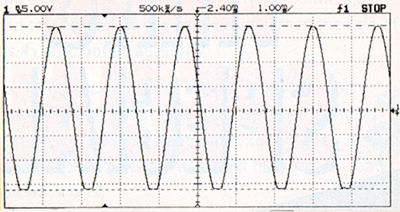 Fig.1 25W transistor amp into 8 ohms, sinewave just into clipping, 17V peak (positive), 5V/vertical div.
 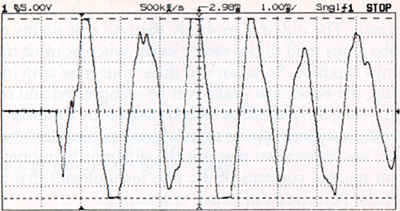 Fig.2 25W transistor amp into Audio Note E loudspeaker, 0:05 into track 1 of Touch, driven to maximum produced 18Vp, 5V/vertical div.
I then simulated the tambourine stroke by an 8ms train of 600Hz sinewaves, then tried a single-period 600Hz burst, then a different speaker as a load, then 8 ohms and bursts, then tried to push the amp harder (to see if there was anything "beyond clipping"). In every case, I ended up with the same 18Vp. I then connected my 300B amp and repeated the tests, with the 'scope's scale set to 10V/div. Fig.3 shows that this amplifier went into mild clipping (estimated THD 3%) into 8 ohms at 14Vp for the positive, least-clipping side, and 11Vp negative. This suggests a maximum output power of 11W RMS. Doubling the amp's input voltage produced heavy clipping at 17Vp positive.
Fig.2 25W transistor amp into Audio Note E loudspeaker, 0:05 into track 1 of Touch, driven to maximum produced 18Vp, 5V/vertical div.
I then simulated the tambourine stroke by an 8ms train of 600Hz sinewaves, then tried a single-period 600Hz burst, then a different speaker as a load, then 8 ohms and bursts, then tried to push the amp harder (to see if there was anything "beyond clipping"). In every case, I ended up with the same 18Vp. I then connected my 300B amp and repeated the tests, with the 'scope's scale set to 10V/div. Fig.3 shows that this amplifier went into mild clipping (estimated THD 3%) into 8 ohms at 14Vp for the positive, least-clipping side, and 11Vp negative. This suggests a maximum output power of 11W RMS. Doubling the amp's input voltage produced heavy clipping at 17Vp positive. 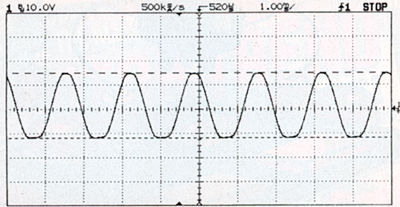 Fig.3 11W 300B SE tube amp into 8 ohms, sinewave just into clipping, 14Vp (positive), 10V/vertical div.
I replaced the 8 ohm load with the speaker and tried to see how far I could crank up the volume with this passage on the CD until no further increase in output occurred. I got fig.4: certainly distorted in comparison to fig.2, although I could hear nothing at all problematic. But look at that 36Vp in the negative half of the picture—it would take an 80W class-A transistor amp to allow such a voltage excursion! Fig.4 also suggests that if the 300B output stage were dimensioned differently and optimized for these transient conditions instead of the usual steady-state sinewave condition, the heavy positive clipping could have been avoided. This deserves investigation, but that means a whole new project...
Fig.3 11W 300B SE tube amp into 8 ohms, sinewave just into clipping, 14Vp (positive), 10V/vertical div.
I replaced the 8 ohm load with the speaker and tried to see how far I could crank up the volume with this passage on the CD until no further increase in output occurred. I got fig.4: certainly distorted in comparison to fig.2, although I could hear nothing at all problematic. But look at that 36Vp in the negative half of the picture—it would take an 80W class-A transistor amp to allow such a voltage excursion! Fig.4 also suggests that if the 300B output stage were dimensioned differently and optimized for these transient conditions instead of the usual steady-state sinewave condition, the heavy positive clipping could have been avoided. This deserves investigation, but that means a whole new project... 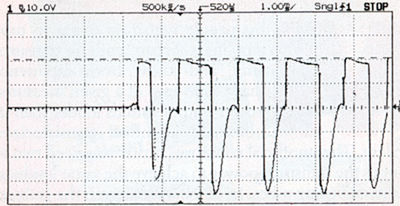 Fig.4 11W 300B SE tube amp into Audio Note E loudspeaker, 0:05 into track 1 of Touch, driven to maximum produced 36Vp (negative), 10V/vertical div. I then tried to simulate the tambourine stroke with 600Hz single-sine and 8ms bursts. The results were roughly similar into the speaker load, but the amp bottomed out at 19Vp into an 8 ohm resistor. I tried the Touch-at-0:05 signal and the 8 ohm load: same 19Vp. So it had to be an interaction between the tube amp and the speaker. I connected a different speaker, an old Wharfedale Denton 2XP, and got an astonishing 39Vp.
Herein lies a key to another mystery: It is well known that tube amps, and especially single-ended variants, are choosy with respect to the speaker they have to drive. High sensitivity (preferably >90dB/W/m) is a necessary condition, of course, but not a sufficient one. Pick a speaker that, impedance-wise, looks like an 8 ohm resistor (the theoretical ideal!) and your tube amp will sound restrained.
Fig.4 11W 300B SE tube amp into Audio Note E loudspeaker, 0:05 into track 1 of Touch, driven to maximum produced 36Vp (negative), 10V/vertical div. I then tried to simulate the tambourine stroke with 600Hz single-sine and 8ms bursts. The results were roughly similar into the speaker load, but the amp bottomed out at 19Vp into an 8 ohm resistor. I tried the Touch-at-0:05 signal and the 8 ohm load: same 19Vp. So it had to be an interaction between the tube amp and the speaker. I connected a different speaker, an old Wharfedale Denton 2XP, and got an astonishing 39Vp.
Herein lies a key to another mystery: It is well known that tube amps, and especially single-ended variants, are choosy with respect to the speaker they have to drive. High sensitivity (preferably >90dB/W/m) is a necessary condition, of course, but not a sufficient one. Pick a speaker that, impedance-wise, looks like an 8 ohm resistor (the theoretical ideal!) and your tube amp will sound restrained.
Fig.1 25W transistor amp into 8 ohms, sinewave just into clipping, 17V peak (positive), 5V/vertical div. Fig.2 25W transistor amp into Audio Note E loudspeaker, 0:05 into track 1 of Touch, driven to maximum produced 18Vp, 5V/vertical div. Fig.3 11W 300B SE tube amp into 8 ohms, sinewave just into clipping, 14Vp (positive), 10V/vertical div. Fig.4 11W 300B SE tube amp into Audio Note E loudspeaker, 0:05 into track 1 of Touch, driven to maximum produced 36Vp (negative), 10V/vertical div. I then tried to simulate the tambourine stroke with 600Hz single-sine and 8ms bursts. The results were roughly similar into the speaker load, but the amp bottomed out at 19Vp into an 8 ohm resistor. I tried the Touch-at-0:05 signal and the 8 ohm load: same 19Vp. So it had to be an interaction between the tube amp and the speaker. I connected a different speaker, an old Wharfedale Denton 2XP, and got an astonishing 39Vp.