Reviewer's Addendum
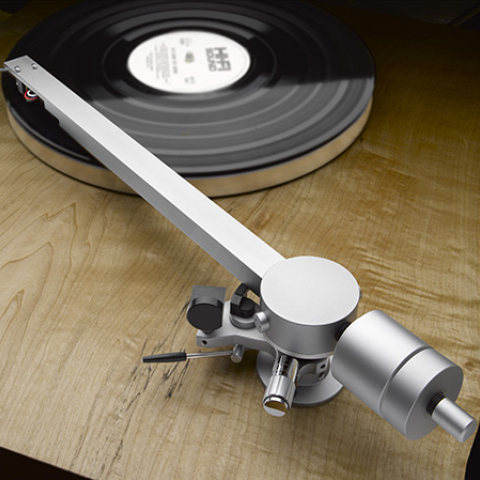
Okay, we admit it. We probably were guilty of oldthink in our reaction to the Vestigial arm. There is no doubt but that tracking cleanness and record life are enhanced by reducing total system mass (or inertia) as much as possible, and that in this respect the Vestigial arm represents a substantial advance in the state of the phono art. It is also true of course that the compliance must be very high (as it is in the KLM) in order to place the resonance of the system at the optimum frequency (or frequencies when vertical and lateral mass are different).
But the fact remains that, as of December 1974, there are only about two pickups in existence whose compliance is high enough and whose mass (total mass, not stylus mass) is low enough to take full advantage of what an arm like this has to offer, and both of them leave much to be desired in terms of some other important (to us) aspects of performance, such as transparency and detail. Other cartridges, which are considerably better in these respects, do not have the requisite compliance or lightness to perform at their best in the Vestigial arm under most conditions (we mentioned the qualifications in the report), and are thus best used with other arms. The sound will be markedly better, and record wear will not be that much worse to offset the sonic advantages unless you value disc life above all other considerations.
As for the remaining comments by Mr. Gammon which are worthy of reply, we will consider them in order:
Mr. Gammon is entitled (and rightfully) to feel that his design is better than any previous vertically articulated designs, but that does not change the fact that there have been such arms many years in the past. Whether or not they "remotely resemble" his is a matter of opinion.
Mr. Gammon is correct in stating "infinite-ratio-pivoting" is beyond our understanding. We are in fact still looking for anyone who can explain to us what it is, since Mr. Gammon did not attempt to do so, and no physicist we have consulted has ever heard of it.
Although Mr. Gammon chose not to comment on our worry about the fragility of the lateral pivots, some subsequent investigations on our part suggested that that problem does not really exist. The bearings can be broken by physical shock, as by dropping the arm before it is installed, but excessive lifting of the platform after installation only bends the arm tube. If it isn't kinked it can be easily straightened and no harm will have been done.
Without considering such matters as the change in stylus/groove contact area with change in tracking force, a pressure variation of 1000% would approximate a force variation of about 1/3 gram, which seems likely if a bit on the high side. But it is specious arguing to attribute record wear to inertia rather than to tracking force (or pressure, if you'd rather), when it is inertia which causes the variations in tracking force.
There may be a couple of semantic problems here, too. Despite our suggestion that "Vestigal" might best be spelled with an "i," Mr. Gammon used his own spelling throughout his letter, which leads us to suspect that it may be an accepted spelling in Ireland (His country of origin) (footnote 3).
Then again, Mr. Gammon obviously considers inertia to be something entirely different from mass, whereas all of the reference texts we have on hand define inertia as the characteristic of resisting change in direction or velocity, and mass as the measure of inertia. The units shown below for the "unarguable figures" would suggest that he is speaking of what American texts call moment of inertia. Since we are indeed dealing here with motion about an axis, it would seem logical to use that term in our resonance formula. The only problem is, the formula doesn't work then. We would appreciate hearing from anyone who can explain why.
As for our obscene resonance theories, we too have racked up a respectable number of years of experience in such matters, and have found that regardless of any criticisms that can be leveled at our arguable computations, they still yield results which correspond closely to those obtained from measurements. And as far as we're concerned, that is the ultimate test of any computation.
We did not state that there are two tonearm resonances. We stated, correctly, that there are two fundamental resonances in every pickup system, one at the low end, the other at the high end.
Damping a resonance produces a damped resonance; it does not eliminate the resonance. In order to eliminate the resonance, damping must approach infinity, which is another way of saying it must eliminate the compliance component of the system. This is hardly the answer for a phono cartridge.
Since the frequency at which acoustic feedback begins to set in depends on the frequency response of the speakers, the standing-wave patterns in the room, the resonant frequency of the room floor (or, sometimes, wall), the vibrational period of the turntable suspension and the natural resonance of the tonearm- mounting board as well as the bass resonance of the pickup system, it strikes us as being very peculiar at the least that an engineer with Mr. Gammon's experience would seem to equate it solely with the tonearm resonance. Perhaps that explains the humbleness.
It appears that Mr. Gammon is confused about the weight component in resonant systems. In the classic resonance figure—a weight suspended by a spring—the weight is the mass component of the system. (It has weight simply because weight is defined as the effect of gravity on mass.) In the case of a pickup system, we must deal with mass (because weight is vertical only and is subject to counterbalancing by a counterweight at the rear of the arm). Tracking "weight" affects the situation only insofar as it compresses the spring (the stylus suspension) and thus shifts the center-point for spring movement in response to change of applied force (from the groove modulations).
Compliance will change only as a result of nonlinearity in the suspension system, and the change is slight enough that it lias negligible effect on the resonance computation. If the pickup compliance under normal tracking-force conditions is substantially different from that under no-load conditions, the loaded figure should be cited by the manufacturer as the compliance of that pickup. And that value should be used as C in the resonance computation.
Finally, Mr. Gammon's contention that an object must be moved in order to have mass is patently absurd. And we are still waiting for an explanation of where that 180Hz system resonance came from. Acoustic feedback, perhaps?—J. Gordon Holt
Footnote 3: We recently heard from Michael Gammon, son of the late David Gammon and Managing Director of Transcriptors.—John Atkinson, May 2017 "My late father was born in Coventry, UK not Carlow, Ireland. This was where his factory was located after we moved from the Borehamwood factory in 1973. The same year my late father granted a license to JA Michell Eng. to produce his Hydraulic Reference turntable until this was revoked in November 1977.
"The spelling of the arm was correct and the 'I' was dropped on purpose due to respect of sufferers of the Thalidomide drug that was used in the 1970s. The deformed limbs of new-born babies were often described as 'vestigial' limbs."—Michael Gammon
Footnote 3: We recently heard from Michael Gammon, son of the late David Gammon and Managing Director of Transcriptors.—John Atkinson, May 2017 "My late father was born in Coventry, UK not Carlow, Ireland. This was where his factory was located after we moved from the Borehamwood factory in 1973. The same year my late father granted a license to JA Michell Eng. to produce his Hydraulic Reference turntable until this was revoked in November 1977.