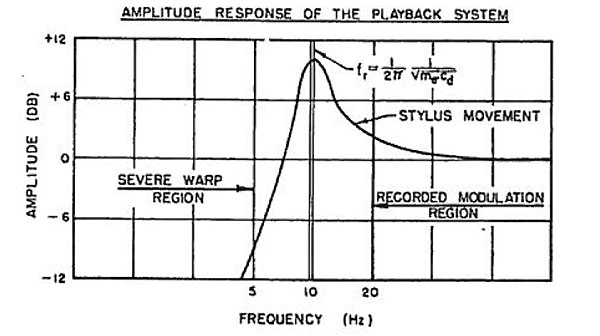
A pickup's output is produced by movements of its stylus relative to the body of the cartridge (which contains the sensing elements). At frequencies above a certain point, the inertia of the cartridge and the arm tends to hold the cartridge still while the stylus vibrates independently of it, thus producing signal output. Below a certain point, the cartridge-and-arm frequency response of a relatively undamped tonearm-pickup combination resonating at 10Hz (fig.1), inertia is insufficient to stabilize the cartridge, and it starts to follow the groove "modulations." Relative stylus/cartridge motion diminishes, and the pickup output dwindles. The transition point between these two modes of operation is the system resonance.
 On the other hand, the vertical resonance of the Vestigial arm with such a cartridge is within the range of potential signal modulation, and could cause problems with a number of discs were it not that (1) very few US disc manufacturers allow any signal that deep to get onto their discs, (2) the incidence of strong musical sound at that low a frequency is very rare, and (3) most discs have their extreme bass range blended between the stereo channels, to prevent extreme vertical excursions of the cutterhead which could otherwise dig down through the lacquer of the master disc and into its aluminum base (thus breaking the sapphire cutting stylus) or could produce vertical modulations that only perfectionist-type pickups could track.
In other words, while the Vestigial arm's mass characteristics are ideally suited for use with the highest-compliance pickups (which are unsatisfactory for use in other arms because of excessively low resonance frequency), it is less than ideal for use with pickups having low-to-moderate compliance. The Decca Mark V, for example, has the lowest vertical compliance of any cartridge currently favored by perfectionists (5xl0–6cm/dyne), and it simply goes to pieces in the Vestigial arm. Its vertical resonance occurs at 71Hz, which is well within the range of recorded bass, and the result is occasional groove-skipping and pronounced mid-bass boom.
Set-Up
On the other hand, the vertical resonance of the Vestigial arm with such a cartridge is within the range of potential signal modulation, and could cause problems with a number of discs were it not that (1) very few US disc manufacturers allow any signal that deep to get onto their discs, (2) the incidence of strong musical sound at that low a frequency is very rare, and (3) most discs have their extreme bass range blended between the stereo channels, to prevent extreme vertical excursions of the cutterhead which could otherwise dig down through the lacquer of the master disc and into its aluminum base (thus breaking the sapphire cutting stylus) or could produce vertical modulations that only perfectionist-type pickups could track.
In other words, while the Vestigial arm's mass characteristics are ideally suited for use with the highest-compliance pickups (which are unsatisfactory for use in other arms because of excessively low resonance frequency), it is less than ideal for use with pickups having low-to-moderate compliance. The Decca Mark V, for example, has the lowest vertical compliance of any cartridge currently favored by perfectionists (5xl0–6cm/dyne), and it simply goes to pieces in the Vestigial arm. Its vertical resonance occurs at 71Hz, which is well within the range of recorded bass, and the result is occasional groove-skipping and pronounced mid-bass boom.
Set-Up
The arm is not difficult to install—the worst parts of the job are cutting the elongated hole for the arm base (not necessary if the arm is being installed on a Transcriptors 'table) and getting the pickup cables through the hole in the bottom mounting ring. If you'd rather not make the elongated hole, you can drill a round one ½" in diameter with its center exactly 8" from the center of the platter spindle, and about 3" behind an imaginary line to the right from the spindle and parallel to the front of the turntable base.
It struck us as being absurd, though, that although there are existing standards for pickup-lead color coding, Transcriptors elected to ignore them and color their own leads green and black—both pairs of them. Thus there is no way of knowing which green and which black constitute a pair (and hum may result if they aren't paired) and no way of telling Left from Right channel without "ringing" the circuits through with an ohm meter. This subjects the pickup leads to some unnecessary handling, and that plus the fact that they must be bent at a sharp angle in order to connect to many pickups raises the real possibility of one (or more) of the fine wires breaking off at the clip. And a clip detachment is, we can assure you, a minor catastrophe, for the wire's insulation is impossible to scrape off with a razor blade, and the wire is too thin to use a stripper on. We had to char the insulation off first with a soldering iron and then scrape it off, very delicately, before soldering.
Three simple things could ameliorate this problem: Color coding the leads properly, making them a fraction of an inch longer so they wouldn't have to take such a sharp bend, and putting a dab of cement on each lead where it joins its clip, so the lead would be held by its insulation rather than just by a few hair-like strands of copper wire.
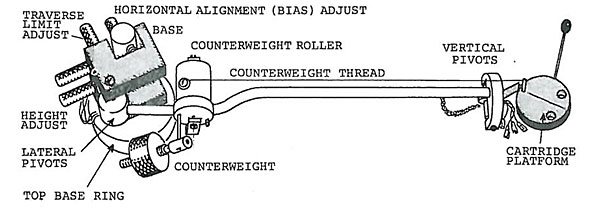 The pivots in our Vestigial arm were apparently in proper adjustment, but they are of a variety whose adjustment is rather critical, and we have heard a few reports from dealers about Vestigials coming through with slight misadjustments, resulting in excessive friction (particularly serious in the vertical pivots because of the short leverage) or occasional rattling at certain recorded frequencies. For this reason, we advise buyers of the Vestigial arm (or any other arm that uses adjustable pivots) to see that their dealer checks out the arm before delivery, or will accept it back for free adjustment or full credit if it doesn't seem to behave properly. Our sample, for instance, was atypical in that its counterweight-cord anchor screw stuck out so far from its drum that it got hung up on the arm base when the cartridge platform was lifted. (The screw was not loose; it just had too fat a head.) This would have only been annoying except that the hangup usually occurred when swinging the arm out to the right after playing a record, and it would sometimes yank the fingerlift out of our grip and send the cartridge bouncing across the disc surface. A potential system buster!
Then there's the matter of durabil¨ ity. Certainly it is unreasonable to expect a light, precision instrument like this to withstand the ministrations of a 3-year-old child, but this one is booby-trapped! One of the reasons the pivot friction in the Vestigial arm is so low is because it uses jeweled bearings, whose main drawback is their fragility. The pivots are most vulnerable before the arm is mounted, and care should be taken when working the cables through the bottom mounting ring to see that the arm is shaken up as little as possible. It seems to us that there should be some sort of warning about this in the instructions, as we have talked to two users to date who apparently managed to damage a pivot jewel while unpacking the arm.
The pivots may not be much safer after the arm is installed, either, for most of us are accustomed to arms that will lift a least a couple of inches above the disc. The Vestigial arm has about 1" of vertical swing, after which the vertical pivots come to a dead stop and any additional lifting force is then applied as shearing force to the horizontal pivots, through the leverage of the entire length of the arm. It is necessary always to remember not to try and lift the Vestigial as high as, say, an AR arm until proper handling of the Vestigial becomes second nature. But one forgetful moment could send the arm back to the factory.
Warp Wow
The pivots in our Vestigial arm were apparently in proper adjustment, but they are of a variety whose adjustment is rather critical, and we have heard a few reports from dealers about Vestigials coming through with slight misadjustments, resulting in excessive friction (particularly serious in the vertical pivots because of the short leverage) or occasional rattling at certain recorded frequencies. For this reason, we advise buyers of the Vestigial arm (or any other arm that uses adjustable pivots) to see that their dealer checks out the arm before delivery, or will accept it back for free adjustment or full credit if it doesn't seem to behave properly. Our sample, for instance, was atypical in that its counterweight-cord anchor screw stuck out so far from its drum that it got hung up on the arm base when the cartridge platform was lifted. (The screw was not loose; it just had too fat a head.) This would have only been annoying except that the hangup usually occurred when swinging the arm out to the right after playing a record, and it would sometimes yank the fingerlift out of our grip and send the cartridge bouncing across the disc surface. A potential system buster!
Then there's the matter of durabil¨ ity. Certainly it is unreasonable to expect a light, precision instrument like this to withstand the ministrations of a 3-year-old child, but this one is booby-trapped! One of the reasons the pivot friction in the Vestigial arm is so low is because it uses jeweled bearings, whose main drawback is their fragility. The pivots are most vulnerable before the arm is mounted, and care should be taken when working the cables through the bottom mounting ring to see that the arm is shaken up as little as possible. It seems to us that there should be some sort of warning about this in the instructions, as we have talked to two users to date who apparently managed to damage a pivot jewel while unpacking the arm.
The pivots may not be much safer after the arm is installed, either, for most of us are accustomed to arms that will lift a least a couple of inches above the disc. The Vestigial arm has about 1" of vertical swing, after which the vertical pivots come to a dead stop and any additional lifting force is then applied as shearing force to the horizontal pivots, through the leverage of the entire length of the arm. It is necessary always to remember not to try and lift the Vestigial as high as, say, an AR arm until proper handling of the Vestigial becomes second nature. But one forgetful moment could send the arm back to the factory.
Warp Wow
We were concerned initially about a phenomenon called warp wow, which is inevitably more pronounced when the vertical pivots are close to the cartridge. There was more of this than from any of the other arms we have on hand, but it proved to be less of a problem than we had anticipated. It was most noticeable on rapid warps (such as "pinch warps" caused by handling pressings before they have completely cooled in the stamper) during sustained musical passages, but was not audible to us at all under most circumstances. (It was very noticeable, however, with a 3kHz test tone from a disc.) We will admit, though, that none of our listening panelists is as sensitive to wow as are some other listeners, so a personal assessment is in order here. If you cringe at the slightest wow, you probably won't be happy with this arm.
Auditioning
It should come as no surprise that the Vestigial arm was at its best with an ADC XLM in it. In fact, it is the first arm we have encountered which does not turn the XLM's fantastic (and excessively high for other arms) compliance into a liability. The XLM performed better in the Vestigial than we have heard it with any other arm, thus necessitating a reassessment of our feelings about that cartridge. If you mate a good XLM with a properly-functioning Vestigial arm, the sound is as clean as from any other arm/cartridge combination we've tried, and can be faulted only through imperfections—slightly tippy top and subtle veiling—of the XLM itself. (System resonances with this combination, incidentally, were measured at around 9Hz laterally and 23Hz vertically.) We tried four other cartridges: The Ortofon M-15 Super, the Shure V15-III, the Supex 900E and the Micro Seiki MC-4100E. All four fared very well, with as sweet and clean a high end as they produce with the new low-mass SME arms, but with varying degrees of low-end smoothness and detail. The Supex sounded the smoothest and most detailed at the low end, probably because its unusually high mass (10 grams) puts the bass resonance farther below the range of signal modulations. Next in order of low-end naturalness were the Shure, the Ortofon and the Micro Seiki. We were not however able to verify Transcriptors' claim of 1/10 gram clean-tracking force with any of the six cartridges we tried, although we did in fact find that all of them (except the Decca) could be tracked at or slightly below the middle of their manufacturers' recommended force ranges without impairment of trackability. (Even in the new SME arms, we find that most cartridges are cleanest when tracked near their maximum recommended force.) This could offer some advantage in terms of increased record life, but just how much of an improvement would be effected by such a small change in force is difficult to assess.
And, of course, disc warps were tracked more easily, and with less flexing of the stylus, than with any other arm we've tried. In terms of overall sound, we found the Vestigial arm to be comparable to the new Shures except for the slightly heavier and woollier low end from most cartridges, under most conditions. Among the exceptions, we found, were a couple of preamplifiers—the Audio Research SP-3A and the modified Dyna PAT-4 that we had on hand. Both of these are capable of passing more subsonic information than any of the other preamps we've tested for some time (the unmodified PAT-4 is more typical in this respect), and the extra tax levied on the power amp's capabilities tipped the scales enough in the Vestigial arm's direction to make our test cartridges sound slightly cleaner throughout their entire range on some (warped) discs and with at least one turntable we tried (an old Thorens TD-125) that was producing more 10Hz rumble than a Linn Sondek that we had on the premises for testing.
All of which raises once again the question of mutual compatibility, which we are beginning to suspect may be just as important as the potential performance of some phono equipment. On the other hand, even with the Thorens, neither the Shure/SME arms nor the Vestigial made any of our test cartridges sound quite as clean and firm as they did in the Decca International Arm, which (wouldn't you know it!) is now a discontinued product.
Summing Up
Despite a formidable list of caveats and cavils, the Vestigial Tonearm is has the potential of producing performance comparable to, but not generally (in our opinion) better than, that of the very best tonearms, which is one very respectable accomplishment for a $100 arm. But as for the claim that all other disc-playing systems are now "hopelessly outdated," we must regretfully report that that happy event is still somewhere in the future.
Fig.1 Frequency response of a relatively undamped tonearm-pickup combination resonating at 10Hz. (Courtesy Shure Bros.).
Since there is a response peak, and the likelihood of instability (groove skipping) at resonance, it is important that the resonance occur below the range of recorded signal frequencies. Most combinations of arms and cartridges easily meet this requirement. But since subsonic "information" from a disc (from warps and rumble) is both unwanted and grossly wasteful of amplifier power that could better be used for reproducing the program, it is also important that the system resonance occur as far as possible above the range where these subsonic disturbances occur, and this is where many modern arm-and-cartridge pairings strike out.
Ideally, then, the bass resonance should occur midway between these two trouble zones, and investigations conducted by Shure Brothers have indicated that the optimum frequency of system resonance is around 10Hz. This is close to the lateral resonance of the Vestigial arm with a very highly compliant cartridge. With other tonearms, including Shure's SME 3009-II improved model, such high-compliance cartridges will resonate at or even substantially below 7Hz, which can cause severe subsonic interference.
The arm is not difficult to install—the worst parts of the job are cutting the elongated hole for the arm base (not necessary if the arm is being installed on a Transcriptors 'table) and getting the pickup cables through the hole in the bottom mounting ring. If you'd rather not make the elongated hole, you can drill a round one ½" in diameter with its center exactly 8" from the center of the platter spindle, and about 3" behind an imaginary line to the right from the spindle and parallel to the front of the turntable base.
The pivots in our Vestigial arm were apparently in proper adjustment, but they are of a variety whose adjustment is rather critical, and we have heard a few reports from dealers about Vestigials coming through with slight misadjustments, resulting in excessive friction (particularly serious in the vertical pivots because of the short leverage) or occasional rattling at certain recorded frequencies. For this reason, we advise buyers of the Vestigial arm (or any other arm that uses adjustable pivots) to see that their dealer checks out the arm before delivery, or will accept it back for free adjustment or full credit if it doesn't seem to behave properly. Our sample, for instance, was atypical in that its counterweight-cord anchor screw stuck out so far from its drum that it got hung up on the arm base when the cartridge platform was lifted. (The screw was not loose; it just had too fat a head.) This would have only been annoying except that the hangup usually occurred when swinging the arm out to the right after playing a record, and it would sometimes yank the fingerlift out of our grip and send the cartridge bouncing across the disc surface. A potential system buster!
We were concerned initially about a phenomenon called warp wow, which is inevitably more pronounced when the vertical pivots are close to the cartridge. There was more of this than from any of the other arms we have on hand, but it proved to be less of a problem than we had anticipated. It was most noticeable on rapid warps (such as "pinch warps" caused by handling pressings before they have completely cooled in the stamper) during sustained musical passages, but was not audible to us at all under most circumstances. (It was very noticeable, however, with a 3kHz test tone from a disc.) We will admit, though, that none of our listening panelists is as sensitive to wow as are some other listeners, so a personal assessment is in order here. If you cringe at the slightest wow, you probably won't be happy with this arm.
It should come as no surprise that the Vestigial arm was at its best with an ADC XLM in it. In fact, it is the first arm we have encountered which does not turn the XLM's fantastic (and excessively high for other arms) compliance into a liability. The XLM performed better in the Vestigial than we have heard it with any other arm, thus necessitating a reassessment of our feelings about that cartridge. If you mate a good XLM with a properly-functioning Vestigial arm, the sound is as clean as from any other arm/cartridge combination we've tried, and can be faulted only through imperfections—slightly tippy top and subtle veiling—of the XLM itself. (System resonances with this combination, incidentally, were measured at around 9Hz laterally and 23Hz vertically.) We tried four other cartridges: The Ortofon M-15 Super, the Shure V15-III, the Supex 900E and the Micro Seiki MC-4100E. All four fared very well, with as sweet and clean a high end as they produce with the new low-mass SME arms, but with varying degrees of low-end smoothness and detail. The Supex sounded the smoothest and most detailed at the low end, probably because its unusually high mass (10 grams) puts the bass resonance farther below the range of signal modulations. Next in order of low-end naturalness were the Shure, the Ortofon and the Micro Seiki. We were not however able to verify Transcriptors' claim of 1/10 gram clean-tracking force with any of the six cartridges we tried, although we did in fact find that all of them (except the Decca) could be tracked at or slightly below the middle of their manufacturers' recommended force ranges without impairment of trackability. (Even in the new SME arms, we find that most cartridges are cleanest when tracked near their maximum recommended force.) This could offer some advantage in terms of increased record life, but just how much of an improvement would be effected by such a small change in force is difficult to assess.
Despite a formidable list of caveats and cavils, the Vestigial Tonearm is has the potential of producing performance comparable to, but not generally (in our opinion) better than, that of the very best tonearms, which is one very respectable accomplishment for a $100 arm. But as for the claim that all other disc-playing systems are now "hopelessly outdated," we must regretfully report that that happy event is still somewhere in the future.